Chapter 12 Recurrent Processing Theory
12.1 Chapter Overview
Recurrent Processing Theory, often abbreviated as RPT, proposes that consciousness depends not merely on sensory activation, but on recurrent or re-entrant feedback interactions within cortical systems. According to this theory, sensory information may pass rapidly through the brain during an initial feedforward sweep without becoming conscious. Conscious perception emerges only when neural activity becomes recursively integrated through feedback loops between cortical areas [@lamme2006; @lamme2010].
RPT became influential because it challenged theories that identify consciousness too closely with reportability, working memory, executive access, language, or global broadcasting. Recurrent processing theorists argue that phenomenal consciousness may emerge earlier than full cognitive access. In other words, a person may have a conscious perceptual experience before that experience becomes available for verbal report, reasoning, or deliberate decision-making.
This makes RPT especially important in debates about the distinction between phenomenal consciousness and access consciousness. Phenomenal consciousness refers to subjective experience itself: what it is like to see, hear, feel, or perceive. Access consciousness refers to information being available for report, reasoning, memory, and action [@block1995]. RPT suggests that local recurrent sensory loops may already support phenomenal awareness, while global access may occur later.
The theory has been especially influential in visual neuroscience, masking experiments, temporal dynamics research, no-report debates, and discussions of phenomenal overflow. It is also important because it offers a biologically grounded theory of consciousness based on real cortical architecture rather than abstract computation alone.
At the same time, RPT remains controversial. Critics argue that recurrent processing may be necessary for conscious perception, but not sufficient to explain the full range of consciousness, including self-awareness, unified cognition, metacognition, and subjective feeling itself. Like many other theories, RPT must still address the hard problem: why should recurrent neural interaction be accompanied by experience at all? [@chalmers1995; @chalmers1996]
This chapter explains the core claims of Recurrent Processing Theory, distinguishes feedforward from recurrent processing, examines masking and perceptual awareness, compares RPT with Global Workspace Theory and other approaches, and evaluates its strengths, limitations, and implications for artificial intelligence.
12.2 Learning Objectives
After reading this chapter, the reader should be able to:
- Define recurrent processing and distinguish it from feedforward processing.
- Explain the central claims of Recurrent Processing Theory.
- Describe the role of cortical feedback loops in conscious perception.
- Analyze visual masking and unconscious perception within the RPT framework.
- Distinguish phenomenal consciousness from access consciousness.
- Explain the temporal unfolding of conscious processing.
- Compare RPT with Global Workspace Theory and related theories.
- Evaluate the strengths and limitations of Recurrent Processing Theory.
- Discuss implications for artificial intelligence and machine consciousness.
12.3 Why Recurrent Processing Theory Became Influential
Recurrent Processing Theory became influential because it offered a biologically grounded answer to a central puzzle in consciousness research: why does some neural processing remain unconscious while other processing becomes consciously experienced?
Many theories emphasize cognitive access, reportability, executive function, or global broadcasting. These features are clearly important for deliberate thought and communication. However, RPT argues that they may occur after phenomenal experience has already begun. Conscious perception, on this view, may not require full reportability or executive access. It may require recurrent interaction within sensory cortex.
This proposal was important because it separated conscious experience from the ability to report that experience. A visual stimulus may be experienced before it becomes available for verbal report, working memory, or deliberate reasoning. This distinction made RPT central to debates about whether consciousness is richer than cognitive access [@block2007].
RPT also fit well with neuroscience. The cortex is not a simple feedforward machine. It contains extensive feedback connections, recurrent loops, and re-entrant interactions between lower and higher areas. These anatomical features make recurrent processing a plausible candidate mechanism for conscious perception.
12.4 Core Idea in One Picture
Figure @ref(fig:fig-rpt) summarizes the major conceptual structure of Recurrent Processing Theory.
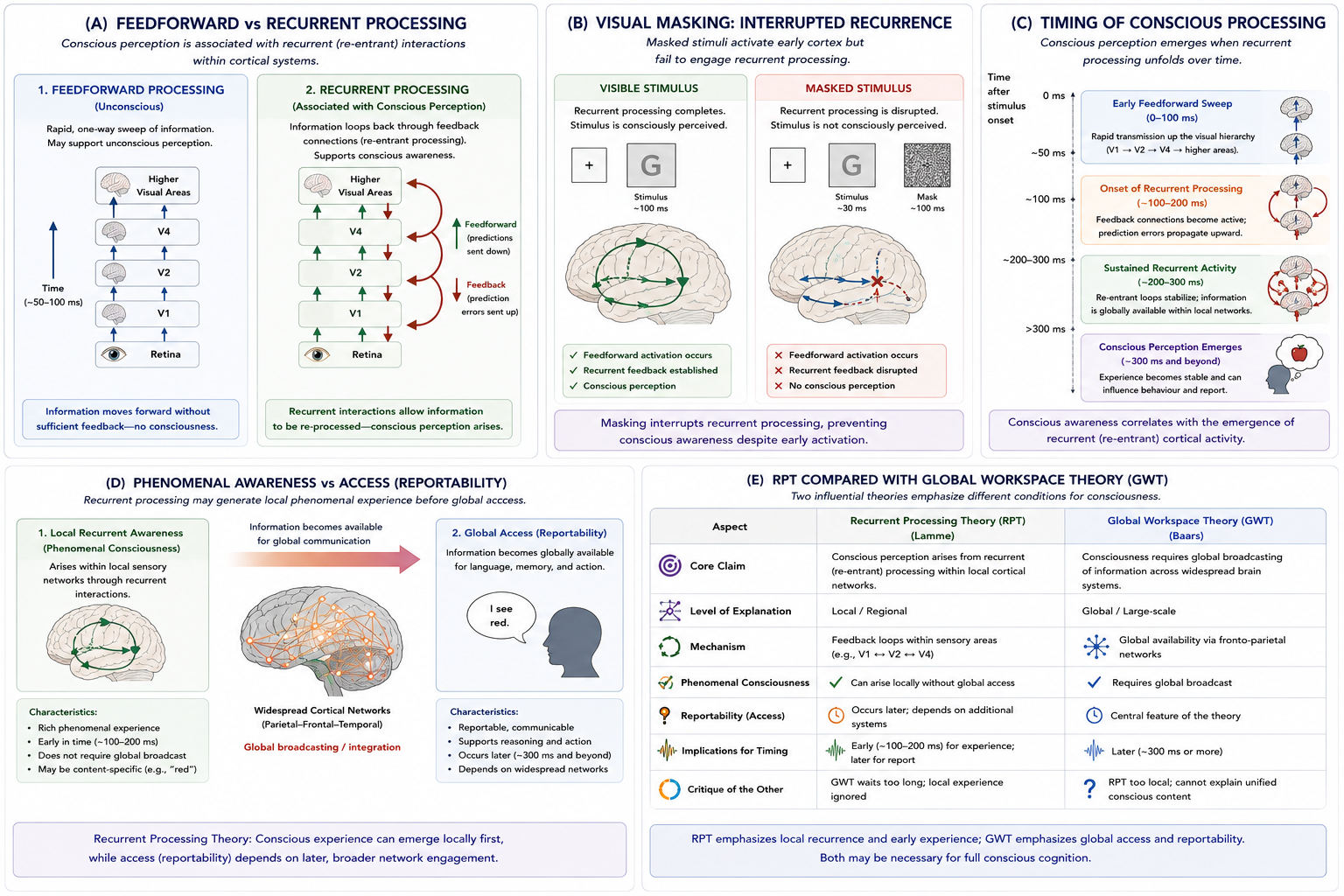
Figure 12.1: Recurrent Processing Theory (RPT). Panel A contrasts feedforward and recurrent processing. Panel B illustrates visual masking and interrupted recurrence. Panel C shows the temporal unfolding of conscious processing. Panel D distinguishes phenomenal consciousness from access consciousness. Panel E compares recurrent processing theory with Global Workspace Theory.
As Figure @ref(fig:fig-rpt) illustrates, feedforward processing may support rapid unconscious discrimination, but recurrent cortical loops stabilize perceptual representations and allow conscious awareness to emerge. The figure also highlights one of RPT’s central philosophical claims: conscious experience may occur locally before global cognitive access.
This makes RPT different from theories that treat consciousness as dependent on executive access, verbal report, or large-scale broadcasting. RPT does not deny that those processes are important. Rather, it argues that they may belong to a later stage of conscious access rather than to the origin of phenomenal experience itself.
12.5 Historical Development
The origins of Recurrent Processing Theory lie in debates about the temporal and neural structure of perception. Earlier models often treated perception as a largely feedforward process. Sensory input entered the system, moved through cortical hierarchies, and eventually produced recognition, action, or report.
However, anatomical and physiological research showed that cortical processing involves extensive feedback. Visual processing, for example, does not simply move from the retina to primary visual cortex and then upward to higher visual areas. Higher cortical areas send signals back to lower areas. These recurrent interactions help refine, stabilize, and contextualize perception.
Victor Lamme developed one of the most influential versions of RPT, arguing that recurrent processing within sensory cortex is central to conscious perception [@lamme2006]. According to Lamme, an initial feedforward sweep may support unconscious processing, rapid categorization, and behavioural response. Consciousness arises when this activity becomes recurrently integrated.
This positioned RPT partly against Global Workspace Theory, which emphasizes global broadcasting and cognitive access [@baars1988; @dehaene2011]. RPT argues that phenomenal consciousness may appear earlier than the global availability required for report.
12.6 Feedforward and Recurrent Processing
A central distinction in RPT is the difference between feedforward processing and recurrent processing.
Feedforward processing is the rapid movement of information through a neural hierarchy. In vision, this can be simplified as:
retina → V1 → V2 → V4 → higher visual cortexThis feedforward sweep is fast and efficient. It can support rapid categorization, priming, automatic response, and partial sensory discrimination. However, according to RPT, feedforward processing alone is usually not sufficient for conscious visual experience.
Recurrent processing involves feedback loops between cortical areas. Information does not only move upward. It also loops backward and sideways through the system. Higher areas influence lower areas, lower areas continue updating higher areas, and perception becomes stabilized through recursive interaction.
According to RPT, conscious perception emerges when neural activity becomes recurrently integrated. This recurrence allows sensory representations to become sustained, coherent, context-sensitive, and phenomenally experienced.
12.7 The Core Claim of RPT
The central claim of Recurrent Processing Theory is that conscious awareness depends on recurrent cortical feedback rather than feedforward activation alone. This means that unconscious processing can occur rapidly and automatically, while conscious perception requires recursive neural integration.
The theory therefore explains why a stimulus can influence behaviour without being consciously seen. A masked stimulus may activate early visual cortex and even affect later responses. But if recurrent processing is interrupted, the stimulus may not become consciously experienced.
This gives RPT a clear explanatory structure:
feedforward sweep → unconscious processing
recurrent integration → conscious perception
The theory also emphasizes that consciousness unfolds over time. Conscious awareness is not an instantaneous result of sensory input. It emerges dynamically as neural activity loops through cortical networks.
12.8 Temporal Dynamics of Consciousness
One of RPT’s most important contributions is its focus on temporal dynamics. Conscious perception is treated as a process that develops across time rather than as a single momentary event.
During the early feedforward sweep, roughly within the first 100 milliseconds, sensory information moves rapidly through cortical pathways. This may support unconscious categorization, priming, and fast behavioural response.
During the next stage, recurrent interactions begin to occur. Feedback loops between cortical areas refine and stabilize the representation. Context, attention, memory, and higher-level expectations may begin influencing perception. RPT suggests that phenomenal awareness may emerge during this recurrent stage.
Later, information may become available for report, working memory, decision-making, and broader cognitive access. This later stage may involve more widespread networks, including frontoparietal systems, but RPT does not treat this later access as necessary for the initial emergence of phenomenal experience.
This temporal account is important because it allows RPT to distinguish between perceptual experience and later cognitive use of that experience.
12.9 Visual Masking
Visual masking provides one of the strongest experimental contexts for RPT. In masking experiments, a target stimulus is presented briefly and then followed by another stimulus, called a mask. The mask can prevent conscious awareness of the original target, even though some processing of the target still occurs.
RPT explains masking by arguing that the target may produce an initial feedforward sweep, but the mask interrupts recurrent processing. Without recurrent stabilization, the target does not become consciously perceived.
This explains why masked stimuli can still produce priming or influence behaviour. Feedforward processing may occur, but conscious experience fails to emerge because recurrent loops are disrupted.
Visual masking therefore supports the idea that sensory activation alone is not enough for consciousness. The timing and recurrence of neural activity matter [@breitmeyer1984; @lamme2006].
12.10 Binocular Rivalry and Perceptual Competition
Binocular rivalry also supports recurrent approaches to consciousness. In binocular rivalry, different images are presented to each eye. Instead of experiencing both images equally, conscious perception alternates between them.
RPT interprets this alternation as evidence that conscious perception depends on dynamic stabilization within recurrent networks. Competing interpretations are not simply registered passively. They are stabilized, suppressed, and replaced through ongoing neural interaction.
This supports a general recurrent view of perception. Conscious awareness is not merely the arrival of sensory input. It is the result of dynamic neural stabilization over time.
12.11 Phenomenal and Access Consciousness
RPT is philosophically important because it strongly distinguishes phenomenal consciousness from access consciousness.
Phenomenal consciousness refers to subjective experience itself. It is the felt character of seeing a colour, hearing a sound, or perceiving a scene. Access consciousness refers to information being available for reasoning, report, memory, and deliberate control [@block1995].
RPT suggests that local recurrent sensory loops may already support phenomenal consciousness. Global access, reportability, and executive control may occur later. This means that a person may experience more than they can report or remember.
This idea challenges theories that identify consciousness with reportability or global broadcasting. RPT argues that report is not the same as experience. Report requires additional cognitive systems, while experience may begin in recurrent sensory processing.
12.12 Phenomenal Overflow
RPT is closely connected to debates about phenomenal overflow. The overflow argument claims that conscious experience may contain more detail than can be accessed, reported, or stored in working memory [@block2007].
For example, a person may seem to experience a rich visual scene even though they can report only a small part of it. If this is correct, then phenomenal consciousness exceeds access consciousness.
RPT supports this idea by proposing that recurrent sensory processing can generate phenomenal awareness before information enters working memory or global broadcast. On this view, experience may be richer than report.
Critics of overflow argue that apparent richness may be an illusion produced by gist perception, expectation, or rapid access to environmental information. This debate remains unresolved, but it is central to the difference between RPT and access-based theories.
12.13 Recurrent Processing and Global Workspace Theory
RPT is often contrasted with Global Workspace Theory. GWT proposes that consciousness requires global broadcasting across cognitive systems [@baars1988; @dehaene2011; @dehaene2014]. Information becomes conscious when it is made available for report, working memory, reasoning, and flexible control.
RPT argues that this may describe access consciousness rather than phenomenal consciousness. According to RPT, local recurrent processing may be sufficient for perceptual experience, while global broadcasting supports later report and cognitive use.
The two theories may not be completely incompatible. They may describe different stages or dimensions of consciousness. RPT may explain early phenomenal perception, while GWT may explain later access, reportability, and cognitive control.
However, the disagreement remains significant. GWT tends to place consciousness at the level of global availability. RPT places the origin of phenomenal experience earlier, within recurrent sensory processing.
12.14 Relation to Other Theories
RPT overlaps with several other theories discussed in this book.
12.14.1 Relation to Integrated Information Theory
Integrated Information Theory emphasizes integrated causal structure and irreducibility [@tononi2004; @oizumi2014]. RPT also emphasizes integration, but more specifically through recurrent cortical loops. IIT is broader and more formal, while RPT is more closely tied to sensory neuroscience and temporal processing.
12.14.2 Relation to Higher-Order Thought Theory
Higher-Order Thought Theory argues that a mental state becomes conscious when it is represented by a suitable higher-order state [@rosenthal2005; @lau2011]. RPT is less metacognitive. It suggests that consciousness may arise within recurrent sensory systems before higher-order reflection or introspection.
12.14.3 Relation to Predictive Processing
Predictive Processing emphasizes hierarchical prediction and error correction [@friston2010; @clark2013]. RPT overlaps with this framework because predictive processing also depends on recurrent exchange between cortical levels. However, RPT focuses specifically on recurrence as a condition for conscious perception, while Predictive Processing interprets recurrence in terms of prediction-error minimization.
12.14.4 Relation to Attention Schema Theory
Attention Schema Theory explains consciousness through the brain’s model of attention [@graziano2013]. RPT differs by emphasizing recurrent sensory stabilization rather than an internal model of attention. Both theories, however, challenge simple feedforward accounts of consciousness.
12.14.5 Relation to Consciousness-First Theories
RPT differs from consciousness-first theories such as panpsychism, cosmopsychism, idealism, or Taheri’s T-Consciousness. RPT begins with neural mechanisms and asks how recurrent processing supports consciousness. Consciousness-first theories begin from the idea that consciousness is fundamental or prior to physical organization. These approaches will be discussed later in the book.
12.15 Dreaming, Anesthesia, and Altered States
RPT can also be applied to dreaming, anesthesia, and altered states. Dreaming may involve internally generated recurrent activity that produces conscious experience without ordinary external sensory input. Anesthesia may disrupt the recurrent interactions required for conscious stabilization. Disorders of consciousness may involve partial preservation or disruption of recurrent cortical dynamics.
These applications show that RPT is not limited to ordinary visual perception. It can be used to think about how conscious states appear, disappear, and transform depending on recurrent neural organization [@koch2016; @seth2021; @laureys2005; @owen2006].
However, applying RPT beyond perception raises additional questions. Consciousness includes emotion, selfhood, bodily feeling, thought, and imagination. The theory must explain whether all these forms of consciousness depend on similar recurrent mechanisms or whether visual consciousness is a special case.
12.16 Neural Basis of Recurrent Processing
Recurrent processing is associated with cortical feedback loops, re-entrant signaling, thalamo-cortical interactions, and reciprocal connections between lower and higher cortical areas. These recurrent circuits are especially well studied in the visual system, but recurrent connectivity is widespread throughout the brain.
The challenge is determining which recurrent interactions are sufficient for consciousness. Not all recurrence appears conscious. Many feedback loops regulate movement, bodily function, or unconscious processing without producing reportable experience.
RPT therefore needs a principled account of conscious recurrence. Is recurrence in sensory cortex enough? Does it require certain timing? Does it require attention? Does it need integration across multiple levels? Does it need connection to memory or self-modeling?
These questions remain open and are central to evaluating the theory.
12.17 Recurrent Processing and Artificial Intelligence
RPT has important implications for artificial intelligence and machine consciousness. If consciousness depends on recurrent processing, then purely feedforward artificial architectures may remain non-conscious even if they perform sophisticated tasks.
From an RPT perspective, a conscious artificial system might require recursive feedback, dynamic temporal integration, re-entrant processing, and stable internal representations. Recurrent neural networks, self-monitoring systems, and architectures with feedback loops may therefore be more relevant to machine consciousness than purely feedforward models.
However, recurrence alone is not enough. Many artificial systems contain feedback without being plausibly conscious. RPT must specify what kind of recurrence matters. Does the system need embodiment, sensory grounding, self-modeling, affective regulation, or global access? These questions overlap with broader debates about AI consciousness [@butlin2023].
RPT therefore suggests that recurrence may be an important condition for machine consciousness, but it does not provide a complete criterion by itself.
12.18 Strengths of Recurrent Processing Theory
RPT has several major strengths. First, it is strongly grounded in neuroscience. The cortex contains extensive recurrent connectivity, and RPT builds directly on this biological architecture.
Second, it explains why feedforward processing can remain unconscious. This makes it useful for understanding masking, priming, and unconscious perception.
Third, RPT emphasizes temporal dynamics. It treats consciousness as something that unfolds through recursive interaction over time, rather than as an instantaneous response to stimulation.
Fourth, it offers an important philosophical distinction between phenomenal consciousness and access consciousness. It challenges theories that identify consciousness too closely with reportability.
Fifth, RPT provides a biologically plausible account of perceptual consciousness. It is especially strong in visual neuroscience, where recurrent processing can be studied experimentally.
12.19 Weaknesses and Criticisms
RPT also faces several criticisms. The first is whether local recurrence is sufficient for consciousness. Critics argue that consciousness may require more than recurrent sensory processing. It may also require attention, memory, selfhood, metacognition, global integration, or bodily regulation.
A second criticism concerns the hard problem. Even if recurrence is correlated with conscious perception, why should recurrent neural interaction feel like anything? RPT may identify an important mechanism without fully explaining subjective experience [@chalmers1995; @chalmers1996].
A third criticism concerns thresholds. RPT does not always specify how much recurrence is necessary, which loops matter, or when recurrent activity becomes conscious.
A fourth criticism concerns excessive localism. Some researchers argue that full conscious cognition requires large-scale coordination across the brain, not only local sensory loops. From this perspective, RPT may explain early perceptual awareness but not the full structure of conscious experience.
Finally, recurrent loops are widespread in the brain. RPT must explain why some recurrent interactions produce consciousness while others do not.
12.20 Open Questions
Several important questions remain unresolved. Why should recurrence generate experience? Is local recurrence sufficient for consciousness? Can phenomenal consciousness occur without global access? What distinguishes conscious recurrence from unconscious recurrence? Are recurrent loops necessary for all conscious states? How does RPT explain selfhood, emotion, and thought? Can artificial recurrent systems become conscious?
These questions show why RPT remains influential but incomplete. It offers a strong account of perceptual awareness, but it must still explain how recurrent processing relates to broader conscious life.
12.21 Evaluation
Recurrent Processing Theory is one of the most influential biologically grounded theories of consciousness. It explains conscious perception through recursive cortical interaction, temporal stabilization, and recurrent sensory integration.
Its greatest strength is its account of perceptual consciousness. RPT explains why initial feedforward activation may remain unconscious and why recurrent processing may be necessary for stable conscious perception. It also provides a powerful distinction between phenomenal consciousness and access consciousness.
Its greatest limitation is that it may not fully explain all forms of consciousness. Local recurrent processing may explain visual awareness, but consciousness also includes selfhood, emotion, bodily feeling, memory, imagination, and reflective thought. RPT must either extend its recurrent framework to these domains or accept that it explains only part of consciousness.
RPT is therefore best understood as a strong theory of perceptual consciousness and phenomenal awareness, especially in vision. Whether it provides a complete theory of consciousness remains unresolved.
12.22 Chapter Summary
Recurrent Processing Theory proposes that consciousness depends on recurrent or re-entrant neural processing. An initial feedforward sweep may support unconscious processing, but conscious perception requires feedback loops that stabilize and integrate neural representations.
RPT is especially important in visual neuroscience and masking research. Masked stimuli may be processed unconsciously because masking interrupts recurrent processing before conscious awareness can emerge.
The theory strongly distinguishes phenomenal consciousness from access consciousness. It suggests that perceptual experience may arise locally within recurrent sensory loops before information becomes globally available for report or reasoning.
RPT differs from Global Workspace Theory, which emphasizes global broadcasting, and from Higher-Order Thought Theory, which emphasizes metacognitive awareness. It overlaps with Integrated Information Theory and Predictive Processing because all emphasize integration or recurrent interaction in some form.
Its strengths include biological plausibility, strong relevance to visual perception, and a clear explanation of unconscious processing. Its weaknesses include uncertainty about whether local recurrence is sufficient, how recurrence explains subjective feeling, and how the theory applies to selfhood, emotion, and artificial intelligence.
The central unresolved question is whether recurrent processing explains consciousness itself or identifies one important neural condition for conscious perception.