Chapter 1 Introduction to Consciousness Studies
1.1 Chapter Overview
Consciousness is both the most familiar feature of human life and one of the most difficult phenomena to explain. Every perception, emotion, memory, scientific observation, mathematical proof, and philosophical reflection appears within conscious awareness. Yet the nature of consciousness itself remains deeply contested.
Modern science has been remarkably successful in explaining physical systems, biological evolution, neural mechanisms, information processing, and complex behaviour. However, subjective experience — the felt quality of awareness itself — continues to raise unusual conceptual and scientific challenges. A person can describe seeing colour, hearing music, feeling pain, imagining the future, remembering the past, or reflecting on the self. What remains difficult is explaining why and how physical processes in the brain are accompanied by first-person experience at all.
This difficulty has made consciousness one of the central problems in philosophy of mind, neuroscience, psychology, cognitive science, artificial intelligence, phenomenology, and medicine. It is not only a question about how the brain works. It is also a question about how objective descriptions of the world relate to subjective experience. As Thomas Nagel famously argued, there appears to be “something it is like” to be a conscious organism, and this subjective character of experience is not easily captured by purely objective description [@nagel1974].
This chapter introduces the foundations of consciousness studies. It explains why consciousness matters, why it is difficult to study, how different disciplines approach it, and how the theories discussed in this book will be evaluated.
1.2 Learning Objectives
After reading this chapter, the reader should be able to:
- Explain why consciousness presents distinctive scientific and philosophical challenges.
- Distinguish several major meanings of consciousness.
- Describe why consciousness research is interdisciplinary.
- Explain the difference between the easy problems and the hard problem of consciousness.
- Understand why theories of consciousness often differ in their explanatory goals.
- Identify the evaluative framework used throughout this book.
1.3 Why Consciousness Matters
Consciousness matters because it is central to human life, scientific inquiry, medicine, ethics, and technology. Questions about consciousness shape debates about personal identity, free will, moral responsibility, suffering, animal minds, artificial intelligence, and the nature of reality itself.
In medicine, consciousness has direct practical importance. Anesthesia, coma, dementia, psychiatric illness, pain management, disorders of consciousness, and end-of-life care all require some understanding of the relation between brain activity and conscious awareness. Clinical work with patients who cannot communicate normally has shown how difficult it can be to distinguish wakefulness, responsiveness, awareness, and subjective experience [@laureys2005; @owen2006].
Consciousness has also become increasingly important in debates about artificial intelligence. As artificial systems become more capable of language use, learning, reasoning, and self-monitoring, researchers increasingly ask whether intelligence alone could ever be sufficient for consciousness. These questions connect consciousness studies with wider debates about personhood, moral status, artificial suffering, autonomy, and responsibility [@dehaene2017; @butlin2023].
For these reasons, consciousness is not merely an abstract philosophical topic. It has implications for science, medicine, ethics, technology, and society.
1.4 Consciousness as an Interdisciplinary Problem
Consciousness research sits at the intersection of multiple disciplines. Neuroscience investigates brain mechanisms associated with conscious states. Psychology studies perception, attention, emotion, memory, and behaviour. Cognitive science examines information processing and mental architecture. Philosophy analyzes subjectivity, explanation, identity, and the relation between mind and matter. Phenomenology studies lived experience from the first-person point of view. Artificial intelligence raises questions about whether consciousness could exist in non-biological systems.
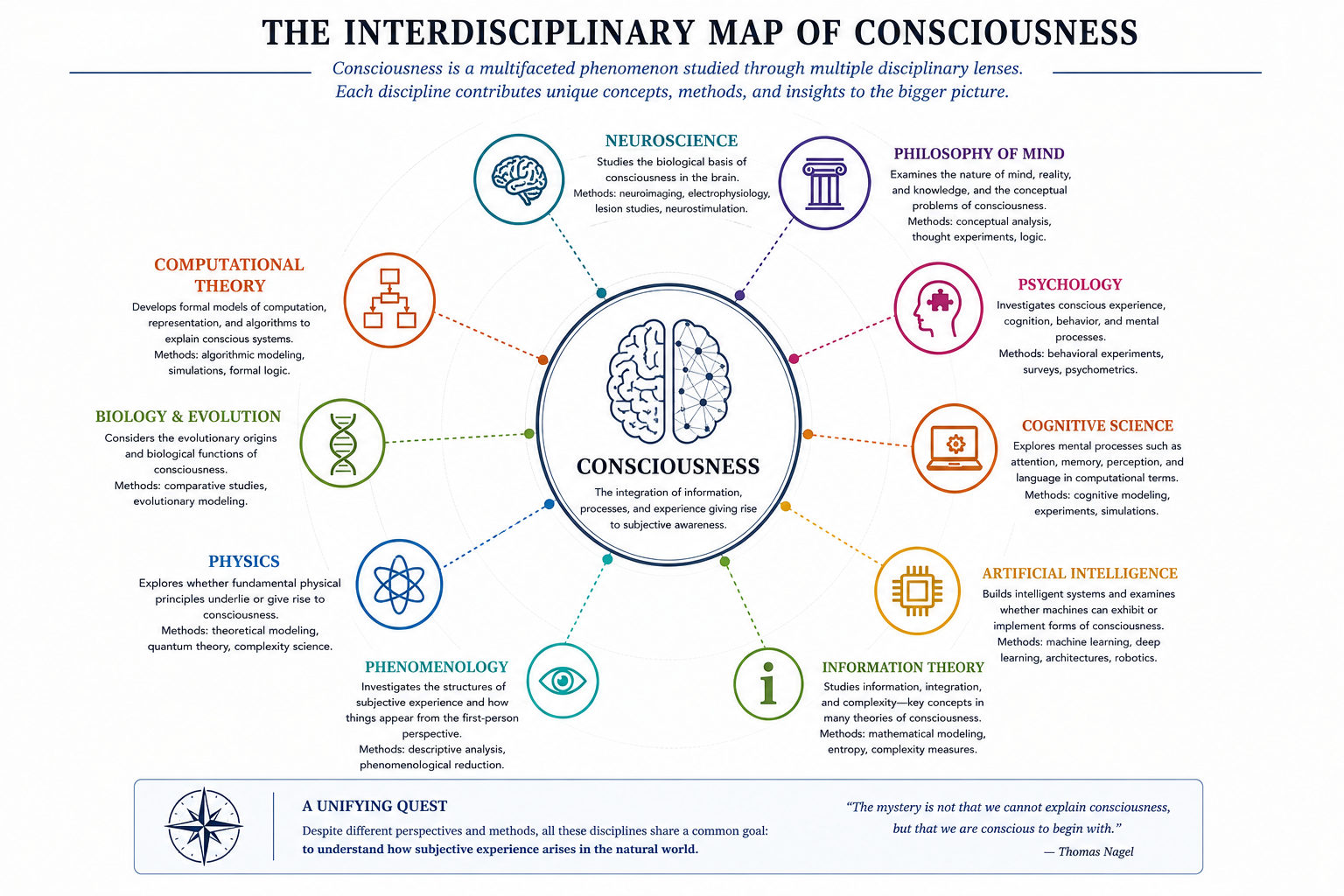
Figure 1.1: An interdisciplinary conceptual map of consciousness research. Contemporary approaches emerge from neuroscience, philosophy, psychology, artificial intelligence, phenomenology, physics, biology, and information theory. Different disciplines emphasize different explanatory targets, methods, and assumptions regarding conscious experience.
Figure @ref(fig:fig-interdisciplinary-map-intro) illustrates why consciousness cannot be easily confined to one field. Different disciplines often study different aspects of consciousness. Some focus on neural mechanisms, behaviour, and reportability. Others focus on subjective experience, embodiment, selfhood, meaning, or metaphysical interpretation.
This diversity helps explain why consciousness studies remains theoretically pluralistic. Researchers do not always disagree because one side has evidence and the other does not. They often disagree because they are trying to explain different aspects of consciousness.
1.5 Why Consciousness Is Difficult to Study
Consciousness is difficult to study because it involves both first-person experience and third-person explanation. Science usually depends on public observation, measurement, experiment, and objective description. Conscious experience, however, is directly available only to the subject who has it.
Researchers can measure neural activity, observe behaviour, collect verbal reports, and build computational models. These methods are powerful, but none of them gives direct access to another person’s experience itself. This creates a methodological challenge: consciousness must be studied through relations among subjective reports, brain activity, behaviour, physiology, and theory.
The difficulty is increased by the fact that consciousness is not a single simple property. Wakefulness, awareness, attention, self-consciousness, reportability, and phenomenal experience can come apart in unusual cases. A person may be awake but minimally aware. A dreamer may be conscious without responding to the external world. An anesthetized patient may show residual neural processing without reportable experience. Neurological injury, sleep, meditation, psychiatric illness, and altered states can all reveal dissociations among different dimensions of consciousness [@laureys2005; @koch2016; @seth2018].
These cases suggest that consciousness may not have one simple explanation. Instead, it may require multiple levels of analysis.
1.6 Multiple Levels of Explanation
Consciousness research often operates across several explanatory levels at once. These include neural mechanisms, cognitive functions, computational processes, bodily regulation, phenomenological structure, information integration, and philosophical interpretation.
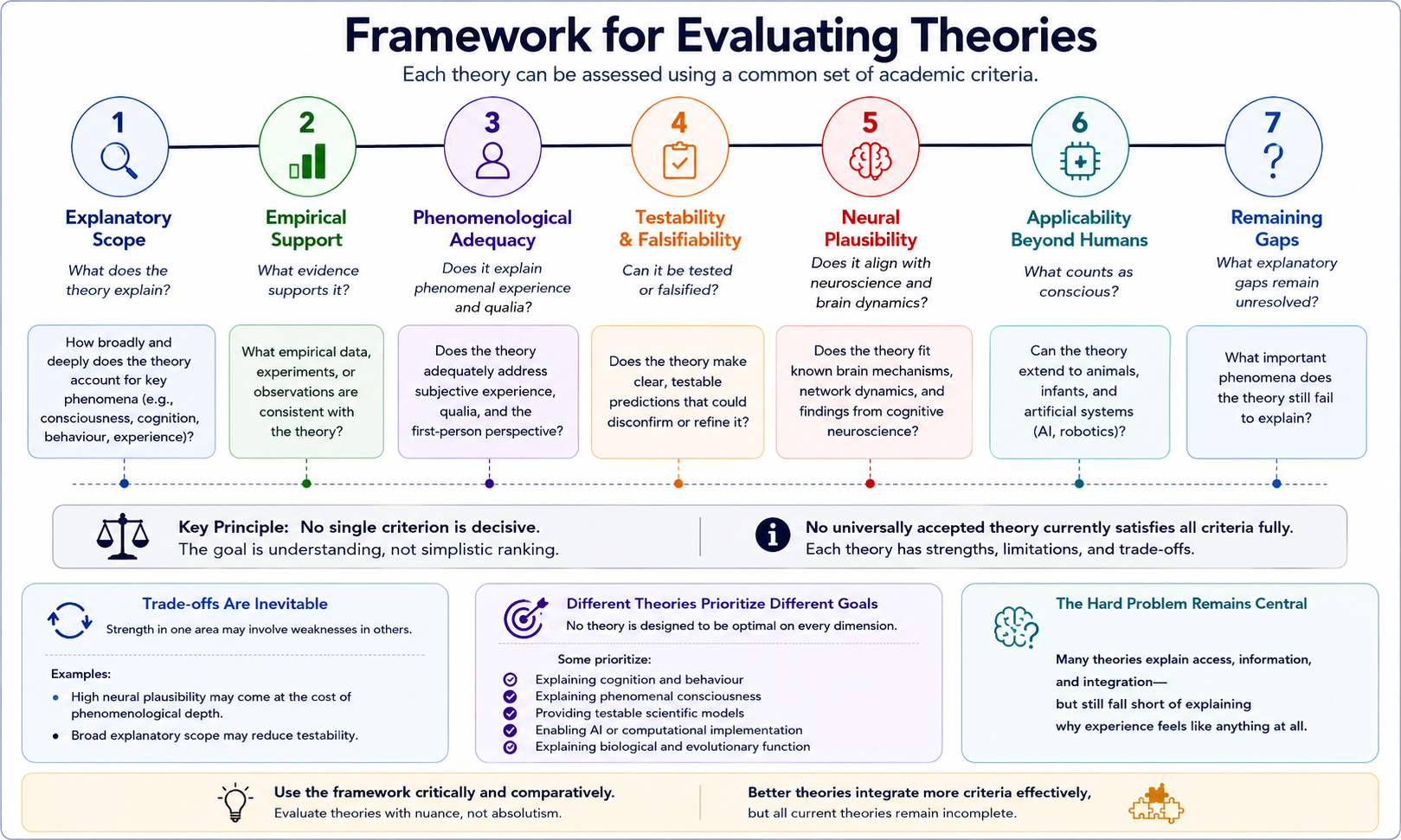
Figure 1.2: Multiple explanatory levels in consciousness research. Contemporary theories often emphasize neural, computational, phenomenological, embodied, informational, biological, or metaphysical dimensions simultaneously.
Figure @ref(fig:fig-levels-intro) introduces a central theme of this book: consciousness may not be fully explainable at one level alone. Neural mechanisms matter, but they may not by themselves answer questions about subjective experience. Computational models may explain information processing, but they may not fully explain feeling. Phenomenology describes lived experience, but it must still be related to brain, body, and world.
Different theories of consciousness often differ because they privilege different levels of explanation. Some theories emphasize neural dynamics. Others emphasize global access, information integration, higher-order representation, prediction, embodiment, or metaphysical structure. Understanding these differences is essential before comparing theories fairly.
1.7 Defining Consciousness
There is no single universally accepted definition of consciousness. The word is used in several overlapping ways.
In one sense, consciousness means wakefulness: being awake rather than asleep, anesthetized, or comatose. In another sense, it means awareness: responsiveness to oneself or the environment. A more philosophically important sense is subjective experience: the fact that there is something it is like to see, hear, feel, think, or suffer. Consciousness can also refer to self-consciousness, meaning awareness of oneself as the subject of experience, or to reflective consciousness, meaning awareness of one’s own mental states.
A major distinction in modern philosophy is between phenomenal consciousness and access consciousness. Phenomenal consciousness refers to qualitative experience: colour, sound, pain, emotion, bodily feeling, and the sense of presence. Access consciousness refers to information being available for reasoning, report, memory, and action [@block1995].
These meanings overlap, but they should not be treated as identical. Confusion often arises when a theory explains one meaning of consciousness but is taken to have explained all of them. For example, a theory may explain reportability or attention without fully explaining subjective experience. Another theory may focus on phenomenology while remaining difficult to test empirically.
1.8 The Easy Problems and the Hard Problem
One of the most influential distinctions in contemporary consciousness studies is David Chalmers’ distinction between the easy problems and the hard problem of consciousness [@chalmers1995; @chalmers1996].
The easy problems concern functions that appear open to ordinary scientific explanation. These include attention, memory access, perceptual discrimination, behavioural report, wakefulness, cognitive control, and information integration. These problems are not easy in a practical sense. They may be scientifically complex. They are called “easy” because they seem explainable in terms of mechanisms, functions, and causal processes.
The hard problem concerns subjective experience itself. Why should neural activity or information processing feel like anything from the inside? Why is there something it is like to see red, feel pain, hear music, or have a sense of self?
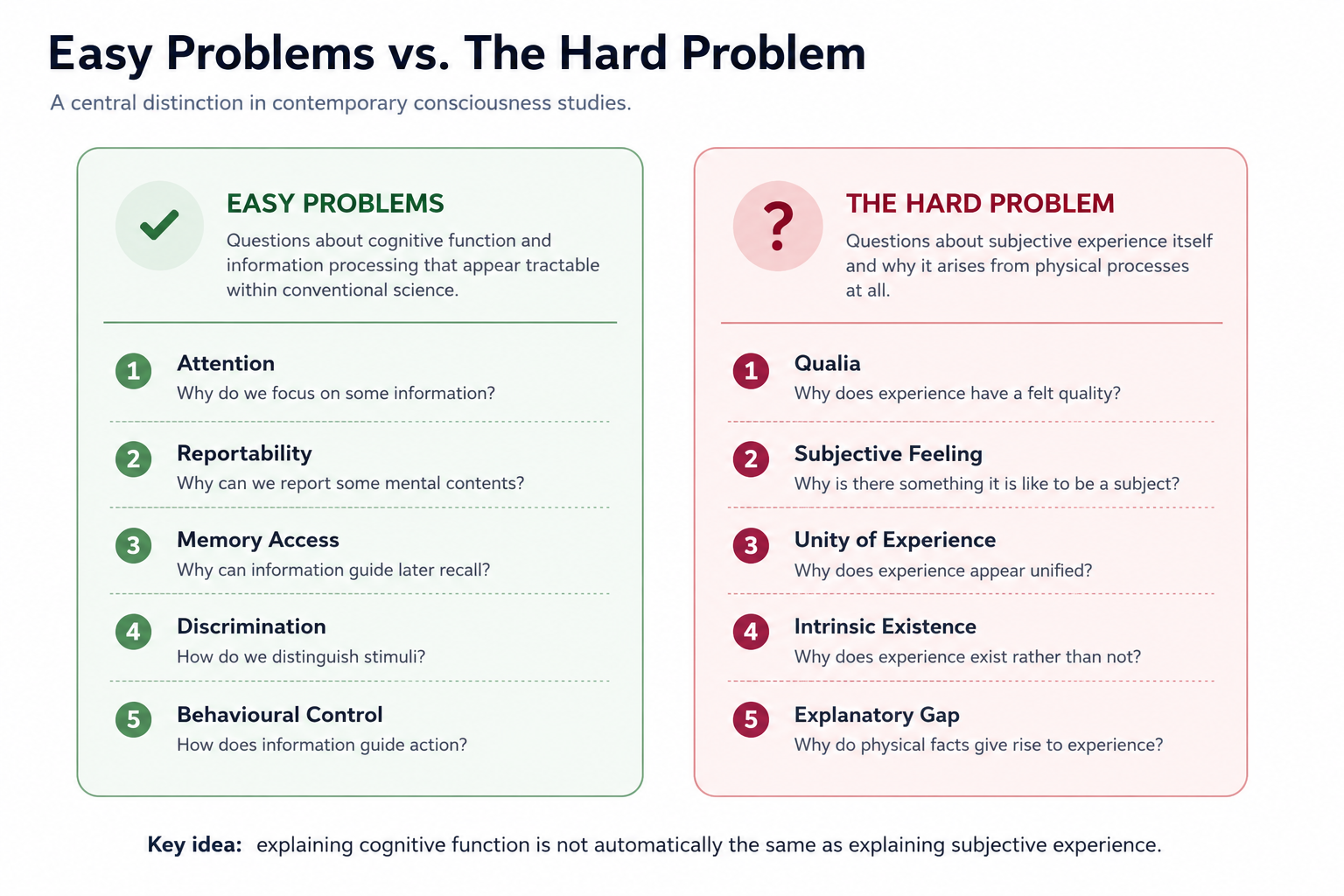
Figure 1.3: The distinction between easy and hard problems of consciousness. Easy problems concern cognitive and functional explanation, while the hard problem concerns subjective experience itself.
Figure @ref(fig:fig-easy-hard-intro) summarizes this distinction. Many theories make progress on the easy problems by explaining behaviour, attention, reportability, and information access. The deeper disagreement concerns whether such explanations also account for phenomenal experience.
The hard problem is closely related to the explanatory gap: the apparent difficulty of deriving first-person experience from objective physical description alone [@levine1983]. Some theories attempt to close this gap. Others argue that the gap reflects a limitation in physicalist explanation. Still others deny that the hard problem is a genuine problem in the first place [@dennett1991; @frankish2016].
1.9 Neural Correlates of Consciousness
A major scientific approach to consciousness focuses on the neural correlates of consciousness, often called NCCs. These are the minimal neural mechanisms associated with specific conscious experiences [@crick1990; @koch2016].
NCC research uses experimental paradigms such as visual masking, binocular rivalry, inattentional blindness, sleep and dreaming, anesthesia, disorders of consciousness, metacognition, and altered states. Advances in neuroimaging, electrophysiology, computational neuroscience, and anesthesiology have made consciousness research increasingly empirical [@dehaene2011; @seth2018].
However, identifying neural correlates is not the same as providing a complete theory of consciousness. Neural correlates may show when consciousness occurs, which brain systems are involved, and how conscious states change. They may not, by themselves, explain why subjective experience exists. This distinction between correlation and explanation will appear throughout the book.
1.10 Why Theories of Consciousness Differ
Theories of consciousness differ because they often aim at different explanatory targets. Some theories focus on conscious access: how information becomes available for reasoning, report, and action. Others focus on phenomenal experience: why mental states feel like something. Some emphasize neural mechanisms, while others emphasize computation, embodiment, selfhood, biological regulation, or metaphysical foundations.
For example, Global Workspace Theory emphasizes the broadcasting of information across cognitive systems [@baars1988; @dehaene2011]. Integrated Information Theory emphasizes the structure and integration of experience [@tononi2004; @oizumi2014]. Higher-Order theories emphasize awareness of mental states [@rosenthal2005; @lau2011]. Predictive Processing emphasizes inference and generative modeling [@friston2010; @clark2013]. Recurrent Processing Theory emphasizes local recurrent neural activity as central to conscious perception [@lamme2006]. Attention Schema Theory explains consciousness in terms of the brain’s model of attention [@graziano2013]. Embodied and enactive theories emphasize the organism’s active engagement with its environment [@varela1991; @thompson2007]. Panpsychism addresses the metaphysical question of whether consciousness, or proto-consciousness, is a basic feature of reality [@goff2017].
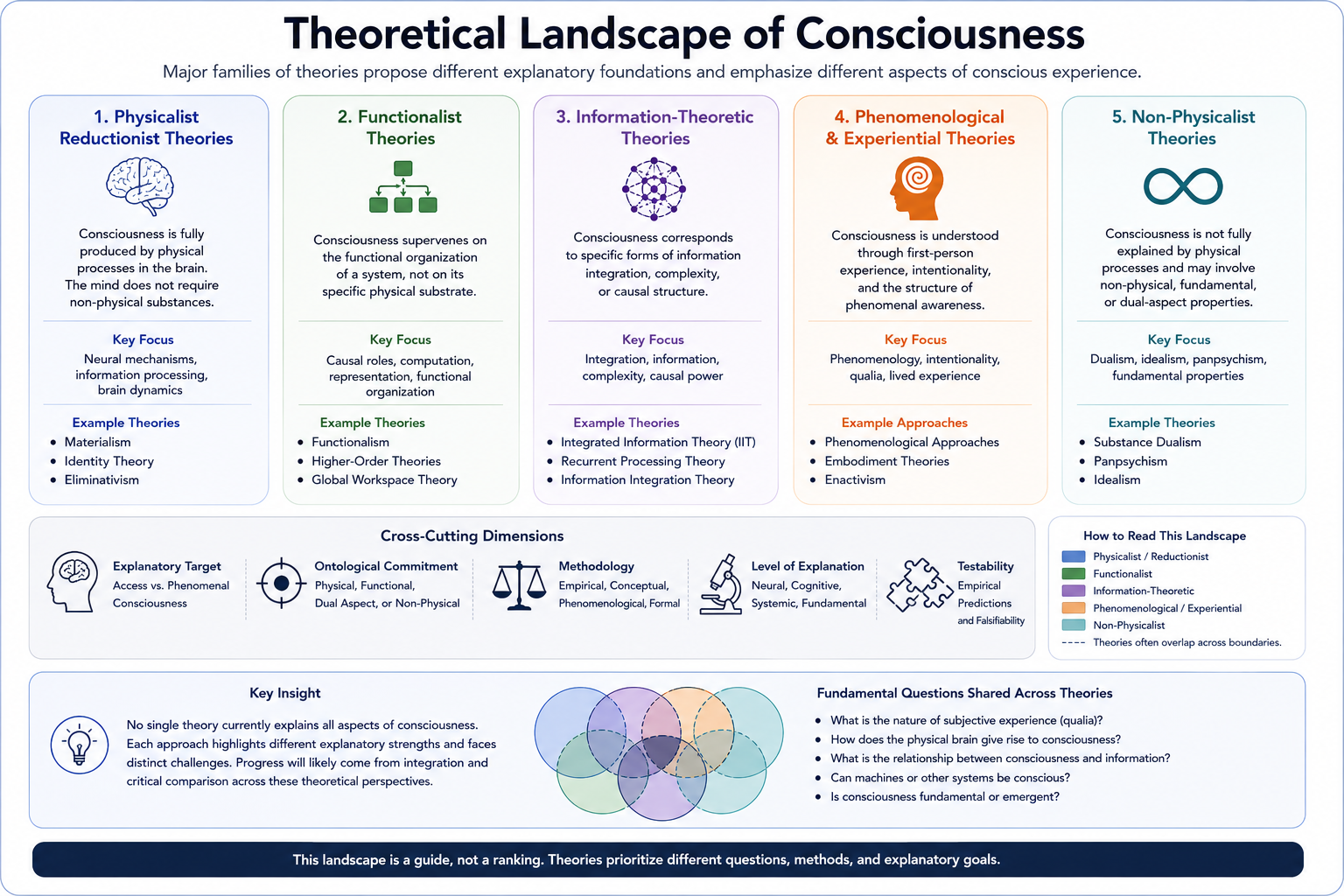
Figure 1.4: A conceptual landscape of major theoretical approaches to consciousness. Different theories emphasize neural mechanisms, computation, embodiment, information integration, cognition, or metaphysical structure. Many disagreements arise because theories prioritize different explanatory targets.
Figure @ref(fig:fig-theoretical-landscape) provides a simplified overview of these theoretical families. The important point is that theories should not be compared as though they all answer exactly the same question. A theory may be strong in explaining cognition but weaker in explaining phenomenology. Another may be philosophically ambitious but empirically difficult to test.
1.11 Framework for Evaluating Theories
Because theories of consciousness differ in their aims, this book evaluates them using several criteria rather than a single ranking. A theory may be empirically powerful but philosophically incomplete. Another may be phenomenologically rich but difficult to test. Another may be computationally precise but biologically uncertain.
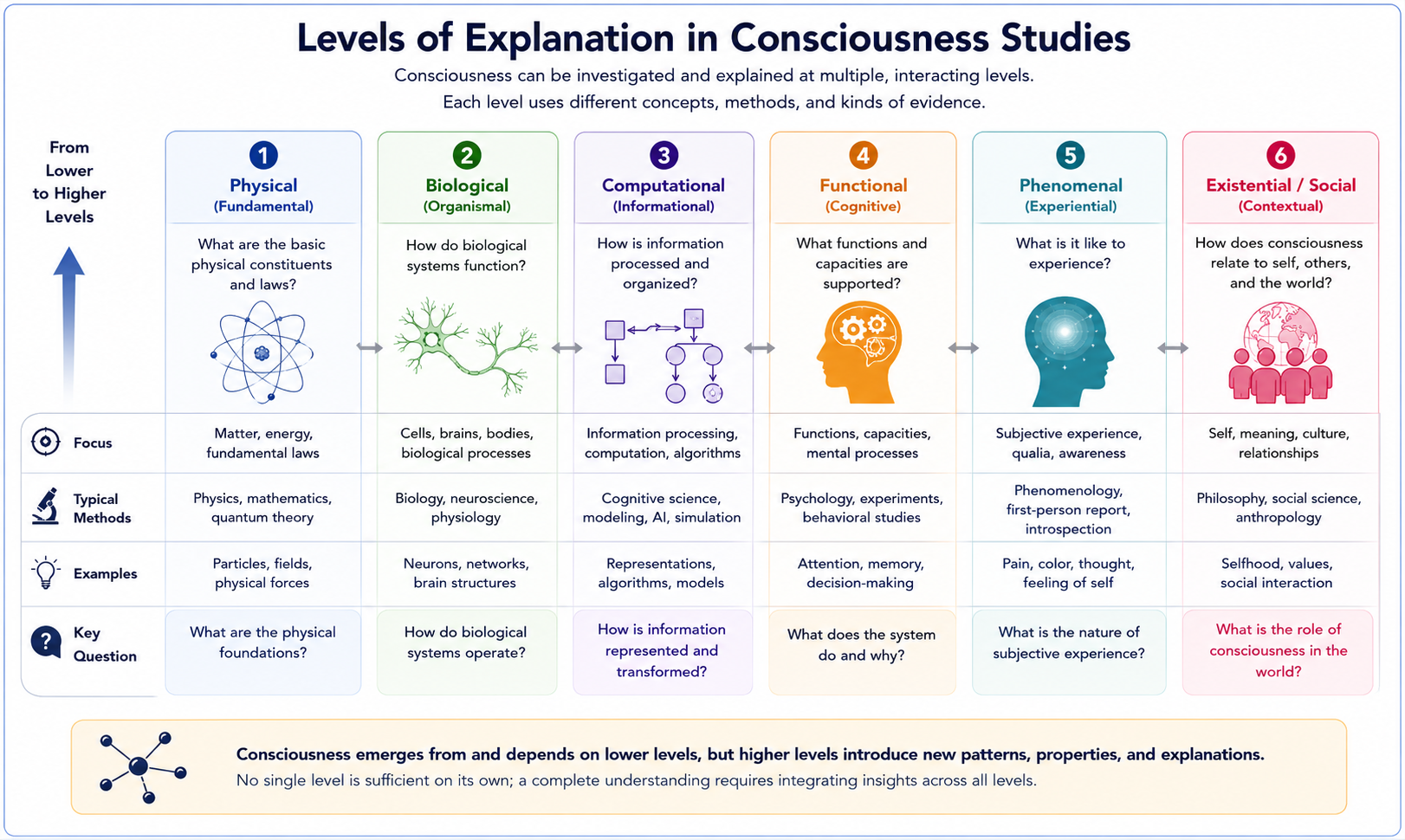
Figure 1.5: Framework for evaluating theories of consciousness. Theories can be assessed according to explanatory scope, empirical support, phenomenological adequacy, testability, neural plausibility, applicability beyond humans, and remaining explanatory gaps. No single criterion is decisive.
Figure @ref(fig:fig-evaluation-framework-intro) introduces the evaluative framework used throughout this book. Each theory will be considered in terms of its explanatory scope, empirical support, phenomenological adequacy, testability, neural plausibility, relevance to non-human animals or artificial intelligence, and remaining explanatory gaps.
The goal is not to declare a simple winner. The goal is to understand what each theory explains, what it leaves unresolved, and how it relates to other approaches.
1.12 Artificial Intelligence and Machine Consciousness
Artificial intelligence raises new questions for consciousness studies. A system may display intelligent behaviour, language ability, planning, learning, and sophisticated information processing. Yet it remains unclear whether such capacities are sufficient for subjective experience.
Different theories imply different criteria for machine consciousness. Some approaches suggest that consciousness may depend on computation, information integration, self-modeling, or global availability. Others argue that biological embodiment, affect, homeostasis, or organism-environment interaction may be necessary [@dehaene2017; @butlin2023].
These debates are not merely technical. If artificial systems could become conscious, then questions about artificial suffering, moral status, responsibility, and rights would become increasingly important. If they cannot become conscious, then it remains important to explain why intelligence and consciousness come apart.
1.13 Contemporary State of the Field
Contemporary consciousness studies remains theoretically pluralistic. No single theory currently commands universal agreement. Competing frameworks differ not only in proposed mechanisms, but also in definitions of consciousness, explanatory targets, methodological assumptions, and philosophical commitments.
At the same time, consciousness research has become increasingly empirical. Questions once treated mainly as philosophical now intersect with neuroscience, anesthesiology, psychiatry, complexity science, artificial intelligence, and computational modeling. This does not mean that the philosophical problems have disappeared. Rather, it means that philosophical questions and scientific methods increasingly shape one another.
Theoretical diversity should not necessarily be viewed as a weakness. Consciousness may involve multiple interacting dimensions requiring explanation across neural, computational, phenomenological, embodied, biological, and philosophical levels simultaneously.
1.14 Structure of the Book
The chapters that follow move from foundational problems to major theories and then to comparative evaluation.
The early chapters introduce the hard problem, the historical development of consciousness studies, and major philosophical positions such as dualism, materialism, physicalism, functionalism, and emergentism. The middle chapters examine contemporary theories, including Global Workspace Theory, Integrated Information Theory, Higher-Order Thought Theory, Predictive Processing, Recurrent Processing Theory, Attention Schema Theory, computationalism, the Bayesian brain, panpsychism, quantum approaches, illusionism, and embodied or enactive theories.
Later chapters apply these debates to anesthesia, disorders of consciousness, altered states, artificial intelligence, comparative theory evaluation, unresolved explanatory problems, and future directions.
The purpose of this book is not simply to identify which theory is correct. It is to clarify what different theories attempt to explain, why they disagree, which problems have been partially solved, and why consciousness continues to resist simple reduction to any single explanatory framework.
Consciousness studies should therefore be understood as a multidimensional and evolving field. Neuroscience, philosophy, phenomenology, computation, embodiment, medicine, and artificial intelligence do not merely compete with one another. They provide different windows onto one of the deepest questions in science and philosophy: how experience fits into the natural world.