Chapter 13 Attention Schema Theory
13.1 Chapter Overview
Attention Schema Theory, often abbreviated as AST, proposes that consciousness is the brain’s simplified internal model of its own attention. According to this theory, awareness is not identical to attention itself. Instead, awareness arises because the brain constructs a simplified representation, or schema, of attentional processes for purposes of monitoring, prediction, and control [@graziano2013; @graziano2016].
AST attempts to explain not only how brains control attention, but also why organisms believe themselves to be conscious. The theory begins from the idea that the brain builds internal models of many complex processes. It models the body, the external world, other agents, and its own control systems. AST proposes that awareness is one such model: a schematic representation of where attention is directed and what information is currently prioritized.
Rather than treating consciousness as a mysterious non-physical property, AST interprets awareness as a model-based construct generated by cognitive systems. This gives the theory a partly deflationary character. It does not deny that people report awareness or experience themselves as conscious. Instead, it asks how the brain constructs the representation that makes such reports and experiences possible.
AST became influential because it connects attention research, self-representation, control theory, social cognition, and neuroscience within a unified framework. It also overlaps with debates about metacognition, artificial intelligence, self-modeling, and the hard problem of consciousness.
At the same time, AST remains controversial. Critics argue that an internal model of attention may explain self-report, awareness attribution, attentional monitoring, and beliefs about consciousness without fully explaining phenomenal feeling itself. The central question is whether modeling attention is enough to explain subjective experience, or whether AST explains only why organisms describe themselves as aware [@chalmers1995; @chalmers1996].
This chapter explains the central claims of Attention Schema Theory, distinguishes attention from awareness, introduces the body-schema analogy, examines the theory’s relation to social cognition and artificial intelligence, and evaluates its strengths and limitations.
13.2 Learning Objectives
After reading this chapter, the reader should be able to:
- Define the central claim of Attention Schema Theory.
- Distinguish attention from awareness.
- Explain the concept of an attention schema.
- Describe the body-schema analogy used in AST.
- Analyze the relationship between awareness and attentional control.
- Explain the social cognition implications of AST.
- Compare AST with Higher-Order Thought Theory, Global Workspace Theory, and Recurrent Processing Theory.
- Evaluate the strengths and criticisms of AST.
- Discuss the relationship between AST and the hard problem.
- Explain AST’s implications for artificial intelligence and machine consciousness.
13.3 Why Attention Schema Theory Became Influential
Attention Schema Theory became influential because it asked a distinctive question: why does the brain represent itself as conscious? Many theories of consciousness focus on neural activity, information integration, global broadcasting, or cognitive access. AST instead focuses on the brain’s internal model of awareness itself.
Michael Graziano proposed that the brain uses simplified models to control complex processes [@graziano2013]. For example, the brain maintains models of the body to guide movement, posture, and spatial coordination. These models are not perfect anatomical descriptions. They are simplified control tools. AST argues that attention is modeled in a similar way.
Attention is a complex process. The brain must select information, prioritize some signals over others, regulate competition, and coordinate perception, action, memory, and thought. According to AST, the brain constructs a simplified model of this process. That model is what the system represents as awareness.
This proposal became important because it connects consciousness with attention, prediction, control, and self-modeling. It also gives awareness a possible evolutionary function. If the brain can model its own attention, it can better control attention, predict its effects, and explain behaviour to itself and others.
13.4 Core Idea in One Picture
Figure @ref(fig:fig-ast) summarizes the major conceptual structure of Attention Schema Theory.
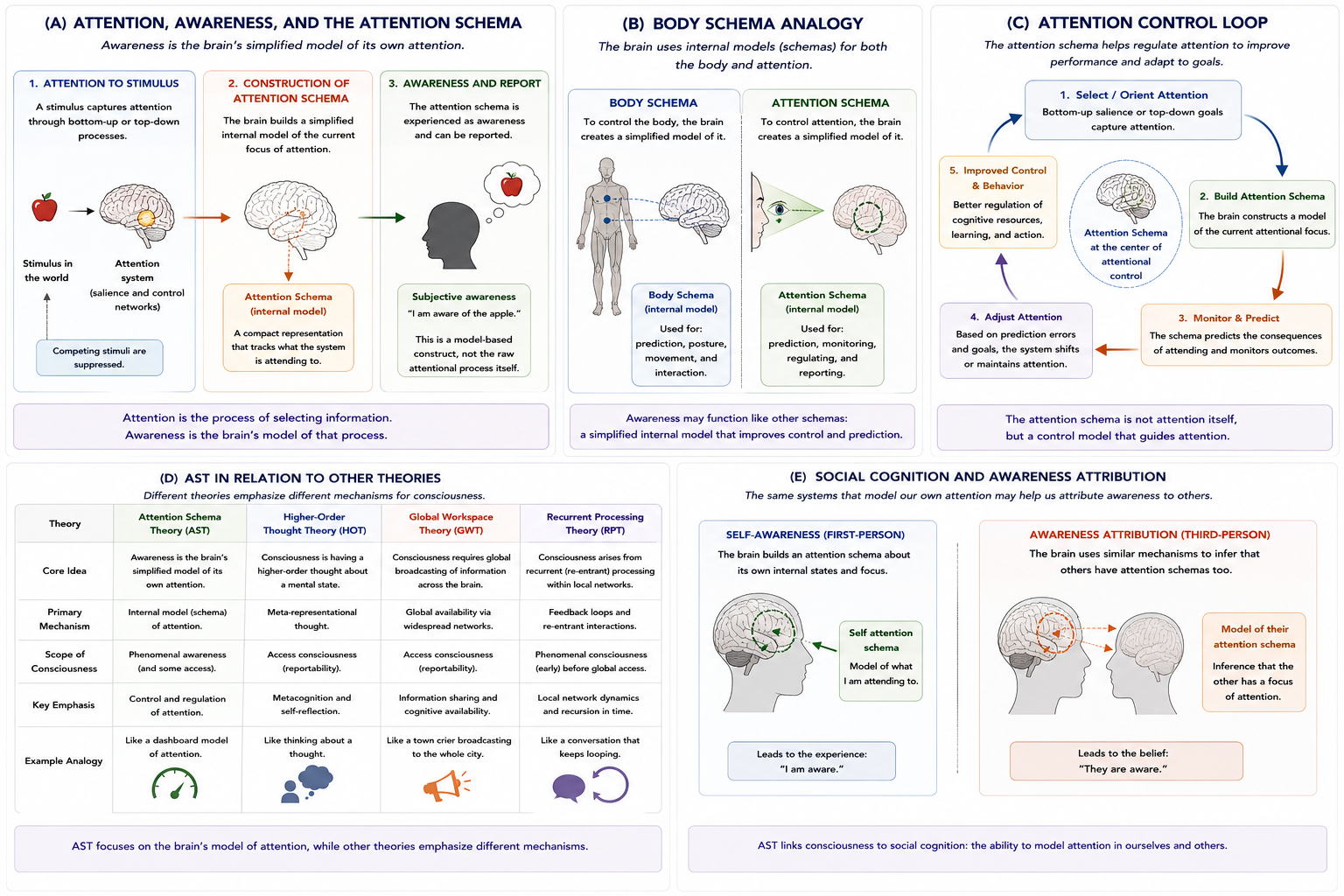
Figure 13.1: Attention Schema Theory (AST). Panel A distinguishes attention, awareness, and the attention schema. Panel B illustrates the body-schema analogy. Panel C shows the attentional control loop. Panel D compares AST with related theories of consciousness. Panel E illustrates the relationship between awareness and social cognition.
As Figure @ref(fig:fig-ast) illustrates, AST sharply distinguishes attention from awareness. Attention is a process of selective information enhancement. Awareness is the brain’s internal model of that process. In this sense, awareness is not attention itself, but a simplified representation of attention.
This distinction is central to the theory. Attention can occur without awareness, and awareness can sometimes misrepresent attentional processes. AST therefore does not simply say that attention equals consciousness. It says that awareness is a model the brain uses to represent and regulate attention.
13.5 Historical Development
Attention Schema Theory developed from broader debates about attention, consciousness, self-representation, cognitive control, and internal modeling. Modern AST is primarily associated with Michael Graziano, who developed the theory as a model-based account of awareness [@graziano2013; @graziano2016].
The theory draws on several older ideas. Research on attention showed that the brain selectively prioritizes some information over other information [@posner1990; @corbetta2002]. Work on body schemas showed that the brain constructs simplified models of the body for movement and control [@head1911; @schilder1935; @gallagher2005]. Theories of predictive control suggested that internal models can help organisms regulate complex systems [@friston2010; @clark2013].
AST combines these ideas. It proposes that, just as the brain models the body to control movement, it models attention to control information processing. Awareness is the simplified internal model that results.
This makes AST different from theories that begin with raw subjective experience. AST begins with a functional problem: how does the brain monitor and control attention? Conscious awareness is then explained as part of the solution to that problem.
13.6 The Attention Schema
The central concept in AST is the attention schema. An attention schema is an internal model of attentional allocation. It represents what the system is attending to, what information is currently prioritized, and how attention is being directed.
The schema is simplified. It does not represent every neural detail of attention. Instead, it provides a useful control-oriented description. This is similar to how the brain’s body schema does not represent every muscle, joint, and nerve in anatomical detail. It represents the body in a way that is useful for action.
According to AST, the attention schema allows the brain to monitor and regulate attention. It helps the organism predict what it will process, control what it focuses on, and explain its own behaviour. When this model represents attention directed toward an object, the organism reports being aware of that object.
This leads to AST’s central claim:
awareness is the brain’s model of attentionThe theory therefore treats awareness as representational. Awareness is not a special non-physical substance. It is a simplified internal model that helps the brain regulate information processing.
13.7 Attention and Awareness
AST strongly distinguishes attention from awareness. Attention is selective information processing. It enhances some signals, suppresses others, prioritizes certain stimuli, and allocates cognitive resources. Awareness is the brain’s representation of that attentional state.
This distinction matters because attention and awareness can come apart. Some attentional processes occur unconsciously. Subliminal cues can shift attention. Automatic orienting can occur before a person reports awareness. Behaviour can be influenced by unattended or weakly attended stimuli [@koch2006].
AST explains this by saying that attention itself is not awareness. Attention may operate without being modeled in the appropriate way. Awareness occurs when the brain constructs a model of attention.
The distinction also helps explain why awareness can be incomplete or mistaken. The brain’s attention schema is simplified. It may represent attentional states in a useful but imperfect way. This may contribute to the intuitive feeling that awareness is simple, unified, and non-physical, even if the underlying neural mechanisms are complex.
13.8 The Body-Schema Analogy
One of AST’s most important ideas is the analogy between the body schema and the attention schema. The brain constructs body schemas to guide movement, posture, spatial awareness, and action. These schemas are practical models, not exact anatomical maps [@head1911; @schilder1935; @gallagher2005].
For example, a person can reach for a cup without calculating the exact position of every muscle and joint. The brain uses a simplified body model to guide action efficiently. This model can also be distorted, as in phantom limb experiences or body ownership illusions.
AST proposes that awareness works in a similar way. Attention is complex, distributed, and neurally detailed. The brain cannot control attention efficiently by representing every detail. Instead, it constructs a simplified model of attention.
This model is useful because it allows the system to regulate its own processing. But because the model is simplified, it may represent attention as a non-physical inner property called awareness. In this way, AST attempts to explain why awareness seems mysterious from the inside.
13.9 Attention Control and Prediction
AST argues that internal models improve control. A system can control a process more effectively when it has a model of that process. This is true for the body, movement, and spatial orientation. AST argues that it is also true for attention.
The attention schema allows the brain to predict how attention will affect perception, memory, decision-making, and action. It helps the system allocate resources, monitor what is being prioritized, and adjust focus when conditions change.
For example, if a person is searching for a face in a crowd, attention must be directed, maintained, and adjusted. A model of attentional state helps the person know what they are focused on and what they are missing. This improves behavioural flexibility.
In this sense, awareness has a functional role. It is not merely an inner glow added to cognition. It is part of a control system that helps the organism regulate attention and behaviour.
13.10 Why Awareness Would Evolve
AST offers an evolutionary explanation for awareness. If attention is central to adaptive behaviour, then organisms benefit from being able to model attention. A system that can monitor and control its own attentional focus can respond more flexibly to threats, opportunities, social cues, and changing environments.
Awareness may therefore have evolved because it improves prediction and control. It helps organisms track what they are processing, what others may be processing, and what matters for action.
This evolutionary explanation is important because it avoids treating awareness as an inexplicable extra feature. AST interprets awareness as a useful internal model. It may feel simple and mysterious from the first-person perspective, but it may have developed as part of ordinary biological control.
13.12 Neural Basis of AST
AST is often associated with neural systems involved in attention, self-representation, and social cognition. These include frontal-parietal attention networks, the temporoparietal junction, superior temporal sulcus, and regions involved in theory of mind and attentional control [@corbetta2002; @graziano2013].
The temporoparietal junction is especially relevant because it has been linked to attention, perspective-taking, body representation, and social cognition. These functions fit AST’s proposal that awareness involves modeling attentional states in oneself and others.
However, the neural basis of AST remains under investigation. The theory provides a broad functional architecture, but the precise neural implementation of the attention schema is not fully established.
This is one of AST’s open empirical challenges. To become more testable, the theory must specify how attention schemas are implemented, how they can be measured, and how disruptions affect awareness.
13.13 Clinical Evidence
Clinical disorders provide partial support for AST because they show that attention and awareness can dissociate. Hemispatial neglect is especially relevant. Patients with neglect may fail to become aware of stimuli on one side of space despite having partially preserved sensory processing. This suggests that awareness depends not simply on sensory input, but on attentional and representational systems.
AST interprets neglect as evidence that disruptions in attentional modeling can alter awareness. If the brain fails to represent attention to part of space, the person may behave as though that region does not exist.
Other attention-related disorders may also affect awareness, self-monitoring, and conscious report. These cases support the idea that awareness is deeply connected to attentional control. However, they do not by themselves prove AST. Competing theories can also explain these disorders in terms of attention, access, or recurrent processing.
13.14 Consciousness as a Model-Based Construct
AST proposes a major philosophical shift. Instead of treating awareness as an irreducible inner essence, it treats awareness as a model-based construct. The brain represents itself as having awareness because doing so helps it control attention and behaviour.
This makes AST partly deflationary. It suggests that some intuitions about consciousness may arise from the simplified nature of the attention schema. The brain does not model the neural machinery of attention in detail. It models attention as a simple relation between subject and object: “I am aware of that.”
Because the model leaves out mechanistic details, awareness can seem non-physical or mysterious. AST argues that this sense of mystery may be a feature of the model rather than evidence for a separate mental substance.
This does not mean that awareness is unreal. Body schemas are not unreal just because they are simplified. Awareness may be real as a model-based representation, even if it is not the kind of inner essence introspection suggests.
13.15 AST and Other Theories
AST overlaps with several major theories of consciousness, but it remains conceptually distinct.
13.15.1 Relation to Higher-Order Thought Theory
AST and Higher-Order Thought Theory both involve internal representation and self-monitoring [@rosenthal2005; @lau2011]. HOT theory argues that a mental state becomes conscious when it is represented by a suitable higher-order state. AST argues that awareness arises from the brain’s model of attention.
The difference is emphasis. HOT focuses on higher-order representation of mental states. AST focuses specifically on the modeling of attentional processes.
13.15.2 Relation to Global Workspace Theory
Global Workspace Theory explains consciousness in terms of global broadcasting and cognitive access [@baars1988; @dehaene2011]. AST explains awareness through attentional self-modeling. The two theories may be complementary. Global broadcasting may make information widely available, while the attention schema may model the attentional relation between the subject and that information.
13.15.3 Relation to Recurrent Processing Theory
Recurrent Processing Theory emphasizes recurrent sensory feedback and local perceptual loops [@lamme2006]. AST focuses less on sensory recurrence and more on attentional modeling, self-representation, and control. RPT may explain how perceptual contents stabilize, while AST may explain how the system models itself as aware of those contents.
13.15.4 Relation to Predictive Processing
Predictive Processing explains perception and cognition through prediction-error minimization and generative modeling [@friston2010; @clark2013]. AST fits naturally with predictive ideas because it treats awareness as an internal model used for control. The attention schema may be understood as a predictive model of attentional allocation.
13.15.5 Relation to Embodied and Enactive Theories
Embodied and enactive theories emphasize bodily action, environmental coupling, and lived experience [@varela1991; @thompson2007]. AST is more internally representational, but it can be expanded by asking how attentional models are shaped by bodily action and social interaction.
13.15.6 Relation to Consciousness-First Theories
AST differs from consciousness-first theories such as panpsychism, cosmopsychism, idealism, or Taheri’s T-Consciousness. AST begins with attention, internal modeling, and biological control systems. Consciousness-first theories begin from the idea that consciousness is fundamental or prior to material organization. These approaches will be discussed later in the book.
13.16 AST and the Hard Problem
AST has important implications for the hard problem of consciousness. Some interpretations of AST attempt to dissolve parts of the hard problem by explaining why brains represent themselves as aware, why organisms report consciousness, and why awareness appears simple, unified, and internal.
However, many philosophers argue that AST still does not fully explain why awareness feels like anything. A model of attention may explain why a system says “I am aware,” but why should that model be accompanied by subjective experience? This is the central criticism [@chalmers1995; @chalmers1996].
AST can respond that the question may be partly generated by the structure of the attention schema itself. Because the model omits mechanistic detail, awareness appears as an unexplained inner property. The hard problem may therefore reflect how the brain represents awareness, rather than a separate metaphysical fact.
Critics reply that this may explain beliefs about consciousness without explaining consciousness itself. The debate remains unresolved. AST is powerful as a theory of awareness representation, but whether it fully explains phenomenology remains contested.
13.17 Attention Without Awareness and Awareness Without Attention
AST must account for cases where attention and awareness dissociate. Attention can occur without awareness. Subliminal cues, automatic orienting, and unconscious attentional capture can influence behaviour without reportable experience [@koch2006].
AST explains this by distinguishing attention from the attention schema. Attention may operate without being modeled in the right way. Awareness requires a representation of attentional state, not attention alone.
The reverse issue is also important. Some experiences, such as diffuse awareness, open-monitoring meditation, or altered states, may seem to involve awareness without sharply focused attention. Critics argue that this challenges theories that tie awareness too closely to attentional modeling.
AST can respond that awareness may involve broader or more diffuse attention schemas rather than narrow focal attention. However, this remains an area where further theoretical and empirical work is needed.
13.18 Strengths of Attention Schema Theory
AST has several major strengths. First, it clearly distinguishes attention from awareness. This distinction helps explain why attention and consciousness are closely related but not identical.
Second, AST offers a strong body-schema analogy. The brain already uses simplified models to control the body. It is plausible that it uses similar models to control attention.
Third, AST connects consciousness with social cognition. It explains why organisms attribute awareness not only to themselves but also to others.
Fourth, AST has evolutionary plausibility. Awareness has an adaptive function: it helps regulate attention, behaviour, and social prediction.
Fifth, AST fits naturally with internal modeling and predictive control. It explains awareness as part of a broader biological strategy for managing complex systems.
Finally, AST is relevant to artificial intelligence because it suggests that machine consciousness may require not only intelligence, but also internal models of attention and self-monitoring.
13.19 Weaknesses and Criticisms
AST also faces several important criticisms. The most important is whether modeling attention is sufficient for experience. Critics argue that an internal model may explain awareness attribution without explaining subjective feeling.
A second criticism is that AST may leave the explanatory gap unresolved. Even if awareness is a model, why does the model have phenomenal character? Why is there something it is like to instantiate the attention schema?
A third criticism is oversimplification. Consciousness involves more than attention. It includes embodiment, emotion, memory, selfhood, affect, interoception, and phenomenological structure. AST may explain one important component of consciousness without explaining the whole phenomenon.
A fourth criticism concerns neural specificity. The theory needs clearer empirical predictions about where and how the attention schema is implemented.
A fifth criticism is that AST may explain beliefs about consciousness better than consciousness itself. It may explain why people claim to be aware, but critics argue that this is not the same as explaining experience.
These criticisms show why AST remains both elegant and controversial.
13.20 AST and Artificial Intelligence
Attention Schema Theory has important implications for artificial intelligence. According to AST, intelligence alone is not sufficient for consciousness. A system would need attentional processes and an internal model of those processes.
A conscious artificial system, from the AST perspective, would require mechanisms for selecting information, monitoring attention, representing attentional state, and using that representation for control. It would need not only to process information, but to model its own processing in a simplified self-referential way.
This suggests that artificial consciousness might require self-modeling architectures, attentional control loops, awareness representations, and perhaps social modeling capacities. Some recent discussions of AI consciousness include attention, self-monitoring, and internal modeling among possible indicators [@butlin2023].
However, AST does not settle whether such systems would possess genuine phenomenal experience. A machine might model its own attention and report awareness without there being anything it is like to be that machine. The same hard problem remains.
13.21 Open Questions
Several questions remain unresolved. Is attentional modeling sufficient for consciousness? Can awareness exist without attention? How does the brain implement the attention schema? Does AST explain subjective feeling or only awareness attribution? How does AST account for emotion, embodiment, and interoception? Can artificial systems possess genuine awareness if they model their own attention? Does the hard problem reflect a real metaphysical gap or a limitation of the brain’s self-model?
These questions show why AST remains an important but incomplete theory. It provides a powerful account of awareness representation, but its relation to phenomenal consciousness remains debated.
13.22 Evaluation
Attention Schema Theory is one of the most conceptually distinctive theories of consciousness. It explains awareness as the brain’s simplified internal model of attention. This makes it different from theories that emphasize global broadcasting, integrated information, recurrent sensory loops, or higher-order thoughts.
Its greatest strength is its explanatory clarity. AST explains why awareness is closely related to attention, why awareness supports control, why organisms attribute awareness to themselves and others, and why consciousness may appear simpler and more mysterious than the underlying mechanisms.
Its greatest weakness is that it may not fully explain phenomenal experience. Modeling attention may explain why a system represents itself as aware, but critics argue that it may not explain why awareness feels like anything.
For this reason, AST is best understood as a powerful theory of awareness representation and attentional self-modeling. Whether it provides a complete theory of consciousness remains unresolved.
13.23 Chapter Summary
Attention Schema Theory proposes that awareness is the brain’s simplified internal model of attention. Attention is the process of selectively prioritizing information. Awareness is the model the brain constructs of that process.
AST uses the body-schema analogy to explain its central claim. Just as the brain uses simplified body models to guide movement, it may use simplified attention models to guide cognition and behaviour.
The theory connects consciousness with attention, control, prediction, self-representation, and social cognition. It explains why organisms represent themselves and others as aware.
AST differs from Higher-Order Thought Theory, Global Workspace Theory, Recurrent Processing Theory, and Integrated Information Theory by focusing specifically on attentional self-modeling. It also differs from consciousness-first theories because it treats awareness as a biological model-based construct rather than as fundamental.
The theory’s strengths include conceptual clarity, evolutionary plausibility, relevance to social cognition, and strong connection to attention research. Its weaknesses include the explanatory gap, uncertainty about neural implementation, and the challenge of explaining phenomenal feeling itself.
The central unresolved question is whether an internal model of attention is sufficient for subjective experience, or whether AST explains only why organisms represent and report themselves as aware.
13.11 Social Cognition and Theory of Mind
One of AST’s distinctive contributions is its connection between self-awareness and social cognition. The theory proposes that the same kinds of models used to represent one’s own attentional state may also be used to represent the awareness of others [@graziano2013; @graziano2019].
Humans naturally attribute awareness to other people. We say that someone sees us, notices an object, ignores a sound, or is aware of a danger. These judgments require modeling the attentional states of others. AST suggests that awareness attribution may have evolved partly for social prediction.
This creates a link between consciousness and theory of mind. A brain that can model attention in itself may also model attention in others. It can predict what others know, what they are looking at, what they might do next, and what they may believe.
According to AST, awareness is therefore not only private self-monitoring. It is also part of social cognition. Consciousness, selfhood, and social intelligence may be deeply connected.