Chapter 5 Physicalism and Materialist Theories of Consciousness
5.1 Chapter Overview
Physicalism is the view that everything that exists is ultimately physical in nature, including consciousness. According to physicalist approaches, conscious experience does not require a separate mental substance, immaterial soul, or fundamentally non-physical reality. Instead, consciousness is understood as depending on physical systems, neural organization, biological processes, computational dynamics, or information-processing structures.
Physicalism is the dominant working framework within contemporary neuroscience and much of cognitive science. This is because consciousness is closely connected to brain activity, bodily regulation, behaviour, perception, memory, emotion, and cognition. Changes in the brain reliably alter conscious experience, and physical interventions such as anesthesia, brain stimulation, psychoactive drugs, injury, and neurodegenerative disease can transform or suppress awareness [@koch2016; @seth2021].
At the same time, physicalism remains philosophically controversial. Critics argue that even a complete physical description of the brain may fail to explain why subjective experience exists at all. A theory may explain neural activity, information processing, behaviour, and reportability while still leaving open the question of why these processes feel like anything from the inside [@chalmers1995; @chalmers1996].
This chapter examines physicalism as a family of theories rather than a single position. It explains why physicalism became dominant in modern consciousness research, distinguishes major forms of physicalism, evaluates the evidence supporting physicalist approaches, and considers major criticisms such as the explanatory gap, qualia, and the knowledge argument.
5.2 Learning Objectives
After reading this chapter, the reader should be able to:
- Explain the central claim of physicalism.
- Distinguish reductive, non-reductive, functionalist, eliminative, and emergent forms of physicalism.
- Explain why physicalism became dominant in neuroscience and cognitive science.
- Describe evidence linking consciousness to physical brain processes.
- Explain the explanatory gap critique of physicalism.
- Compare physicalism with dualism, functionalism, and consciousness-first theories.
- Evaluate the strengths and weaknesses of physicalist theories.
- Understand how physicalism relates to artificial intelligence and computational theories of mind.
5.3 The Core Idea of Physicalism
Physicalism begins from the claim that consciousness is part of the natural world. Consciousness may be difficult to explain, but it is not treated as supernatural, immaterial, or outside scientific investigation. On this view, conscious experience depends on physical organization in some way.
This does not mean that all physicalists believe consciousness has already been explained. Nor does it mean that all physicalists reduce consciousness to simple neural activity. Physicalism includes a range of positions. Some physicalists argue that conscious states are identical to brain states. Others argue that consciousness emerges from complex physical systems. Others emphasize functional organization, computation, biological regulation, or information processing.
What unites these approaches is the rejection of a separate non-physical mind. Physicalists argue that a complete account of consciousness must ultimately fit within the physical world.
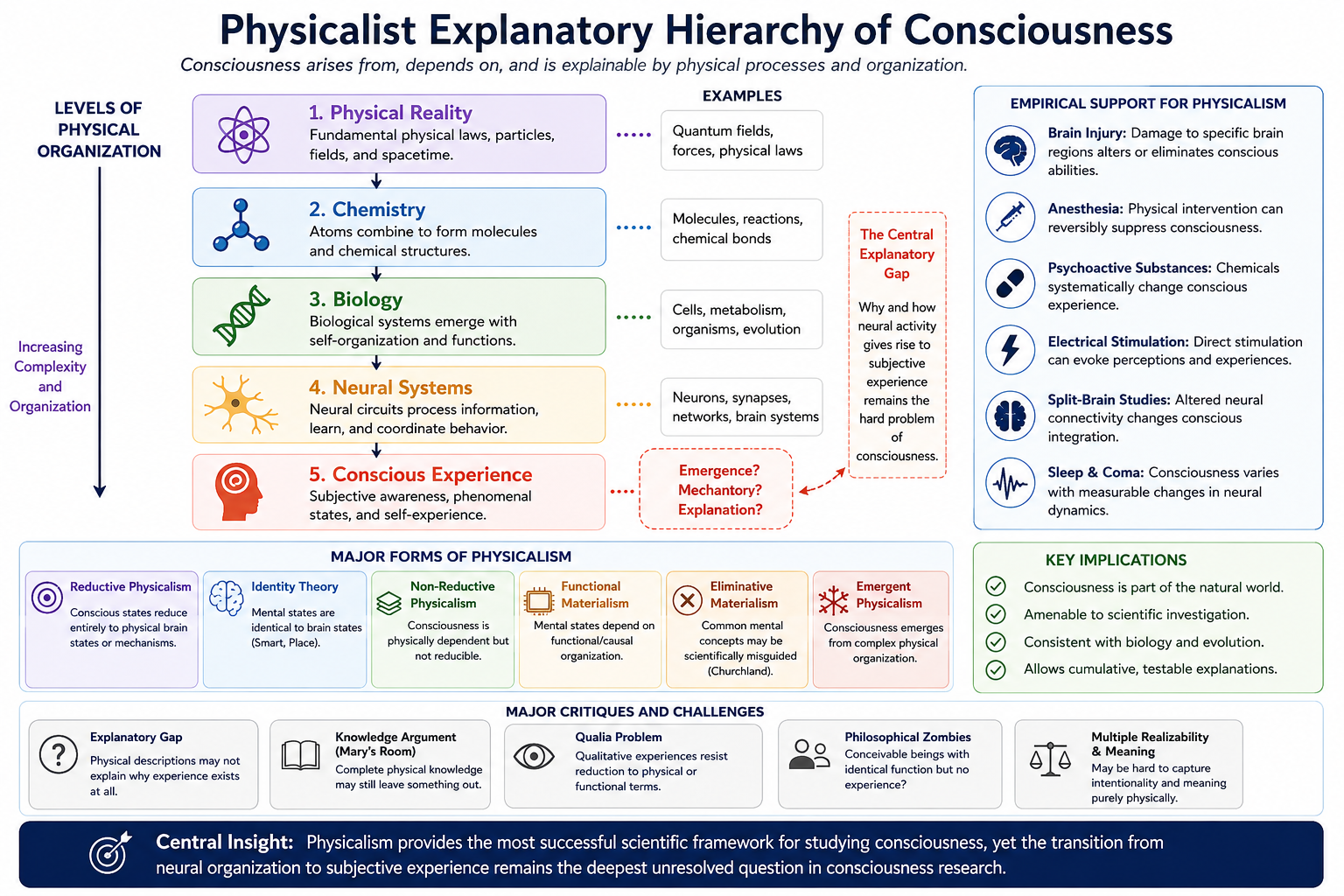
Figure 5.1: Physicalist explanatory hierarchy. Physicalist theories interpret consciousness as arising from increasingly organized physical systems ranging from fundamental physics to chemistry, biology, neural organization, and conscious experience. The highlighted transition between neural systems and subjective experience illustrates the continuing explanatory gap debated within consciousness studies.
Figure @ref(fig:fig-physicalism-hierarchy) illustrates a general physicalist hierarchy. Physical systems form chemical structures, chemical structures support biological systems, biological systems include nervous systems, and sufficiently organized nervous systems may give rise to conscious experience. The most controversial transition is the final one: how neural organization becomes subjective experience.
This transition is where physicalism faces its deepest challenge. The physicalist claim is that consciousness depends on physical organization. The philosophical question is whether physical organization fully explains consciousness.
5.4 Why Physicalism Became Dominant
Physicalism became dominant in modern consciousness research because of the strong relationship between conscious experience and physical brain processes. Consciousness changes when the brain changes. This is one of the most powerful motivations for physicalist theories.
Brain injury can alter memory, language, perception, personality, bodily awareness, attention, and selfhood. Anesthesia can suppress conscious awareness through physical intervention. Psychoactive substances can transform perception, emotion, and self-experience. Electrical stimulation of the brain can produce sensations, memories, movements, or emotional responses. Neurodegenerative diseases can progressively alter cognition, identity, and conscious functioning.
These examples strongly suggest that consciousness is deeply dependent on physical brain organization. Modern neuroscience has also made this dependence experimentally tractable through neuroimaging, electrophysiology, lesion studies, neural stimulation, anesthesia research, and computational neuroscience [@koch2016; @seth2021].
Physicalism also fits naturally with evolutionary biology. If human consciousness depends on biological systems that evolved over time, then consciousness can be investigated as part of the natural history of life rather than as a separate supernatural phenomenon. This does not solve the hard problem, but it gives physicalism a powerful scientific foundation.
For these reasons, physicalism functions as the default background assumption in much contemporary neuroscience, psychology, medicine, and cognitive science.
5.5 Physicalism as a Response to Dualism
Physicalism is partly a response to the problems faced by dualism. Dualist theories treat consciousness as distinct from, or not fully reducible to, physical processes. Cartesian substance dualism, for example, treats mind and matter as different substances [@descartes1641].
Physicalists reject this separation. They argue that consciousness should be explained within the same natural world studied by physics, biology, neuroscience, and cognitive science. This avoids the interaction problem that challenges substance dualism: if mind is non-physical, how does it causally interact with the physical brain?
Physicalism does not deny that consciousness seems different from other physical phenomena. Rather, it argues that this difference should be explained without positing a separate non-physical realm. The goal is to understand how consciousness fits into nature.
This makes physicalism both scientifically attractive and philosophically demanding. It avoids dualist metaphysics, but it must still explain why physical processes are accompanied by subjective experience.
5.6 Core Assumptions of Physicalism
Most physicalist theories share several broad assumptions. First, consciousness depends on physical systems. In humans and other animals, this means that conscious experience depends on the brain, nervous system, body, and biological regulation.
Second, mental states depend on physical states. Changes in the brain can change perception, memory, emotion, thought, agency, and self-experience.
Third, consciousness is part of nature. It is not treated as outside scientific explanation, even if current science does not yet explain it fully.
Fourth, consciousness can be studied empirically. Neuroscience, psychology, medicine, computational modeling, and artificial intelligence may all contribute to a physical understanding of consciousness.
Finally, physicalism rejects the need for a separate mental substance. It does not require immaterial souls, non-physical minds, or supernatural explanation.
However, physicalism is not a single unified theory. Physicalists disagree about whether consciousness can be reduced, whether it emerges, whether it is functional, whether it is computational, and whether current concepts of consciousness should be revised or eliminated.
5.7 Major Forms of Physicalism
Physicalism includes several different approaches to the relation between mind and matter. These positions share a commitment to naturalism, but they differ in how they understand reduction, explanation, emergence, and mental properties.
5.7.1 Reductive Physicalism
Reductive physicalism argues that conscious states can ultimately be reduced to physical brain states or neural mechanisms. On this view, consciousness is not merely correlated with the brain. It is identical with, or fully explainable by, physical processes.
The strongest version of this approach is identity theory. Identity theorists argue that mental states are identical to brain states [@place1956; @smart1959]. Pain, for example, would not merely be caused by neural activity; it would be a neural state described at a different level.
Reductive physicalism has the advantage of offering a clear naturalistic explanation. It treats consciousness as part of the physical world without requiring additional metaphysical principles. However, critics argue that identity theory struggles with qualia, multiple realizability, and the explanatory gap.
5.7.2 Non-Reductive Physicalism
Non-reductive physicalism argues that consciousness depends entirely on physical systems but cannot be straightforwardly reduced to lower-level physical descriptions. Consciousness is physically grounded, but it may possess higher-level properties that require their own explanatory vocabulary.
This position attempts to preserve both scientific naturalism and the complexity of mental life. It accepts that consciousness depends on the physical world while resisting overly simple reductions of experience to neural activity.
Non-reductive physicalism is attractive because many sciences already use higher-level explanations. Biology is grounded in chemistry, but biological explanations are not always replaced by chemical explanations. Psychology may be grounded in neuroscience, but psychological concepts may still remain useful. The challenge is explaining how higher-level mental properties fit into the physical world without becoming either reducible or mysteriously independent [@kim2005].
5.7.3 Functionalist Materialism
Functionalist forms of materialism define mental states in terms of what they do rather than what they are made of. A mental state is understood by its causal role: how it receives inputs, interacts with other states, and produces outputs [@putnam1967; @fodor1975].
Functionalism is often compatible with physicalism because functional organization must be realized in some physical system. However, it does not require that consciousness be tied to one specific biological material. In principle, different physical systems could realize the same functional organization.
This idea became highly influential in debates about artificial intelligence and machine consciousness. If consciousness depends on functional organization, then a sufficiently organized artificial system might become conscious. Critics argue, however, that functionalism may explain access, cognition, and behaviour more easily than phenomenal experience.
5.7.4 Eliminative Materialism
Eliminative materialism argues that some ordinary mental concepts may eventually be replaced by more accurate scientific concepts. According to this view, folk psychological categories such as beliefs, desires, or even qualia may not correspond to real natural kinds in the way common sense assumes [@churchland1981; @churchland1986].
Eliminative materialists compare ordinary psychology to outdated scientific theories. Just as modern science abandoned concepts such as phlogiston, future neuroscience may revise or eliminate some everyday concepts of mind.
This approach is controversial because critics argue that it risks denying the very phenomenon that needs explanation. If a theory claims that qualia do not exist, it must still explain why experience appears so immediate and undeniable.
5.7.5 Emergent Physicalism
Emergent physicalism proposes that consciousness emerges from sufficiently complex physical organization. Consciousness is real and physically grounded, but it may not be reducible to simple lower-level descriptions.
Emergentism is attractive because it allows consciousness to be both natural and genuinely novel. Many physical systems have higher-level properties that arise from organized complexity. Water has properties not obvious from isolated hydrogen and oxygen atoms. Living cells have properties not found in simple molecules. Similarly, consciousness may emerge from complex neural organization.
The challenge is explaining emergence clearly. If emergence means only that consciousness is complicated, then the theory may not solve the hard problem. If emergence means that consciousness has genuinely novel causal powers, then the theory must explain how those powers fit within physical causation.
5.8 Neural Dependence of Consciousness
One of the strongest arguments for physicalism is the neural dependence of consciousness. Across many domains, conscious experience varies with brain activity.
In perception, damage to specific sensory systems can alter or eliminate conscious awareness of certain features of the world. In memory disorders, changes to the hippocampus and related structures can disrupt the continuity of experience and identity. In language disorders, brain injury can alter the ability to express or understand conscious thought. In disorders of bodily awareness, patients may lose the sense of ownership over parts of the body.
Anesthesia provides another major line of evidence. Physical changes to brain dynamics can suppress consciousness in a controlled and reversible way. Sleep and dreaming show that consciousness can be transformed even without external stimulation. Psychedelic states show that changes in neurochemistry can dramatically alter perception, selfhood, and meaning.
Split-brain research also suggests that the unity of consciousness depends on neural organization. When communication between the hemispheres is disrupted, behaviour and report can reveal surprising dissociations in awareness, action, and interpretation.
Research on disorders of consciousness, including coma, vegetative states, minimally conscious states, and locked-in syndrome, further supports the close connection between brain organization and conscious awareness [@laureys2005; @owen2006].
Together, these findings make it difficult to deny that consciousness depends deeply on physical systems. The harder question is whether dependence is the same as complete explanation.
5.9 Correlation and Explanation
Physicalism is strongly supported by correlations between brain activity and consciousness. However, critics argue that correlation alone is not the same as explanation.
Identifying neural correlates may show when consciousness occurs, how conscious states change, and which mechanisms participate. But this may not fully explain why subjective experience exists. This concern is central to the explanatory gap [@levine1983].
The issue can be stated simply: even if every conscious state has a neural correlate, why should neural activity feel like anything from the inside? Why should physical information processing be accompanied by experience rather than occurring without awareness?
This is the central philosophical challenge for physicalism. The strongest physicalist response is that a complete neuroscience will eventually explain why the gap appears to exist. Critics respond that no amount of structural or functional description seems sufficient to derive subjective experience.
5.10 Physicalism and the Hard Problem
Physicalist theories differ in how they approach the hard problem. Some physicalists accept the hard problem as a genuine challenge but argue that it will eventually be solved by neuroscience, cognitive science, or a more mature theory of mind. Others argue that the hard problem is based on misleading intuitions about experience [@dennett1991; @frankish2016].
Reductionist physicalists often argue that consciousness will be identified with physical mechanisms. Functionalists argue that consciousness can be explained by causal organization and information processing. Higher-order and representational approaches argue that conscious experience depends on how mental states are represented or made available to cognition. Illusionists argue that phenomenal consciousness, as traditionally conceived, may be a cognitive illusion [@frankish2016].
Critics of physicalism argue that these responses still fail to explain why physical processes are accompanied by subjective feeling. Chalmers’ hard problem and Jackson’s knowledge argument both challenge the idea that physical explanation is sufficient [@jackson1982; @chalmers1995; @chalmers1996].
Physicalism therefore faces a central question: can subjective experience be fully explained in physical terms, or does consciousness reveal a limitation in physical explanation?
5.11 Physicalism, Qualia, and the Knowledge Argument
Qualia are the qualitative features of experience, such as the redness of red, the painfulness of pain, or the taste of bitterness. Physicalists must explain how such qualitative features fit into the physical world.
One of the most influential challenges is Frank Jackson’s Mary’s Room thought experiment. Mary is a scientist who knows all the physical facts about colour vision but has lived in a black-and-white environment. When she sees red for the first time, does she learn something new? If she does, then complete physical knowledge may not include all knowledge about conscious experience [@jackson1982].
Physicalists have responded in several ways. Some argue that Mary gains a new ability rather than new factual knowledge. Others argue that she gains acquaintance with an experience she already knew about physically. Still others argue that the thought experiment depends on an unrealistic idea of complete physical knowledge.
The knowledge argument remains important because it captures a persistent worry about physicalism: objective physical description may leave out the subjective character of experience.
5.12 Multiple Realizability and Physicalism
Another challenge for reductive physicalism is multiple realizability. If the same mental state can be realized by different physical systems, then mental states may not be identical to specific neural states.
For example, pain in humans, animals, or possible artificial systems might be implemented by different physical mechanisms while playing similar functional roles. This idea was central to functionalist criticisms of strict identity theory [@putnam1967; @fodor1975].
Multiple realizability does not refute all forms of physicalism. A physicalist can argue that every mental state must be physically realized, even if it is not always realized in the same physical way. However, it challenges simple reductions of mental states to particular human brain states.
This is one reason contemporary physicalism often takes non-reductive, functionalist, or emergent forms rather than strict identity theory.
5.13 Physicalism and Artificial Intelligence
Physicalism has important implications for artificial intelligence. If consciousness depends on physical organization, then the question becomes: what kind of physical organization is sufficient?
Functionalist and computational physicalists are more open to the possibility of machine consciousness. If consciousness depends on causal structure, information processing, global availability, or self-modeling, then artificial systems might become conscious if they instantiate the relevant organization [@dehaene2014; @butlin2023].
Other physicalists are more cautious. Biological and embodied approaches argue that consciousness may depend on living systems, bodily regulation, affect, homeostasis, and organism-environment interaction [@varela1991; @thompson2007; @seth2021]. From this perspective, current artificial systems may simulate intelligent behaviour without having subjective experience.
This debate shows that physicalism does not automatically imply that AI systems can be conscious. It depends on what kind of physical, biological, functional, or computational organization a theory considers necessary.
5.14 Strengths of Physicalism
Physicalism has several major strengths. First, it is highly compatible with science. It fits naturally with neuroscience, biology, medicine, psychology, and empirical investigation.
Second, physicalism generates productive research programs. The search for neural correlates of consciousness, studies of anesthesia, research on perception and attention, computational neuroscience, and investigations of disorders of consciousness all depend on physicalist assumptions [@crick1994; @koch2016; @dehaene2011; @seth2021].
Third, physicalism integrates consciousness with evolutionary biology. Consciousness can be studied as a biological phenomenon that developed through natural processes rather than as a separate immaterial entity.
Fourth, physicalism avoids the interaction problem that challenges dualism. If consciousness is physical or physically realized, then there is no need to explain how a non-physical mind affects a physical brain.
Finally, physicalism connects consciousness research with broader scientific accounts of matter, life, computation, information, and biological organization.
5.15 Weaknesses and Criticisms
Despite its strengths, physicalism faces serious criticisms. The most important is the explanatory gap. Critics argue that physical explanations may describe neural dynamics, behaviour, cognition, and information processing without explaining subjective feeling itself [@levine1983].
The knowledge argument raises a related challenge by suggesting that complete physical knowledge may still fail to capture what experience is like [@jackson1982]. Qualia critiques argue that the qualitative features of experience resist purely structural, computational, or functional description.
Physicalism also faces challenges concerning intentionality, meaning, selfhood, and lived experience. A physical system may process information, but it remains difficult to explain how information becomes meaningful for a subject.
Finally, some critics argue that physicalism may be too broad. If everything must ultimately be physical, then the central question becomes what kind of physical explanation is needed. Without a specific theory, physicalism can become a general worldview rather than a detailed account of consciousness.
5.16 Physicalism and Other Theories
Physicalism differs from dualism by rejecting a separate non-physical mind. It differs from panpsychism by usually denying that consciousness is fundamental or widespread throughout nature. It differs from consciousness-first theories by treating consciousness as dependent on physical organization rather than as the foundation of reality.
However, physicalism overlaps with several major theories discussed later in this book. Global Workspace Theory is often physicalist because it explains consciousness through neural broadcasting and cognitive access [@baars1988; @dehaene2011]. Integrated Information Theory is more complex: it is naturalistic and formal, but it also treats consciousness as intrinsic to certain causal structures [@tononi2004; @oizumi2014]. Predictive Processing and the Bayesian brain framework are usually physicalist because they explain perception and cognition through embodied prediction, inference, and neural dynamics [@friston2010; @clark2013].
Physicalism is therefore not one theory among many in a simple way. It is a broad metaphysical and scientific background within which many specific theories operate.
5.17 Evaluation
Physicalism remains the dominant framework in scientific consciousness research because it aligns strongly with neuroscience, biology, medicine, computation, and empirical methodology. It explains why changes in the brain alter conscious experience and provides a powerful basis for experimental research.
However, physicalism remains philosophically contested. The central unresolved issue is whether physical explanation can fully account for phenomenal experience. A physicalist theory may explain neural mechanisms, functional organization, and behavioural capacities, but critics argue that this may still leave unanswered why experience exists at all.
For this reason, physicalism is both powerful and incomplete. It is powerful because consciousness clearly depends on physical systems in humans and other animals. It is incomplete because the precise relation between physical organization and subjective experience remains unresolved.
The future of physicalism depends on whether neuroscience, cognitive science, computational theory, and philosophy can together explain not only the mechanisms associated with consciousness, but also the first-person character of experience itself.
5.18 Chapter Summary
Physicalism is the view that consciousness is ultimately part of the physical world. It rejects separate mental substances and attempts to explain consciousness through neural, biological, computational, functional, or emergent physical organization.
Major forms of physicalism include reductive physicalism, identity theory, non-reductive physicalism, functionalist materialism, eliminative materialism, and emergent physicalism. These positions differ in how they understand reduction, emergence, and explanation.
Physicalism is strongly supported by the dependence of consciousness on brain activity. Brain injury, anesthesia, psychoactive substances, sleep, dreaming, neural stimulation, and disorders of consciousness all show that changes in physical systems can alter conscious experience.
The major challenge for physicalism is the explanatory gap. Critics argue that physical descriptions may explain mechanisms and functions without explaining why experience feels like anything from the inside. The knowledge argument, qualia, multiple realizability, and questions of meaning and subjectivity all continue to challenge physicalist theories.
Physicalism remains the dominant scientific framework for consciousness research, but whether it can fully explain subjective experience remains one of the central unresolved questions in the field.