Chapter 22 Comparative Matrix of Theories
22.1 Chapter Overview
Consciousness research contains a remarkably diverse set of theories. These theories attempt to explain subjective experience, awareness, cognition, selfhood, neural integration, perception, embodiment, artificial intelligence, altered states, and the relationship between mind and matter.
Importantly, these theories do not always compete directly with one another. Some theories focus mainly on neural mechanisms of conscious access. Others focus on phenomenology, self-modeling, embodiment, information integration, computational architecture, metaphysics, or the foundational status of consciousness itself.
For example, Global Workspace Theory primarily explains conscious access and reportability [@baars1988; @dehaene2011]. Integrated Information Theory focuses on intrinsic causal integration and the structure of experience [@tononi2004; @oizumi2014]. Predictive Processing emphasizes inference, prediction, and error minimization [@friston2010; @clark2013]. Panpsychism and T-Consciousness address deeper consciousness-first questions about whether consciousness is fundamental rather than produced by matter alone [@goff2017; @goff2019; @taheri2020; @taheri2023].
This chapter compares the major theories of consciousness across shared dimensions and explanatory criteria. The goal is not to rank theories simplistically, but to identify what each theory explains well, where each faces unresolved challenges, how theories overlap or diverge, and where future integration may become possible.
22.2 How to Read This Chapter
This chapter is comparative rather than argumentative. It does not claim that one theory has already won the debate. Instead, it organizes the theoretical landscape so that the strengths and limitations of each approach can be seen more clearly.
As you read this chapter, keep three points in mind.
First, different theories often explain different targets. A theory of conscious access is not necessarily a theory of phenomenal experience. A theory of neural mechanism is not necessarily a metaphysical theory of consciousness.
Second, some theories may be complementary. For example, Predictive Processing may explain perceptual inference, Global Workspace Theory may explain cognitive access, embodied theories may explain situated experience, and Higher-Order theories may explain reflective awareness.
Third, every theory has tradeoffs. Some theories are empirically productive but philosophically incomplete. Others address the hard problem directly but are difficult to test experimentally.
22.3 Learning Objectives
After reading this chapter, the reader should be able to:
- Compare major theories of consciousness across multiple dimensions.
- Distinguish empirical, computational, phenomenological, and metaphysical approaches.
- Explain how theories differ in their explanatory targets.
- Analyze how different theories approach the hard problem.
- Compare implications for artificial intelligence and altered states.
- Identify strengths and limitations of major frameworks.
- Understand why no current consensus exists.
- Evaluate possibilities for theoretical integration.
- Explain where T-Consciousness fits within the broader consciousness-first landscape.
22.4 Core Idea in One Picture
Figure @ref(fig:fig-comparison) summarizes the multidimensional landscape of major consciousness theories.
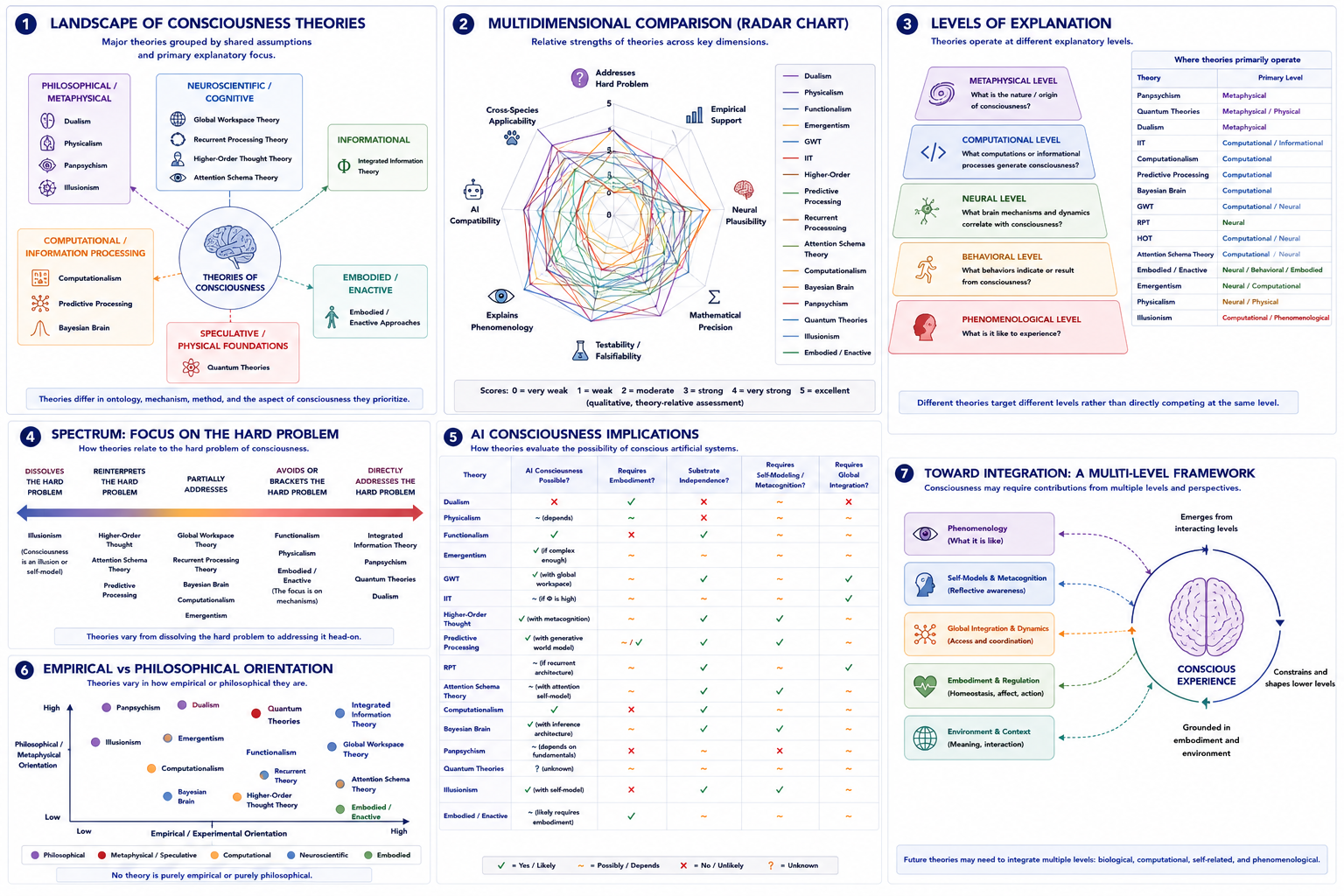
Figure 22.1: Comparative landscape of consciousness theories. Panel 1 groups theories by major explanatory orientation. Panel 2 compares theories across multiple dimensions using radar-style analysis. Panel 3 illustrates levels of explanation targeted by different theories. Panel 4 compares approaches to the hard problem. Panel 5 summarizes implications for AI consciousness. Panel 6 contrasts empirical and philosophical orientations. Panel 7 illustrates possible future integration across levels of explanation.
As Figure @ref(fig:fig-comparison) illustrates, consciousness theories differ not only in their conclusions, but also in their explanatory targets, philosophical assumptions, levels of analysis, empirical methods, and definitions of consciousness itself.
This is one reason consciousness research remains difficult. Researchers may appear to disagree about one problem while actually focusing on different aspects of consciousness.
22.5 Why Theories Differ
One of the most important insights in consciousness research is that disagreements between theories often arise because they attempt to explain different aspects of consciousness.
Global Workspace Theory focuses primarily on conscious access, broadcasting, and reportability. Integrated Information Theory focuses on intrinsic integration and the structure of experience. Higher-Order theories emphasize reflective awareness and metacognition. Predictive Processing emphasizes hierarchical inference and prediction. Recurrent Processing Theory emphasizes feedback loops and perceptual stabilization. Attention Schema Theory emphasizes the brain’s model of attention. Panpsychism addresses the metaphysical origin of experience. Illusionism questions whether phenomenal consciousness exists in the traditional sense [@dennett1991; @frankish2016].
This means that theories differ not only because they disagree, but because they often prioritize different explananda. The word consciousness may refer to several related but distinct phenomena: wakefulness, awareness, reportability, phenomenal feeling, selfhood, integration, attention, embodiment, or metaphysical subjectivity.
A comparative matrix is therefore useful because it prevents false equivalence. It helps show which theories are answering which questions.
22.6 Major Families of Theories
22.6.1 Philosophical and Metaphysical Theories
Philosophical and metaphysical theories address the nature of consciousness and its place in reality. These include dualism, physicalism, panpsychism, illusionism, and consciousness-first frameworks such as T-Consciousness.
Dualism emphasizes the distinction between mind and matter. Physicalism attempts to explain consciousness within the physical world. Panpsychism treats consciousness or proto-consciousness as a fundamental aspect of reality [@goff2017]. Illusionism argues that phenomenal consciousness, as traditionally conceived, may be an introspective illusion [@frankish2016]. T-Consciousness treats consciousness as foundational and non-material rather than as a product of neural or computational processes [@taheri2020; @taheri2023].
These theories often engage most directly with the hard problem of consciousness.
22.6.2 Computational and Information-Processing Theories
Computational and information-processing theories explain mind in terms of representation, computation, inference, information transformation, and cognitive architecture.
This family includes computationalism, functionalism, Predictive Processing, Bayesian brain theories, and some interpretations of Global Workspace Theory [@putnam1967; @fodor1975; @turing1950; @friston2010; @clark2016].
These theories are especially important for artificial intelligence because they often suggest that consciousness may depend on organization rather than biological substrate alone.
22.6.3 Neuroscientific Theories
Neuroscientific theories attempt to identify the brain mechanisms associated with conscious experience or conscious access.
This family includes Global Workspace Theory, Recurrent Processing Theory, Higher-Order Thought Theory, and Attention Schema Theory. These theories focus on neural broadcasting, recurrent feedback, metacognition, attention, and self-modeling [@baars1988; @dehaene2011; @lamme2006; @rosenthal2005; @lau2011; @graziano2013].
Their strength is empirical relevance. Their limitation is that they may explain neural mechanisms without fully resolving why those mechanisms are accompanied by subjective experience.
22.6.4 Informational and Formal Theories
Integrated Information Theory occupies a unique position. It combines phenomenological starting points, formal mathematical structure, and claims about intrinsic causal integration [@tononi2004; @oizumi2014].
IIT attempts to explain consciousness in terms of how much integrated information a system generates. It is both scientific and philosophical. It offers a formal framework, but its implications and measurement challenges remain controversial.
22.6.5 Embodied and Enactive Theories
Embodied and enactive theories emphasize bodily interaction, organism-environment coupling, sensorimotor engagement, interoception, emotion, and lived experience [@varela1991; @thompson2007; @seth2021].
These theories challenge purely brain-centered and computational accounts. They argue that consciousness cannot be fully understood by studying neural activity or internal representation alone. Consciousness belongs to living, acting, embodied organisms situated in environments.
22.6.6 Speculative Physical Theories
Quantum theories explore possible relationships between consciousness and non-classical physical processes, such as quantum coherence, state reduction, or fundamental physics [@penrose1989; @hameroff2014].
These approaches remain controversial and empirically uncertain. Their importance lies in how they challenge the assumption that classical neural computation is necessarily sufficient for consciousness.
22.7 Different Levels of Explanation
Theories of consciousness operate at different explanatory levels. Recognizing these levels helps explain why theories may sometimes complement rather than contradict one another.
22.7.1 Metaphysical Level
At the metaphysical level, theories ask what consciousness is fundamentally. Is consciousness reducible to physical processes? Is it fundamental? Is it an illusion? Is it non-material? This level is addressed by dualism, physicalism, panpsychism, illusionism, quantum theories, and T-Consciousness.
22.7.2 Computational Level
At the computational level, theories ask how information is represented, processed, transformed, integrated, and used. Computationalism, functionalism, Predictive Processing, and Bayesian brain theories operate strongly at this level.
22.7.3 Neural Level
At the neural level, theories ask which brain mechanisms support consciousness. Global Workspace Theory, Recurrent Processing Theory, Higher-Order Thought Theory, and Attention Schema Theory focus strongly on neural dynamics, attention, recurrence, access, and self-monitoring.
22.7.4 Phenomenological Level
At the phenomenological level, theories ask how consciousness is lived and structured from the first-person perspective. Embodied approaches, IIT, panpsychism, and consciousness-first theories often emphasize this level.
22.7.5 Ethical and Artificial-Systems Level
At the ethical and AI level, theories ask whether non-human animals, artificial systems, or altered-state patients may be conscious. This level is increasingly important because consciousness theories now influence AI ethics, clinical care, and moral status debates [@butlin2023].
22.8 Comparative Matrix
The following table compares major theories across shared criteria.
| Theory | Main_Target | Strength | Major_Gap | AI_Implication |
|---|---|---|---|---|
| Dualism | Mind-body distinction | Takes subjectivity seriously | Interaction problem | Usually skeptical |
| Physicalism | Physical basis of consciousness | Scientifically parsimonious | Explanatory gap | Depends on physical substrate |
| Functionalism | Functional organization | Substrate flexibility | Qualia problem | Potentially possible |
| Emergentism | Complexity-based emergence | Captures complexity | Vague emergence mechanism | Possible if complexity sufficient |
| Global Workspace Theory | Conscious access and broadcasting | Strong cognitive-neuroscience fit | Phenomenology may be underexplained | Possible with workspace architecture |
| Integrated Information Theory | Integrated experience | Formal and phenomenology-oriented | Measurement and implications | Depends on causal integration |
| Higher-Order Thought | Metacognitive awareness | Explains introspective awareness | Animal and infant consciousness | Requires metacognition |
| Predictive Processing | Perceptual inference and prediction | Broad unifying framework | Experience not fully explained | Requires generative world model |
| Recurrent Processing | Feedback-based perception | Neurally plausible for perception | Limited beyond perception | Requires recurrent architecture |
| Attention Schema Theory | Model of attention | Mechanistic self-model account | May explain belief, not experience | Requires attention schema |
| Computationalism | Computational mind | Connects mind and AI | Simulation versus experience | Potentially possible |
| Bayesian Brain | Probabilistic inference | Handles uncertainty | Phenomenology not central | Possible with inference architecture |
| Panpsychism | Fundamental consciousness | Addresses hard problem directly | Combination problem | Depends on experiential organization |
| Cosmopsychism | Universal consciousness | Avoids micro-combination problem | Decombination problem | Depends on relation to whole-consciousness |
| T-Consciousness | Foundational non-material consciousness | Centers consciousness as primary | Limited mainstream scientific integration | Not reducible to computation alone |
| Quantum Theories | Physical foundations of consciousness | Explores physical limits | Limited evidence | Unknown; may require quantum processes |
| Illusionism | Illusion of qualia | Dissolves hard problem | May deny what it explains | May focus on self-representation |
| Embodied/Enactive | Embodied lived experience | Connects mind, body, and world | Neural specificity | Requires embodiment |
22.9 Comparative Criteria
The comparison in this chapter uses several criteria.
The first criterion is explanatory target. Some theories explain conscious access, while others explain phenomenology, metaphysics, selfhood, embodiment, or artificial consciousness.
The second criterion is empirical support. Some theories are closely tied to experimental neuroscience. Others are primarily philosophical or metaphysical.
The third criterion is testability. A theory becomes scientifically stronger when it generates clear predictions.
The fourth criterion is neural plausibility. Theories that propose mechanisms should be consistent with known brain organization.
The fifth criterion is treatment of subjective experience. Some theories address phenomenal consciousness directly. Others focus more on reportability or information processing.
The sixth criterion is treatment of the hard problem. Some theories attempt to solve it, some reinterpret it, and some dissolve it.
The seventh criterion is applicability beyond humans. A theory should clarify whether animals, infants, patients with disorders of consciousness, or artificial systems could be conscious.
No theory scores maximally across all criteria. Each theory explains some dimensions well and faces unresolved difficulties elsewhere.
22.10 Theories and the Hard Problem
One of the largest differences between theories concerns how they approach the hard problem.
22.10.1 Directly Addressing the Hard Problem
Dualism, panpsychism, cosmopsychism, IIT, and T-Consciousness attempt to address subjective experience directly. They do not treat consciousness merely as reportability or information access. Panpsychism and cosmopsychism treat consciousness as fundamental or cosmic in scope. T-Consciousness treats consciousness as foundational and non-material [@taheri2020; @taheri2023].
22.10.2 Reinterpreting the Hard Problem
Predictive Processing, Higher-Order theories, Attention Schema Theory, and some computational approaches reinterpret consciousness in terms of inference, self-modeling, metacognition, or information access [@friston2010; @rosenthal2005; @graziano2013].
These theories may not solve the hard problem directly, but they explain why consciousness has the structure it does.
22.10.3 Dissolving the Hard Problem
Illusionism attempts to dissolve the hard problem by arguing that phenomenal consciousness, as traditionally conceived, may be an introspective illusion [@frankish2016].
Rather than asking why qualia exist, illusionism asks why humans believe in qualia.
22.10.4 Focusing on Mechanisms
Global Workspace Theory, Recurrent Processing Theory, computationalism, and many neuroscientific models focus mainly on mechanisms. They explain access, broadcasting, recurrence, cognition, and reportability. Their strength is empirical relevance. Their weakness is that they may leave phenomenal consciousness underexplained.
22.11 Empirical and Philosophical Orientation
Theories differ in how strongly they lean toward empirical science or philosophical interpretation.
Global Workspace Theory, Recurrent Processing Theory, Predictive Processing, Higher-Order theories, and Attention Schema Theory are closely connected to neuroscience and cognitive science.
Integrated Information Theory is both formal and philosophical. It proposes a mathematical structure but also begins from phenomenological axioms.
Panpsychism, cosmopsychism, illusionism, and T-Consciousness are more strongly philosophical or metaphysical, though they may still engage with scientific debates.
Quantum theories sit in a difficult position. They appeal to physical science, but their application to consciousness remains speculative.
Embodied and enactive theories bridge phenomenology, biology, cognitive science, and philosophy.
No theory is purely empirical or purely philosophical. Even the most empirical theories contain assumptions about what consciousness is. Even the most philosophical theories must eventually confront empirical evidence.
22.12 AI Consciousness Implications
Theories differ sharply in their implications for artificial intelligence.
Functionalism, computationalism, Global Workspace Theory, Higher-Order theories, Attention Schema Theory, and some versions of Predictive Processing are relatively open to AI consciousness. They emphasize organization, access, self-modeling, inference, and architecture.
Biological naturalism, embodied theories, and some interpretations of IIT are more cautious. They ask whether artificial systems possess the right causal powers, bodily regulation, intrinsic integration, or organism-environment interaction.
Panpsychism leaves open the possibility that artificial systems may possess some degree of experience, depending on intrinsic organization or experiential structure. T-Consciousness frames the question differently. It does not treat consciousness as produced by computation alone. Instead, it asks how artificial systems relate to a foundational consciousness field or reality.
Illusionism may be relatively permissive because it focuses on self-modeling and the representation of consciousness rather than irreducible qualia.
The result is clear: whether AI can be conscious depends strongly on which theory of consciousness is adopted [@butlin2023].
22.13 Altered States and Disorders of Consciousness
Theories also differ in how they explain anesthesia, dreaming, psychedelic states, meditation, and disorders of consciousness.
Global Workspace Theory predicts that anesthesia disrupts global broadcasting and cognitive access.
Integrated Information Theory predicts reduced integrated causal structure and lower complexity.
Recurrent Processing Theory predicts disruption of recurrent feedback loops.
Predictive Processing emphasizes altered priors, prediction errors, and precision weighting.
Higher-Order theories emphasize disruption of metacognition and self-monitoring.
Embodied theories emphasize changes in bodily regulation, interoception, and organism-environment interaction.
T-Consciousness may interpret altered states differently, not merely as neural disruptions, but as changes in relation to or manifestation of consciousness. However, this interpretation should be presented carefully as part of a consciousness-first framework rather than mainstream clinical neuroscience.
Altered states are important because they test whether a theory can explain not only ordinary waking consciousness, but also partial, altered, disrupted, or internally generated experience.
22.14 Philosophical Costs and Tradeoffs
Every theory faces tradeoffs.
Dualism preserves subjectivity strongly, but faces the interaction problem.
Physicalism aligns closely with science, but faces the explanatory gap.
Functionalism and computationalism are flexible and AI-relevant, but struggle with qualia and subjective feeling.
Emergentism captures complexity, but often leaves the emergence mechanism vague.
Global Workspace Theory explains access and reportability well, but may underexplain phenomenology.
Integrated Information Theory gives a formal account of integration, but faces measurement challenges and controversial implications.
Higher-Order theories explain reflective awareness, but face questions about non-human, infant, and non-reflective consciousness.
Predictive Processing provides a powerful unifying framework, but prediction alone may not explain subjectivity.
Recurrent Processing Theory is strong for perceptual awareness, but may be limited beyond sensory consciousness.
Attention Schema Theory gives a clear model of awareness representation, but may explain belief in awareness more than experience itself.
Panpsychism addresses the hard problem directly, but faces the combination problem.
Cosmopsychism avoids micro-combination but faces the decombination problem.
T-Consciousness places consciousness at the foundation, but requires careful articulation and stronger connection to mainstream scientific methods.
Quantum theories explore physical foundations, but lack strong empirical support.
Illusionism is naturalistic and parsimonious, but may seem to deny the very phenomenon it seeks to explain.
Embodied and enactive theories connect mind, body, and world, but sometimes lack neural specificity.
These tradeoffs explain why no single theory currently dominates the field.
22.15 Toward Integration
Future progress may require integration across levels rather than the victory of one theory over all others.
A mature theory of consciousness may need several components. It may need neuroscience to explain mechanisms, computation to explain information processing, phenomenology to clarify lived experience, embodiment to situate consciousness in life and action, and metaphysics to address the hard problem.
For example, Global Workspace Theory may explain conscious access. Recurrent Processing Theory may explain early perceptual awareness. Predictive Processing may explain inference and perceptual construction. Higher-Order theories may explain metacognitive awareness. Attention Schema Theory may explain awareness modeling. Embodied theories may explain lived bodily experience. IIT may explain integration. Panpsychism and T-Consciousness may force deeper reconsideration of whether consciousness is derivative or foundational.
This does not mean all theories can simply be combined without conflict. Some make incompatible claims. Illusionism and panpsychism, for example, disagree sharply about whether phenomenal consciousness is real or fundamental. Computationalism and T-Consciousness differ strongly on whether consciousness can be produced by information processing alone.
Nevertheless, partial integration may be possible. Consciousness may require explanation across multiple dimensions rather than from a single level alone.
22.16 Main Comparative Conclusion
No existing theory currently explains all dimensions of consciousness simultaneously.
Some theories are empirically productive but philosophically incomplete. Others address metaphysical questions directly but remain difficult to test experimentally. Some explain access but not phenomenal experience. Others explain subjectivity but not mechanisms. Some are AI-friendly. Others are biologically or metaphysically restrictive.
Consciousness may ultimately require explanation across multiple interacting dimensions, including neural dynamics, computation, embodiment, phenomenology, selfhood, information integration, altered states, artificial systems, and physical or metaphysical foundations.
The diversity of theories therefore reflects not only disagreement, but also the extraordinary complexity of consciousness itself.
22.17 Chapter Summary
This chapter compared major theories of consciousness across multiple dimensions. The central conclusion is that consciousness theories often differ because they explain different targets.
Some theories focus on conscious access, such as Global Workspace Theory. Some focus on integration, such as Integrated Information Theory. Some focus on metacognition, such as Higher-Order theories. Some focus on prediction, such as Predictive Processing and Bayesian brain theories. Some focus on feedback, such as Recurrent Processing Theory. Some focus on self-modeling, such as Attention Schema Theory and illusionism. Some focus on embodiment, such as embodied and enactive theories. Some focus on metaphysical foundations, such as dualism, panpsychism, cosmopsychism, and T-Consciousness.
No theory currently explains everything. Each has strengths and limitations. Theories also differ in their implications for artificial intelligence, altered states, animal consciousness, and the hard problem.
The most promising future direction may involve multi-level integration. A complete account of consciousness may need to combine neural mechanisms, computational architecture, bodily life, phenomenological structure, self-modeling, and philosophical analysis.
The central lesson is that consciousness is too complex to be captured by a single simple comparison. A comparative matrix helps clarify the landscape, but the deeper challenge is to understand how these different levels of explanation relate to one another.