Chapter 4 Dualism
4.1 Chapter Overview
Dualism is one of the oldest and most influential approaches in the philosophy of mind and consciousness studies. Broadly defined, dualism holds that consciousness cannot be fully reduced to physical processes alone. Mental states, subjective experience, and first-person awareness are treated as fundamentally distinct from, or at least not exhaustively explainable by, purely material descriptions of the brain.
Dualist theories arise largely from dissatisfaction with reductionist accounts of consciousness. Neuroscience may explain neural activity, perception, memory, cognition, behaviour, and decision-making with increasing precision. Yet dualists argue that such explanations may still leave something important unexplained: why conscious experience exists at all and why experience has qualitative, first-person character.
This concern connects dualism directly to the hard problem of consciousness. If physical descriptions explain brain mechanisms but do not explain why those mechanisms are accompanied by subjective experience, then consciousness may require a different kind of explanation [@chalmers1995; @chalmers1996]. Dualism is one of the major philosophical responses to this problem.
This chapter examines dualism as a family of positions rather than a single theory. It introduces the historical origins of dualist thought, distinguishes major forms of dualism, explains why dualism remains important in contemporary consciousness studies, and evaluates its strengths, limitations, and implications for neuroscience, artificial intelligence, and the study of subjective experience.
4.2 Learning Objectives
After reading this chapter, the reader should be able to:
- Define dualism in the philosophy of mind.
- Distinguish substance dualism, property dualism, interactionism, epiphenomenalism, and naturalistic dualism.
- Explain the relationship between dualism and the hard problem of consciousness.
- Describe the explanatory gap that motivates many dualist arguments.
- Evaluate the strengths and weaknesses of dualist explanations.
- Compare dualism with physicalist, functionalist, and computational theories.
- Assess the implications of dualism for neuroscience, artificial intelligence, and subjective experience.
4.3 What Dualism Claims
Dualism begins from the idea that mind and matter cannot be understood as exactly the same kind of thing. Physical objects can be described in terms of mass, extension, location, motion, structure, and causal interaction. Conscious experience, by contrast, seems to involve subjectivity, feeling, intentionality, perspective, and qualitative awareness.
The central dualist claim is not simply that the brain and consciousness are different words. Rather, the claim is that physical description may not fully capture what consciousness is. A complete account of neural activity might describe electrical signals, neurotransmitters, brain networks, and behavioural outputs. But dualists argue that such an account may still fail to explain what it is like to undergo an experience.
This is why dualism remains important even in a scientific age. It challenges the assumption that explaining brain mechanisms automatically explains consciousness. Dualism asks whether subjective experience can be reduced to physical processes, or whether consciousness reveals something incomplete in purely material explanation.
4.4 Historical Development
Questions about the relationship between mind and matter existed long before modern neuroscience. Ancient philosophical traditions debated the nature of soul, perception, selfhood, life, and awareness. However, dualism became especially influential in early modern philosophy through René Descartes.
Descartes argued that mind and body are fundamentally different kinds of substance. Matter is extended in space and governed by mechanical laws, whereas mind is characterized by thought, awareness, and subjectivity [@descartes1641]. This view became known as substance dualism.
Cartesian dualism strongly shaped the modern mind-body problem. If mind and body are different substances, then one must explain how they relate to one another. How can subjective thought interact with physical matter? How can conscious intention move the body? How can brain processes give rise to experience?
Although contemporary neuroscience rarely accepts Cartesian substance dualism in its original form, many contemporary debates still inherit dualist concerns. The hard problem, the explanatory gap, debates about qualia, and questions about first-person experience all reflect the continuing difficulty of explaining consciousness in purely physical terms [@nagel1974; @levine1983; @chalmers1996].
Twentieth-century behaviourism temporarily marginalized consciousness by focusing psychology on observable behaviour rather than private experience [@watson1913; @skinner1953]. Later, the cognitive revolution reintroduced internal mental processes into psychology, while neuroscience made consciousness increasingly available to empirical study. However, these developments did not eliminate dualist questions. Instead, they sharpened them: even if cognition and neural mechanisms can be studied scientifically, does this fully explain subjective experience?
4.5 Dualism and the Hard Problem
Dualism is closely connected to the hard problem of consciousness. The hard problem asks why physical or computational processes are accompanied by subjective experience at all [@chalmers1995]. Dualism offers one possible answer: perhaps subjective experience cannot be fully explained because it is not reducible to physical processes in the first place.
This does not mean that all dualists reject neuroscience. Many contemporary dualists accept that the brain is deeply involved in consciousness. They may agree that changes in brain activity correspond to changes in experience. What they deny is that neural correlation alone provides a complete explanation of phenomenal consciousness.
The distinction between access consciousness and phenomenal consciousness is especially important here [@block1995]. Access consciousness concerns information that is available for reasoning, report, memory, and action. Phenomenal consciousness concerns qualitative experience itself: what it is like to see red, feel pain, hear music, or experience oneself as a subject.
Dualist theories are usually motivated by phenomenal consciousness. A physicalist or functionalist theory may explain how information becomes available for report and action. The dualist question is whether such an explanation also explains why there is something it is like to have the experience.
4.6 Major Forms of Dualism
Dualism is not a single unified theory. It is a family of positions concerning the relation between consciousness and the physical world. These positions differ in how strongly they separate mind from matter and in how they understand the causal relationship between mental and physical states.
4.6.1 Substance Dualism
Substance dualism is the view that mind and matter are fundamentally different substances. On this view, the physical body belongs to the material world, while the conscious mind belongs to a non-physical domain. Descartes is the most famous defender of this position [@descartes1641].
Substance dualism has intuitive appeal because conscious experience seems very different from physical matter. Thoughts, feelings, and sensations do not appear to occupy space in the same way that physical objects do. However, substance dualism faces a serious challenge: if mind is non-physical, how does it interact with the physical brain and body?
This is known as the interaction problem, and it remains one of the strongest objections to Cartesian dualism.
4.6.2 Property Dualism
Property dualism rejects the idea that mind and body are separate substances. Instead, it argues that conscious experience involves properties that are not reducible to physical properties. On this view, consciousness may arise from physical systems, but phenomenal experience cannot be fully explained in physical terms.
Property dualism is more compatible with contemporary science than traditional substance dualism. It does not require a separate mental substance. However, it still claims that physical descriptions leave out something essential about experience.
Chalmers’ naturalistic dualism is often understood as a form of property dualism. He argues that consciousness may be a fundamental feature of reality governed by psychophysical laws, rather than something reducible to known physical processes [@chalmers1996].
4.6.3 Interactionist Dualism
Interactionist dualism holds that mental and physical states can causally influence one another. Conscious intentions may affect bodily actions, while brain events may affect conscious experience. This view preserves the ordinary intuition that conscious decisions matter and that mental life plays a causal role in behaviour.
The difficulty is explaining how this interaction occurs. If physical events are fully governed by physical laws, then it is unclear how non-physical mental events could influence the brain without violating causal closure. This challenge has been central to critiques of dualist mental causation [@kim2005; @papineau2002].
4.6.4 Epiphenomenalism
Epiphenomenalism holds that physical brain processes produce conscious experience, but conscious experience does not itself cause physical events. On this view, consciousness is real but causally inert. It accompanies neural activity without influencing behaviour.
Epiphenomenalism avoids some versions of the interaction problem because it does not require consciousness to act back on the physical world. However, it creates other difficulties. If consciousness has no causal role, then it becomes difficult to explain why humans talk about consciousness, why conscious pain seems to guide action, or why experience would have evolved.
Frank Jackson’s original knowledge argument was often associated with epiphenomenalist intuitions, although Jackson later revised his position [@jackson1982].
4.6.5 Naturalistic Dualism
Naturalistic dualism attempts to combine scientific realism with the claim that consciousness is fundamental. Chalmers argues that consciousness may require new basic principles linking physical processes with experience [@chalmers1996]. These would not be supernatural principles, but they would go beyond current physical explanation.
Naturalistic dualism is important because it does not reject science. Instead, it argues that science may need to expand its explanatory framework to include consciousness as a fundamental feature of reality.
This position is closely related to broader debates about whether consciousness can be reduced, whether it must be treated as fundamental, and whether a future science of consciousness may require psychophysical laws.
4.7 Conceptual Framework
Dualism can be understood as a response to the explanatory gap between physical description and subjective experience. The gap arises because objective science describes mechanisms, structures, functions, and causal relations, while consciousness appears as first-person experience [@levine1983].
Figure @ref(fig:fig-dualism-gap) illustrates this tension.
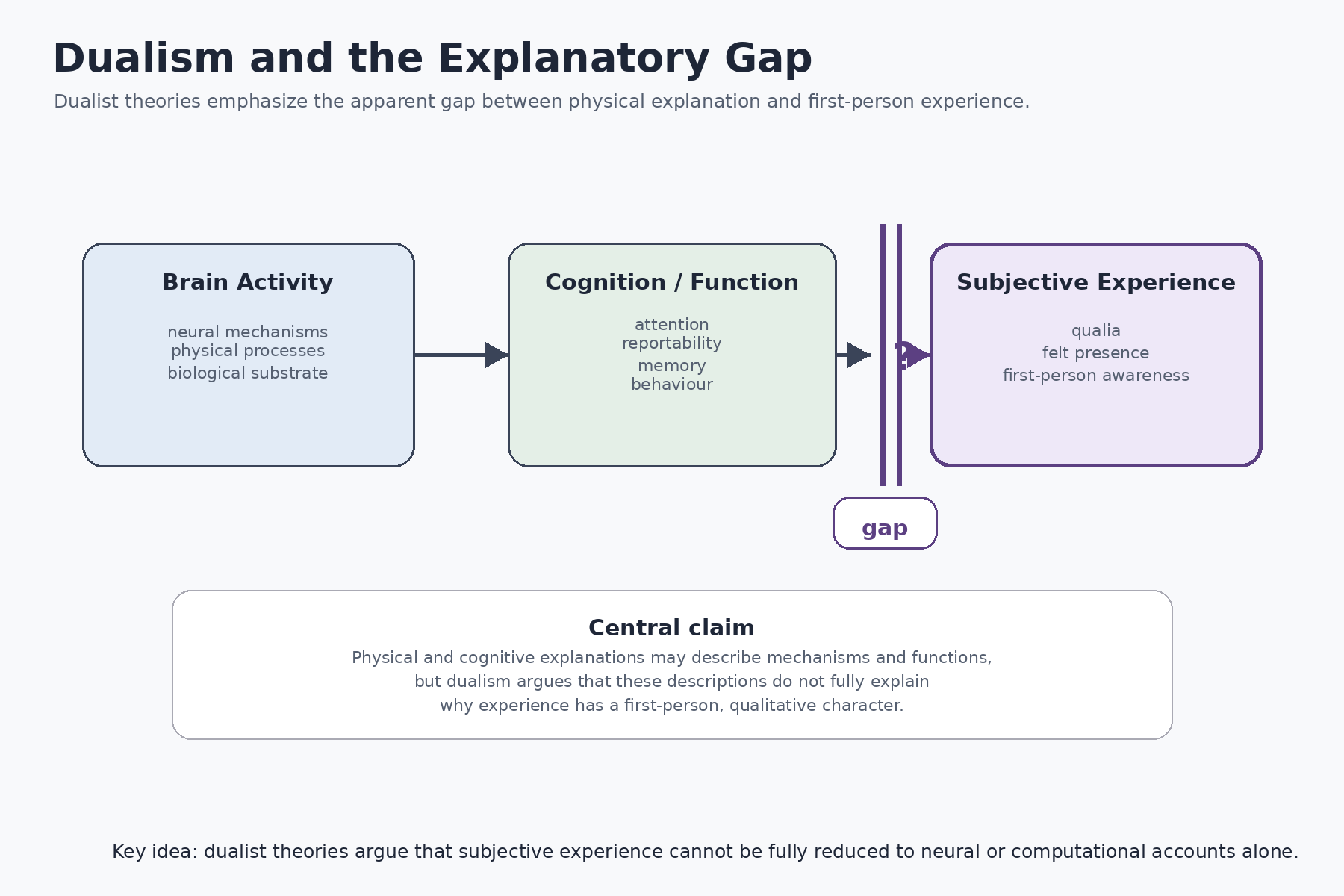
Figure 4.1: Dualism and the explanatory gap. Dualist theories argue that subjective experience cannot be fully reduced to physical or cognitive explanation alone.
As Figure @ref(fig:fig-dualism-gap) suggests, dualist theories do not usually deny that neural activity and cognitive processing are important. Rather, they argue that explanations at these levels may remain incomplete if they do not account for phenomenal experience itself.
Figure @ref(fig:fig-dualism-triangle) places dualism within the broader conceptual structure of consciousness studies.
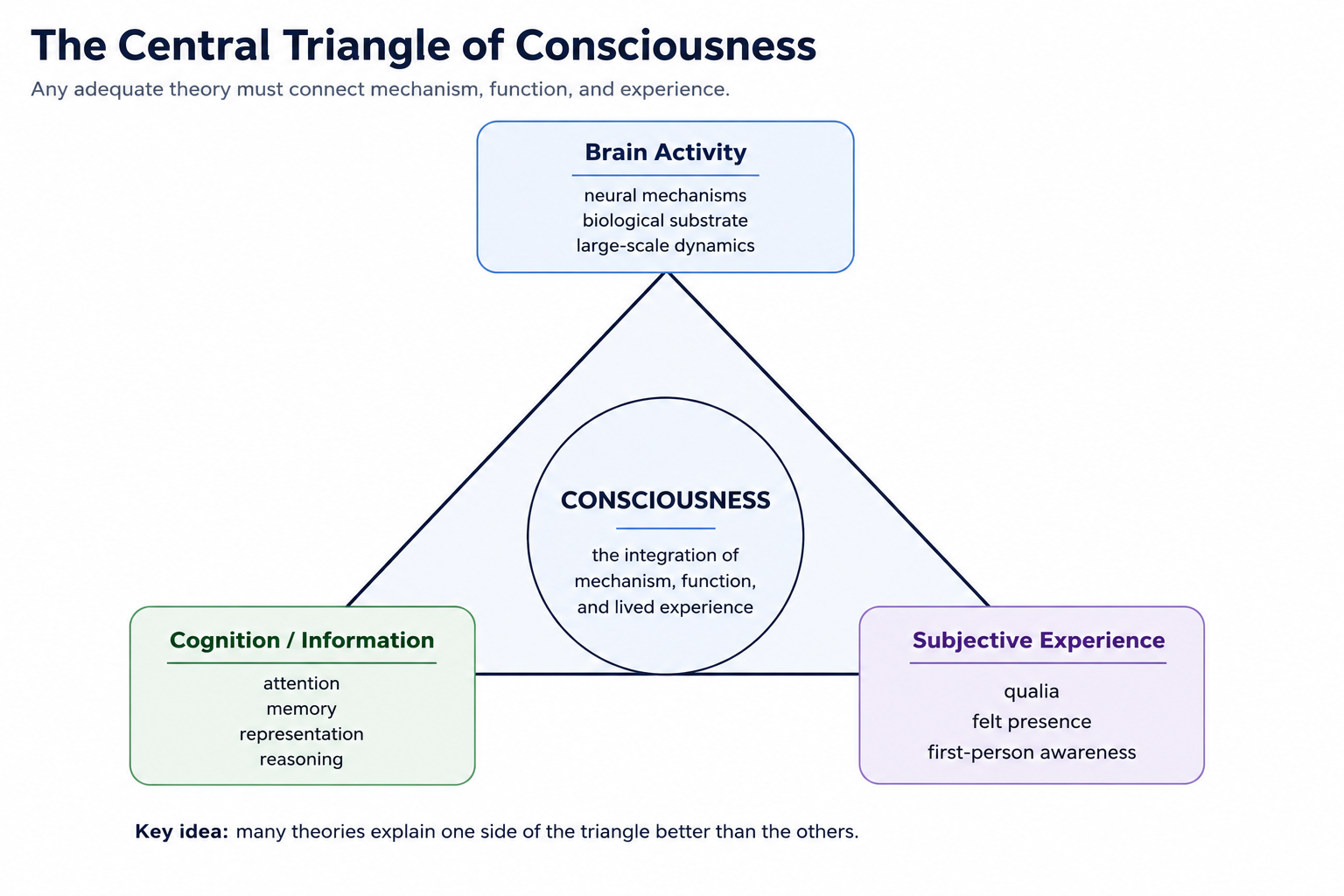
Figure 4.2: The central explanatory domains involved in consciousness research. Dualist approaches emphasize the difficulty of fully reducing subjective experience to neural or computational accounts alone.
As shown in Figure @ref(fig:fig-dualism-triangle), consciousness research involves at least three domains: neural mechanisms, cognitive or informational processing, and subjective experience. Dualism emphasizes the claim that subjective experience cannot be fully derived from the other two domains alone.
4.8 Dualism and Qualia
Dualism is strongly motivated by the problem of qualia, the qualitative features of conscious experience. Qualia include the redness of red, the painfulness of pain, the taste of bitterness, the sound of music, or the feeling of warmth.
The problem is that qualia do not seem easily captured by objective description. A scientist may describe the wavelength of red light, the structure of the retina, the activation of visual cortex, and the behavioural ability to identify colours. Yet the dualist argues that this still may not explain what red looks like from the first-person point of view.
This concern is closely related to Nagel’s argument that subjective experience has a perspectival character that cannot be fully captured by objective science [@nagel1974]. It is also central to Jackson’s Mary’s Room thought experiment, where complete physical knowledge seems insufficient to provide knowledge of what colour experience is like [@jackson1982].
Dualism therefore forces the question: are qualia reducible to physical and functional descriptions, or do they reveal an irreducible aspect of consciousness?
4.9 The Interaction Problem
The interaction problem is one of the most important objections to dualism. If consciousness is non-physical, how can it affect the physical brain? If conscious intention causes bodily movement, then mental events seem to influence physical events. But if the physical world is causally closed, then every physical event already has a sufficient physical cause [@papineau2002].
This creates a dilemma for dualism. If consciousness affects the physical world, dualism must explain how this interaction occurs. If consciousness does not affect the physical world, then dualism risks epiphenomenalism, where consciousness becomes causally irrelevant.
This problem is especially serious for substance dualism. Property dualism and naturalistic dualism sometimes attempt to avoid it by treating consciousness as dependent on physical systems while still irreducible. However, critics argue that the problem of mental causation remains unresolved [@kim2005].
4.10 Mental Causation and Agency
Dualism is also connected to questions of free will, agency, and intentional action. In ordinary life, people experience themselves as making choices, forming intentions, and acting for reasons. Dualism often preserves the intuition that conscious decisions genuinely influence behaviour.
However, many physicalist theories argue that behaviour can be explained through brain processes without appealing to non-physical mental causation. From this perspective, conscious intention may be part of the physical causal order rather than something outside it.
The challenge is to explain how subjective agency fits with neuroscience. If all behaviour is physically caused, what causal role does conscious intention play? If consciousness has no causal role, why does agency feel so central to human life?
Dualism keeps these questions visible, even when it does not fully solve them.
4.11 Empirical Relevance and Scientific Challenges
Dualism is primarily a philosophical position, but it has implications for empirical consciousness research. Studies of anesthesia, dreaming, blindsight, split-brain patients, disorders of consciousness, and altered states all raise questions about the relation between neural activity and conscious awareness [@laureys2005; @owen2006; @koch2016; @seth2018].
Dualists may interpret such cases as evidence that consciousness cannot be reduced simply to behaviour or report. For example, a patient may show limited behavioural responsiveness while still possibly retaining some form of awareness. A person with blindsight may respond to visual stimuli without ordinary conscious seeing. Split-brain cases raise questions about unity of consciousness and the relation between brain organization and subjective selfhood.
However, these cases do not automatically prove dualism. Physicalist, functionalist, and neuroscientific theories can also explain many of these phenomena. A major challenge for dualism is that it often lacks clear empirical tests that would distinguish it from non-dualist explanations.
This is one reason many scientists regard dualism as philosophically significant but scientifically difficult to operationalize.
4.12 Strengths of Dualism
Dualism has several important strengths. First, it directly confronts subjective experience rather than reducing consciousness immediately to behaviour, computation, or neural function. It insists that a theory of consciousness must explain experience itself.
Second, dualism highlights the difference between first-person and third-person explanation. This distinction remains important even for researchers who reject dualism, because consciousness studies must still relate subjective reports to objective measurements.
Third, dualism provides a powerful critique of overly reductionist theories. It asks whether explanations of attention, memory, reportability, or information processing are sufficient to explain phenomenal consciousness.
Finally, dualism preserves the philosophical importance of qualia, selfhood, agency, and the apparent reality of inner life. Even if dualism is ultimately rejected, the problems it raises continue to shape contemporary theories.
4.13 Weaknesses of Dualism
Dualism also faces major weaknesses. The most serious is the interaction problem. If consciousness is non-physical, it is difficult to explain how it affects the physical world. If it has no effect, then it becomes difficult to explain agency, decision-making, and the apparent causal role of experience.
Dualism also faces challenges of empirical testability. Many versions do not provide clear experimental predictions or measurable markers that would distinguish dualism from physicalist theories.
Another criticism is that dualism may explain mystery by adding more mystery. Instead of explaining how consciousness arises, it may simply declare consciousness irreducible. Critics argue that this can weaken dualism as a scientific theory.
Some philosophers also argue that dualism relies too heavily on intuition and thought experiments. Dennett, for example, argues that many traditional assumptions about qualia are misleading and that consciousness should be explained through cognitive functions and information-processing capacities [@dennett1991]. Illusionists go further by arguing that phenomenal consciousness, as traditionally conceived, may itself be a cognitive illusion [@frankish2016].
4.14 Dualism and Artificial Intelligence
Dualism has important implications for artificial intelligence. If consciousness depends only on functional organization or information processing, then artificial consciousness may be possible in principle. But if consciousness involves non-reducible mental properties or fundamental phenomenal features, then computational sophistication alone may not be sufficient.
This creates a major contrast between dualist and functionalist approaches. Functionalism suggests that a system with the right causal organization could be conscious, regardless of whether it is biological or artificial [@putnam1967; @fodor1975]. Dualist approaches are more cautious. They ask whether artificial systems could possess subjective experience rather than merely simulate intelligent behaviour.
Recent debates about AI consciousness often turn on this distinction. A system may produce language, solve problems, model itself, and report internal states, yet it remains unclear whether there is anything it is like to be that system [@dehaene2017; @butlin2023].
Dualism therefore challenges the assumption that intelligence and consciousness are the same. It reminds us that behavioural sophistication does not automatically settle questions about subjective experience.
4.15 Dualism and Other Theories
Dualism differs from physicalism, functionalism, and computationalism in its treatment of subjective experience. Physicalism argues that consciousness is ultimately physical. Functionalism argues that mental states are defined by their causal roles. Computationalism treats cognition, and sometimes consciousness, in terms of information processing.
Dualism accepts that these approaches may explain many aspects of mind. However, it denies that they necessarily explain phenomenal consciousness. From the dualist perspective, a theory that explains cognition has not automatically explained experience.
Dualism also differs from panpsychism, although both resist simple reductionism. Panpsychism argues that consciousness or proto-consciousness may be fundamental and widespread in nature [@goff2017]. Dualism, especially in its Cartesian form, more strongly separates mind and matter. Naturalistic dualism and panpsychism can sometimes overlap, but they are not identical.
This comparison shows why dualism remains useful even when one does not accept it fully. It clarifies what is at stake when theories claim to explain consciousness.
4.16 Evaluation
Dualism remains one of the most historically influential and philosophically significant approaches to consciousness. Its central contribution is that it keeps subjective experience at the center of the discussion. It challenges any theory that explains cognition, behaviour, or neural activity while leaving phenomenal consciousness unexplained.
At the same time, dualism faces serious difficulties. Substance dualism struggles with the interaction problem. Property dualism must explain how irreducible mental properties fit into the physical world. Epiphenomenalism risks making consciousness causally irrelevant. Naturalistic dualism requires new explanatory principles that remain difficult to specify and test.
For this reason, dualism is often more powerful as a critique than as a complete scientific theory. It identifies a problem that physicalist and functionalist theories must address, but it does not always provide a clear mechanism or empirical research program of its own.
Whether dualism is ultimately correct remains deeply contested. Nevertheless, nearly every major theory of consciousness must respond to the questions dualism raises: Can subjective experience be reduced to physical processes? Is consciousness a physical, functional, or fundamental feature of reality? Does explaining the brain explain the mind? And can a complete science of consciousness avoid the first-person character of experience?
4.17 Chapter Summary
Dualism is the view that consciousness cannot be fully reduced to physical processes alone. Its most famous historical form is Cartesian substance dualism, which treats mind and matter as distinct substances. Contemporary forms include property dualism, interactionism, epiphenomenalism, and naturalistic dualism.
Dualism is motivated by the hard problem of consciousness, the explanatory gap, and the difficulty of explaining qualia through objective physical description. It emphasizes phenomenal consciousness rather than access consciousness alone.
The strengths of dualism include its direct focus on subjective experience, its critique of reductionism, and its emphasis on the difference between first-person and third-person explanation. Its weaknesses include the interaction problem, limited empirical testability, difficulties concerning mental causation, and the risk of introducing additional metaphysical mystery.
Dualism remains important because it forces all theories of consciousness to confront the problem of subjective experience. Even theories that reject dualism must explain why consciousness seems difficult to reduce to brain mechanisms, computation, or behaviour alone.