Chapter 16 Panpsychism
16.1 Chapter Overview
Panpsychism is the view that consciousness, or at least extremely simple forms of proto-consciousness, is a fundamental feature of reality rather than something that appears suddenly from entirely non-conscious matter. According to this view, consciousness is not created from nothing when matter reaches a certain level of complexity. Instead, experiential properties may already exist in very primitive form within the basic structure of nature [@chalmers1996; @strawson2006; @goff2017].
Panpsychism differs from standard physicalist theories that treat consciousness as an emergent product of neural complexity. Physicalist theories often begin with non-conscious matter and then attempt to explain how consciousness arises from biological organization. Panpsychism changes the starting point. It proposes that experience, or proto-experience, is already part of reality at a fundamental level.
This makes panpsychism especially important in debates about the hard problem of consciousness. The hard problem asks why physical processes should give rise to subjective experience at all [@chalmers1995]. Panpsychists argue that if matter is assumed to be entirely non-experiential, then the emergence of experience becomes deeply mysterious. If experiential properties are already present in nature, the explanatory gap may be reduced.
Panpsychism has become increasingly influential in contemporary philosophy of mind because it directly addresses the question of how subjective experience relates to the physical world. It also connects with debates about Russellian monism, cosmopsychism, Integrated Information Theory, consciousness-first theories, and artificial intelligence [@russell1927; @goff2019; @tononi2004; @oizumi2014].
This chapter examines the historical development, conceptual foundations, metaphysical assumptions, strengths, criticisms, and unresolved challenges associated with panpsychism. Particular attention is given to the explanatory gap, the combination problem, Russellian monism, cosmopsychism, and the relationship between panpsychism and other theories of consciousness, including Taheri’s T-Consciousness as a related but distinct consciousness-first framework.
16.2 Learning Objectives
After reading this chapter, the reader should be able to:
- Define the core claims of panpsychism.
- Explain why panpsychism is motivated by the hard problem of consciousness.
- Distinguish panpsychism from physicalism, dualism, and idealism.
- Describe proto-consciousness and fundamental experience.
- Explain the combination problem.
- Distinguish constitutive panpsychism from cosmopsychism.
- Explain Russellian monism and its relation to panpsychism.
- Analyze the relationship between panpsychism and Integrated Information Theory.
- Explain how T-Consciousness differs from standard panpsychism.
- Evaluate the strengths and criticisms of panpsychism.
16.3 Core Idea in One Picture
Figure @ref(fig:fig-panpsychism) summarizes the major conceptual structure of panpsychism.
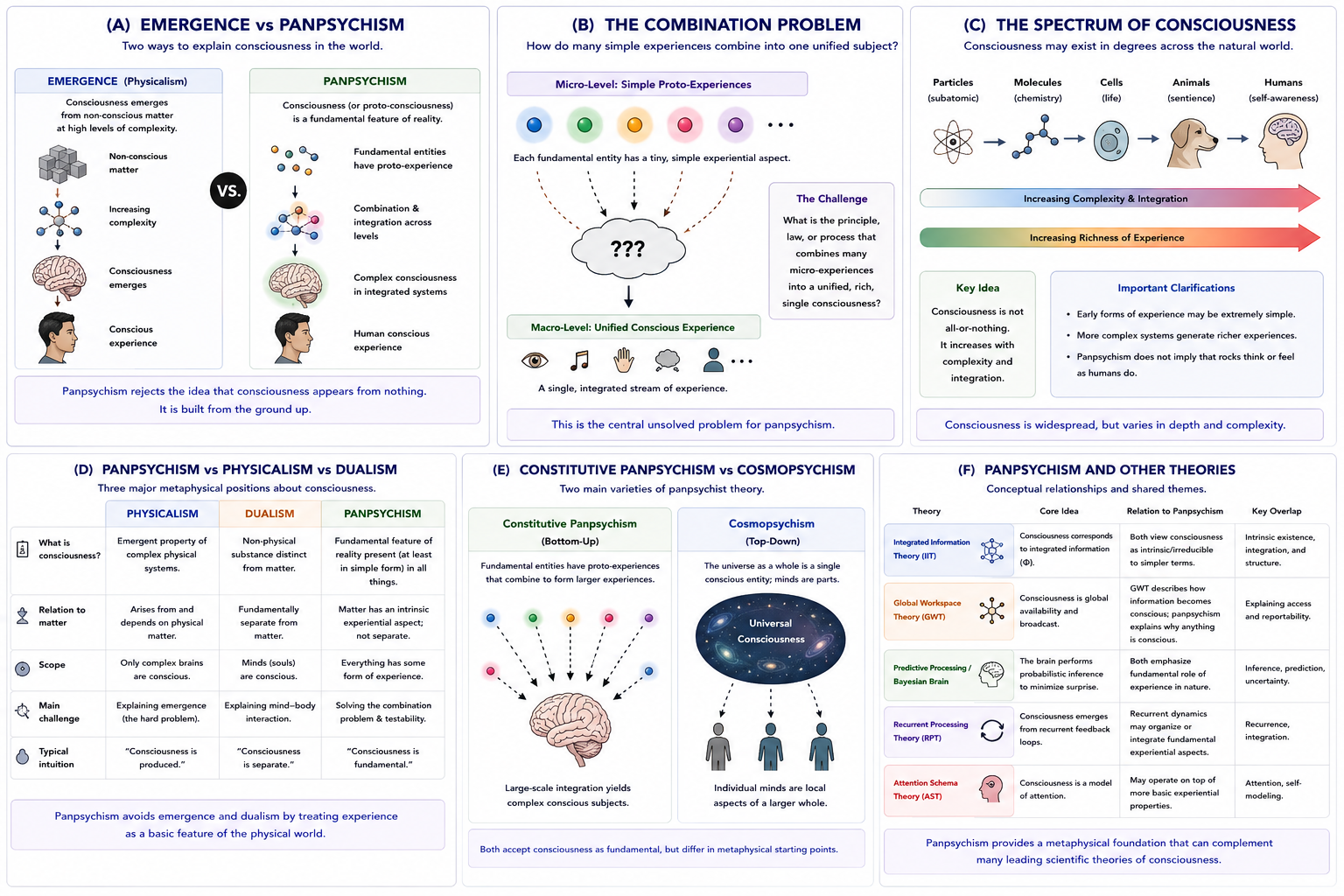
Figure 16.1: Panpsychism and fundamental consciousness. Panel A contrasts emergent physicalism with panpsychism. Panel B illustrates the combination problem. Panel C shows consciousness as a continuum across systems. Panel D compares panpsychism with physicalism and dualism. Panel E distinguishes constitutive panpsychism from cosmopsychism. Panel F shows conceptual relationships between panpsychism and other theories of consciousness.
As Figure @ref(fig:fig-panpsychism) illustrates, panpsychism attempts to avoid the problem of consciousness emerging from entirely non-conscious matter by treating experience as a fundamental aspect of reality itself. The theory does not claim that electrons, atoms, or cells think like humans. Rather, it proposes that very simple forms of experience or proto-experience may exist at basic levels of nature.
This idea makes panpsychism both attractive and controversial. It offers a direct response to the hard problem, but it also raises difficult questions about how simple experiential properties combine into unified conscious subjects.
16.4 The Problem of Emergence
Panpsychism is motivated by dissatisfaction with standard emergent explanations of consciousness. Many physicalist theories propose that consciousness arises when matter becomes organized into sufficiently complex nervous systems. This view can be summarized as:
matter → neural complexity → consciousnessThe difficulty is explaining why this transition should produce subjective experience. Physical processes can explain behaviour, information processing, attention, memory, and reportability. However, critics argue that these explanations may not fully explain why there is something it is like to be a conscious subject [@nagel1979; @chalmers1995].
Panpsychism responds by rejecting the assumption that matter is completely non-experiential at the most basic level. It proposes that consciousness does not emerge from nothing. Instead, complex consciousness develops from simpler experiential foundations already present in reality.
This does not remove all explanatory problems, but it changes their form. Instead of asking how consciousness appears from wholly non-conscious matter, panpsychism asks how simple forms of experience relate to complex unified consciousness.
16.5 Historical Development
Panpsychist ideas have deep historical roots. Related views appear in ancient, early modern, and modern philosophy. Spinoza argued that mind and matter could be understood as different aspects of one underlying reality [@spinoza1677]. Leibniz proposed that reality is composed of monads, each with a form of inner perspective or perception [@leibniz1714].
In the modern period, William James considered the possibility that experience might be more widespread in nature than standard materialism allows [@james1904]. Alfred North Whitehead developed a process philosophy in which experiential events are fundamental to reality [@whitehead1929]. Bertrand Russell argued that physics describes the structural and relational properties of matter, but may leave open the intrinsic nature of matter itself [@russell1927].
Contemporary panpsychism has been developed by philosophers such as Galen Strawson, David Chalmers, Philip Goff, Hedda Hassel Mørch, and others [@strawson2006; @chalmers1996; @goff2017; @morch2014]. These thinkers differ in their details, but they share the view that consciousness or proto-consciousness cannot be fully explained if matter is understood as entirely non-experiential.
Historically, panpsychism has often been presented as an alternative to both reductive materialism and substance dualism. It attempts to preserve continuity with the natural world while avoiding the idea that consciousness appears suddenly from something wholly non-conscious.
16.6 Core Assumptions of Panpsychism
Panpsychism usually involves several core assumptions.
First, consciousness or proto-consciousness is fundamental. It is not merely a late accidental product of biological evolution. It belongs, in some basic form, to the structure of reality.
Second, basic physical entities may have primitive experiential properties. This does not mean that atoms have thoughts, emotions, memories, or self-awareness. Panpsychists usually distinguish human consciousness from very simple proto-experiential properties.
Third, complex consciousness requires some form of organization, integration, or combination. Human consciousness is not simply the same as basic proto-experience. It is a highly structured, unified, and integrated form of experience.
Fourth, panpsychism attempts to avoid radical dualism. It does not usually posit a separate mental substance outside the physical world. Instead, it treats experiential properties as part of the intrinsic nature of reality.
These assumptions allow panpsychism to offer a distinctive solution to the hard problem. Consciousness is not added to matter from outside. It is already present, in very basic form, within the natural order.
16.7 Proto-Consciousness
Many versions of panpsychism introduce the idea of proto-consciousness. Proto-consciousness refers to primitive experiential properties, extremely simple phenomenal aspects, or foundational experiential potentials.
Proto-consciousness is not the same as human consciousness. It does not imply language, memory, self-reflection, reasoning, emotion, or personal identity. Instead, it refers to whatever basic experiential features might exist at the lowest levels of reality.
This distinction is important because panpsychism is often misunderstood. The theory does not normally claim that rocks, atoms, or electrons are conscious in the way humans are conscious. Rather, it proposes that the building blocks of reality may possess very simple experiential properties that, under appropriate forms of organization, contribute to more complex consciousness.
This allows panpsychism to treat consciousness as gradual rather than all-or-nothing. Consciousness may exist along a continuum, from extremely simple proto-experiential properties to complex forms of animal and human awareness.
16.8 Russellian Monism
One of the most important contemporary forms of panpsychism is Russellian monism. This approach builds on ideas associated with Bertrand Russell [@russell1927; @russell1927a].
Russellian monism begins with a claim about physics. Physics describes the structural, relational, and dispositional properties of matter. It tells us how physical entities behave, how they relate to one another, and how they can be mathematically described. However, it may not tell us the intrinsic nature of matter: what matter is in itself.
Panpsychists use this point to suggest that the intrinsic nature of matter may involve experiential or proto-experiential properties. On this view, consciousness is not outside the physical world. Rather, it reveals something about the inner nature of the physical world that physics alone does not describe.
Russellian monism is attractive because it attempts to preserve scientific realism while addressing the explanatory gap. It accepts the success of physics but argues that physics may leave room for consciousness at the intrinsic level of reality.
However, Russellian monism also faces challenges. It must explain how intrinsic experiential properties relate to observable physical structure and how simple proto-experiential properties become unified human consciousness.
16.9 The Combination Problem
The greatest challenge facing panpsychism is the combination problem. The problem can be stated simply:
How do many simple experiential units combine into one unified conscious subject?If basic entities possess proto-experiences, how do these become a single human experience? How do many tiny experiential properties combine into one visual field, one stream of thought, or one sense of self?
This problem is difficult because subjective experience appears unified. A person does not experience the brain as billions of separate micro-subjects. Consciousness appears as one field of awareness. Panpsychism must explain how this unity arises.
The combination problem has several forms. The subject-combination problem asks how many simple subjects combine into one larger subject. The quality-combination problem asks how simple qualities combine into complex experiences, such as colour, pain, or emotion. The structure-combination problem asks how micro-level experiential structure becomes macro-level conscious structure [@seager1995; @morch2014].
Critics argue that the combination problem is as difficult for panpsychism as the emergence problem is for physicalism. Panpsychism avoids consciousness emerging from nothing, but it must still explain how simple experience becomes unified consciousness.
16.10 Constitutive Panpsychism
Constitutive panpsychism is the view that macro-consciousness is constituted by micro-consciousness or micro-experience. According to this view, human consciousness arises because simpler experiential properties combine to form complex conscious subjects.
This approach can be summarized as:
micro-experiences → larger conscious systemsThe advantage of constitutive panpsychism is that it provides continuity between basic reality and complex consciousness. Consciousness is not created suddenly. It is built up from simpler forms.
The difficulty is the combination problem. It is not clear how many small experiential units could combine into one unified subject. Physical parts can combine into physical wholes, but it is much less clear how subjects or experiences combine into a single subject of experience.
Constitutive panpsychism therefore offers an elegant solution to emergence, but it faces a serious challenge concerning unity.
16.11 Cosmopsychism
Cosmopsychism is a related but distinct view. Instead of beginning with micro-conscious entities, cosmopsychism proposes that the universe as a whole may possess a fundamental consciousness, and that individual minds are derived from or grounded in this larger cosmic consciousness [@shani2015].
This reverses the direction of explanation:
universal consciousness → individual mindsCosmopsychism attempts to avoid the combination problem by starting with unity rather than trying to build unity from many separate experiential parts. If consciousness is already unified at the cosmic level, then the problem becomes explaining how individual minds are formed within or from that larger whole.
This creates a different challenge, sometimes called the decombination problem. If the universe has a unified consciousness, how do finite individual subjects arise from it? How does one cosmic subject become many localized subjects?
Cosmopsychism is important because it shows that consciousness-first theories can take different forms. Some begin with micro-experience. Others begin with universal consciousness. Both attempt to avoid the emergence of consciousness from wholly non-conscious matter.
16.12 Panpsychism, Physicalism, and Dualism
Panpsychism is often positioned between physicalism and dualism.
Physicalism proposes that consciousness arises from physical processes. In reductive versions, consciousness is identical to or fully explainable by physical and functional organization. In non-reductive versions, consciousness depends on physical systems but may not be reducible to lower-level descriptions.
Dualism proposes that mind and matter are fundamentally distinct. Substance dualism treats consciousness as belonging to a non-physical mental substance. Property dualism treats consciousness as a non-reducible property that depends on physical systems but is not identical to them.
Panpsychism differs from both. It agrees with physicalism that consciousness is part of the natural world. But it disagrees with reductive physicalism that consciousness can be derived from wholly non-conscious matter. It agrees with dualism that consciousness is not easily reduced to physical structure. But it rejects the idea that consciousness belongs to a separate non-physical substance.
Panpsychism therefore attempts to integrate consciousness into nature by treating experience as fundamental within reality itself.
16.13 Consciousness as a Continuum
Many panpsychist frameworks imply that consciousness exists along a continuum. Rather than appearing suddenly at a sharp threshold, experience may become richer and more complex as systems become more integrated, organized, or unified.
This view has implications for animal consciousness, infant consciousness, artificial intelligence, and non-human forms of mind. It suggests that consciousness may not be limited to adult human beings or language-using organisms.
However, panpsychism does not imply that all systems are conscious in the same way. A human, dog, insect, cell, and simple physical system would not have the same kind of experience. If panpsychism is true, then different systems may have radically different degrees and forms of experience.
This continuum view can be attractive because it avoids sharp and arbitrary boundaries. However, it also raises the problem of over-attribution. Critics worry that panpsychism may attribute experience too broadly unless it provides clear criteria for different degrees of consciousness.
16.14 Panpsychism and Integrated Information Theory
Some philosophers and scientists have observed conceptual similarities between panpsychism and Integrated Information Theory. IIT proposes that consciousness corresponds to integrated information generated by a system with intrinsic causal structure [@tononi2004; @oizumi2014].
Both panpsychism and IIT emphasize intrinsic existence, integration, and the possibility that consciousness may not be limited to human reportability. Both also imply that consciousness may exist in degrees.
However, important differences remain. IIT is a formal theory that attempts to measure consciousness through integrated information, or Φ. Panpsychism is a metaphysical theory about the fundamental nature of reality. IIT does not necessarily require panpsychism, although some interpretations of IIT appear panpsychist or panpsychist-like [@koch2016].
The connection between IIT and panpsychism remains controversial. IIT may provide tools for thinking about degrees of consciousness, but it does not by itself solve the combination problem or establish that experience is fundamental.
16.15 Panpsychism and T-Consciousness
Taheri’s T-Consciousness can be discussed in this chapter as a related consciousness-first framework, but it should not be treated as identical to standard panpsychism. Panpsychism usually proposes that experiential or proto-experiential properties exist at fundamental levels of nature. T-Consciousness, by contrast, presents consciousness as a non-material and foundational reality through which matter, life, and organization are understood or manifested [@taheri2020; @taheri2023].
The relationship between the two views is therefore one of family resemblance rather than identity. Both challenge the standard physicalist idea that consciousness is merely a late product of biological complexity. Both treat consciousness as more fundamental than many mainstream neuroscientific theories allow. Both also attempt to reverse the usual explanatory direction from matter-to-consciousness toward consciousness-as-foundational.
However, important differences remain. Panpsychism usually tries to remain close to naturalistic metaphysics by proposing that experience is built into the intrinsic nature of matter. T-Consciousness is more explicitly consciousness-first and non-material. It does not simply say that matter has experiential properties; it treats consciousness as a foundational field-like or organizing reality.
For this reason, T-Consciousness should be presented carefully as an alternative or emerging consciousness-first framework rather than as an established scientific theory or a standard form of panpsychism. Its relevance in this chapter is that it belongs to the broader family of theories that reject the idea that consciousness is merely produced by complex brains.
16.16 Panpsychism and Artificial Intelligence
Panpsychism has important implications for artificial consciousness. If consciousness is fundamental, then artificial systems might possess some degree of experience depending on their organization, integration, intrinsic properties, or relation to broader experiential reality.
However, panpsychism does not imply that all artificial systems are richly conscious. It does not imply that current AI systems possess human-like awareness. It also does not imply that computation alone is sufficient for consciousness.
The key question is what kind of organization, integration, or intrinsic structure allows simple experiential properties to form unified subjectivity. This question overlaps with debates about Integrated Information Theory, computationalism, functionalism, and machine consciousness [@butlin2023].
From a panpsychist perspective, artificial consciousness may be possible, but it depends on whether artificial systems can support unified experiential organization. From a T-Consciousness perspective, the question may be framed differently: whether artificial systems participate in, reflect, or become organized through a more fundamental consciousness field. Both approaches raise possibilities beyond standard computationalism, but neither provides a simple test for current AI consciousness.
16.17 Empirical Challenges
Panpsychism faces serious empirical challenges. Unlike Global Workspace Theory, Recurrent Processing Theory, or Predictive Processing, panpsychism does not provide a specific neural mechanism or experimental marker of consciousness. It does not tell researchers exactly which brain activity, network pattern, or behavioural measure indicates consciousness.
This makes panpsychism difficult to test directly. It functions more as a metaphysical framework than as a detailed empirical theory. It may shape how consciousness is interpreted, but it does not by itself provide laboratory predictions.
Supporters may respond that panpsychism addresses a different question. It is not primarily a theory of neural mechanisms. It is a theory of what consciousness is and how it fits into reality. Neuroscientific theories may still be needed to explain which systems generate complex consciousness.
This suggests that panpsychism may need to be combined with empirical theories such as IIT, Global Workspace Theory, Predictive Processing, or other models if it is to contribute to scientific consciousness research.
16.18 Strengths of Panpsychism
Panpsychism has several major strengths. First, it directly engages with the hard problem of consciousness. It does not avoid the question of subjective experience. Instead, it places experience at the center of metaphysical explanation.
Second, panpsychism avoids the problem of consciousness emerging from nothing. If experience is already part of reality, then complex consciousness does not have to appear suddenly from wholly non-conscious matter.
Third, panpsychism may preserve continuity within nature. It avoids a sharp divide between conscious humans and an entirely non-conscious universe.
Fourth, it offers an alternative to both reductive physicalism and substance dualism. It does not reduce consciousness to structure alone, but it also does not place consciousness outside nature.
Fifth, panpsychism connects with several contemporary debates, including Russellian monism, IIT, cosmopsychism, animal consciousness, and artificial consciousness.
16.19 Weaknesses and Criticisms
Panpsychism also faces serious criticisms. The most important is the combination problem. No widely accepted solution explains how simple experiential properties combine into unified conscious subjects.
A second criticism is lack of testability. Panpsychism often lacks clear empirical predictions, making it difficult to confirm or falsify scientifically.
A third criticism is explanatory vagueness. Critics argue that treating consciousness as fundamental may not explain consciousness. It may simply declare it basic.
A fourth criticism is over-attribution. If experience is everywhere, then the theory may attribute consciousness too broadly unless it distinguishes carefully between proto-experience and complex consciousness.
A fifth criticism is mechanistic weakness. Panpsychism does not explain attention, memory, reportability, selfhood, perception, or cognitive control in detail. It therefore needs to be supplemented by cognitive and neuroscientific theories.
Finally, cosmopsychism and consciousness-first theories face their own version of the combination problem. If consciousness begins as a universal whole, one must explain how individual finite minds arise from that whole.
16.20 Relation to the Hard Problem
Panpsychism is deeply connected to the hard problem. Instead of trying to derive consciousness from entirely non-conscious matter, it changes the explanatory framework. It proposes that consciousness or proto-consciousness is already part of the basic structure of reality.
Supporters argue that this reduces the explanatory gap. If experience is fundamental, then we do not need to explain how experience emerges from something wholly non-experiential.
Critics argue that the hard problem is not fully solved. Panpsychism still must explain why experiential properties exist, why they have the character they do, and how they combine into unified minds. The mystery is moved from emergence to fundamentality and combination.
This makes panpsychism both powerful and incomplete. It offers one of the most direct responses to the hard problem, but it does not eliminate all explanatory challenges.
16.21 Relation to Other Theories
Panpsychism differs from many other theories discussed in this book.
16.21.1 Relation to Physicalism
Physicalism explains consciousness as dependent on physical systems. Panpsychism agrees that consciousness belongs within nature, but it rejects the idea that consciousness arises from wholly non-conscious matter.
16.21.2 Relation to Dualism
Dualism separates mind and matter into different substances or properties. Panpsychism avoids this separation by treating experiential properties as part of the natural world itself.
16.21.3 Relation to Emergentism
Emergentism proposes that consciousness arises from organized complexity. Panpsychism argues that emergence from entirely non-conscious matter is difficult to explain. However, some forms of panpsychism still require emergence or combination at higher levels.
16.21.4 Relation to Integrated Information Theory
IIT and panpsychism both emphasize intrinsic existence and degrees of consciousness. IIT is more formal and mathematical, while panpsychism is more metaphysical [@tononi2004; @oizumi2014].
16.21.5 Relation to Computationalism
Computationalism explains mind in terms of information processing and functional organization. Panpsychism is not primarily computational. It asks what reality must be like for experience to exist at all.
16.21.6 Relation to Consciousness-First Theories
Panpsychism is one form of consciousness-first or consciousness-fundamental thinking, but it is not the only form. Cosmopsychism, idealism, and T-Consciousness also place consciousness in a more fundamental explanatory role, though they do so in different ways [@shani2015; @taheri2020; @taheri2023].
16.22 Open Questions
Several important questions remain unresolved. How do simple experiential properties combine into unified subjects? Can panpsychism be tested scientifically? What determines degrees of consciousness? Are all physical systems experiential, or only some? How does panpsychism explain selfhood, memory, attention, and reportability? Can artificial systems possess unified experience? How does cosmopsychism explain individual minds? How should T-Consciousness be compared with panpsychism without reducing one to the other?
These questions show why panpsychism remains both attractive and controversial. It confronts the hard problem directly, but it still requires further development.
16.23 Evaluation
Panpsychism is one of the most important contemporary alternatives to reductive physicalism and substance dualism. It argues that consciousness or proto-consciousness is a fundamental feature of reality rather than a late product of entirely non-conscious matter.
Its greatest strength is that it directly addresses the explanatory gap. It refuses to treat subjective experience as an accidental by-product of physical complexity. It also offers a unified metaphysical picture in which consciousness belongs within nature rather than outside it.
Its greatest weakness is the combination problem. Panpsychism must explain how simple experiential properties form unified conscious subjects. Without such an explanation, it risks replacing the emergence problem with a combination problem.
Panpsychism is therefore best understood as a serious metaphysical theory of phenomenal consciousness, not as a complete neuroscience of consciousness. It may need to be combined with empirical theories that explain organization, integration, cognition, and behaviour.
T-Consciousness can be included in this broader discussion as a related consciousness-first framework. However, it should be presented as distinct from standard panpsychism because it treats consciousness as a non-material foundational reality rather than simply as an intrinsic experiential property of matter.
16.24 Chapter Summary
Panpsychism proposes that consciousness or proto-consciousness is a fundamental feature of reality. It challenges the view that consciousness emerges suddenly from entirely non-conscious matter.
The theory is motivated by the hard problem of consciousness. If matter is assumed to be wholly non-experiential, it is difficult to explain why subjective experience appears at all. Panpsychism responds by proposing that experience exists in basic form throughout nature.
Major forms include constitutive panpsychism, which attempts to build complex consciousness from simpler experiential units, and cosmopsychism, which begins with universal consciousness and explains individual minds as derivative or localized aspects.
Panpsychism is closely related to Russellian monism, which argues that physics describes the structural properties of matter but may not reveal its intrinsic nature. Panpsychists propose that this intrinsic nature may involve experience or proto-experience.
The theory’s greatest challenge is the combination problem: how many simple experiential properties become one unified conscious subject. Other criticisms include lack of testability, over-attribution, explanatory vagueness, and limited mechanistic detail.
Panpsychism differs from T-Consciousness, although both belong to the broader family of consciousness-first approaches. Panpsychism usually treats experience as an intrinsic feature of matter, while T-Consciousness treats consciousness as a non-material foundational reality.
The central unresolved question is whether treating consciousness as fundamental genuinely explains subjective experience, or whether it relocates the mystery from emergence to fundamentality and combination.