Chapter 2 The Hard Problem of Consciousness
2.1 Chapter Overview
Among all problems in contemporary philosophy, neuroscience, and cognitive science, few have generated as much debate as the question of why conscious experience exists at all. Human beings can increasingly describe neural activity, information processing, behaviour, cognition, and computational mechanisms with remarkable scientific precision. Yet the existence of subjective experience — the felt quality of perception, emotion, thought, and awareness — continues to resist straightforward explanation.
A scientist may identify the neural pathways involved in colour vision, model perceptual processing computationally, and predict behavioural responses experimentally. Yet a further question appears to remain: why should any of these physical or computational processes be accompanied by experience in the first place? Why should seeing red feel like anything at all? Why should pain hurt rather than merely trigger avoidance behaviour? Why is there something it is like to be a conscious subject?
The hard problem of consciousness concerns these questions. It asks why and how physical processes are accompanied by subjective experience. The problem is most closely associated with David Chalmers, who distinguished the “easy problems” of consciousness from the “hard problem” of subjective experience [@chalmers1995; @chalmers1996]. However, related concerns appear throughout the history of philosophy, especially in debates about mind, matter, subjectivity, and the limits of scientific explanation.
This chapter explains the hard problem, its relation to the explanatory gap, the role of qualia and thought experiments, major responses to the problem, and criticisms of the hard problem itself.
2.2 Learning Objectives
After reading this chapter, the reader should be able to:
- Distinguish the hard problem from the easy problems of consciousness.
- Explain the explanatory gap.
- Describe the role of qualia in debates about consciousness.
- Summarize major thought experiments related to the hard problem.
- Compare philosophical and scientific responses to the hard problem.
- Explain major criticisms of the hard problem.
- Understand why the debate persists across philosophy, neuroscience, and cognitive science.
2.3 The Basic Distinction
The hard problem is best understood by first distinguishing between two kinds of explanation. Many scientific explanations of consciousness focus on cognitive and functional processes. These include attention, memory, reportability, behavioural control, perceptual discrimination, and information integration. These are difficult scientific problems, but they appear to fit familiar forms of explanation: one can investigate mechanisms, build models, test predictions, and identify causal processes.
Chalmers called these the “easy problems” of consciousness, not because they are simple, but because they seem explainable using standard scientific methods [@chalmers1995]. The hard problem is different. It concerns why these mechanisms are accompanied by subjective experience at all.
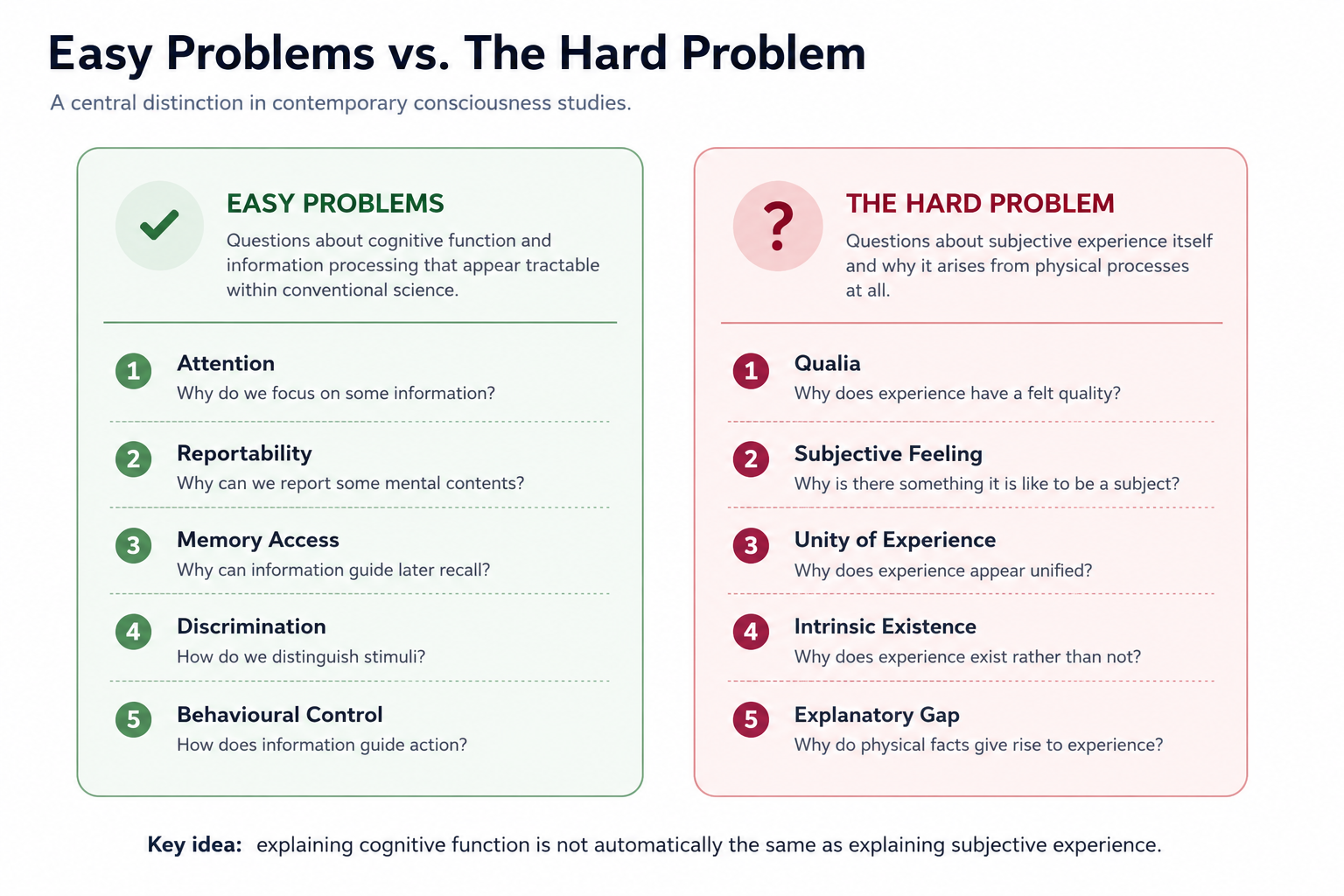
Figure 2.1: The distinction between the easy problems and the hard problem of consciousness. Many contemporary theories explain cognitive and functional aspects of consciousness while differing on whether they explain subjective experience itself.
Figure @ref(fig:fig-easy-hard-hardchapter) illustrates this basic distinction. A theory may explain attention, information access, behavioural report, or memory integration while leaving open the question of why those processes are experienced from the inside.
This is why the hard problem occupies a central place in consciousness studies. It marks the point where explanations of function appear to leave something out: the qualitative, first-person character of experience.
2.4 The Central Conceptual Tension
The hard problem arises from a tension among three explanatory domains: brain activity, cognitive or informational processing, and subjective experience. Neuroscience can investigate brain activity. Cognitive science can model information processing and behaviour. Phenomenology and philosophy can describe the structure of experience. The challenge is explaining how these domains relate to one another.
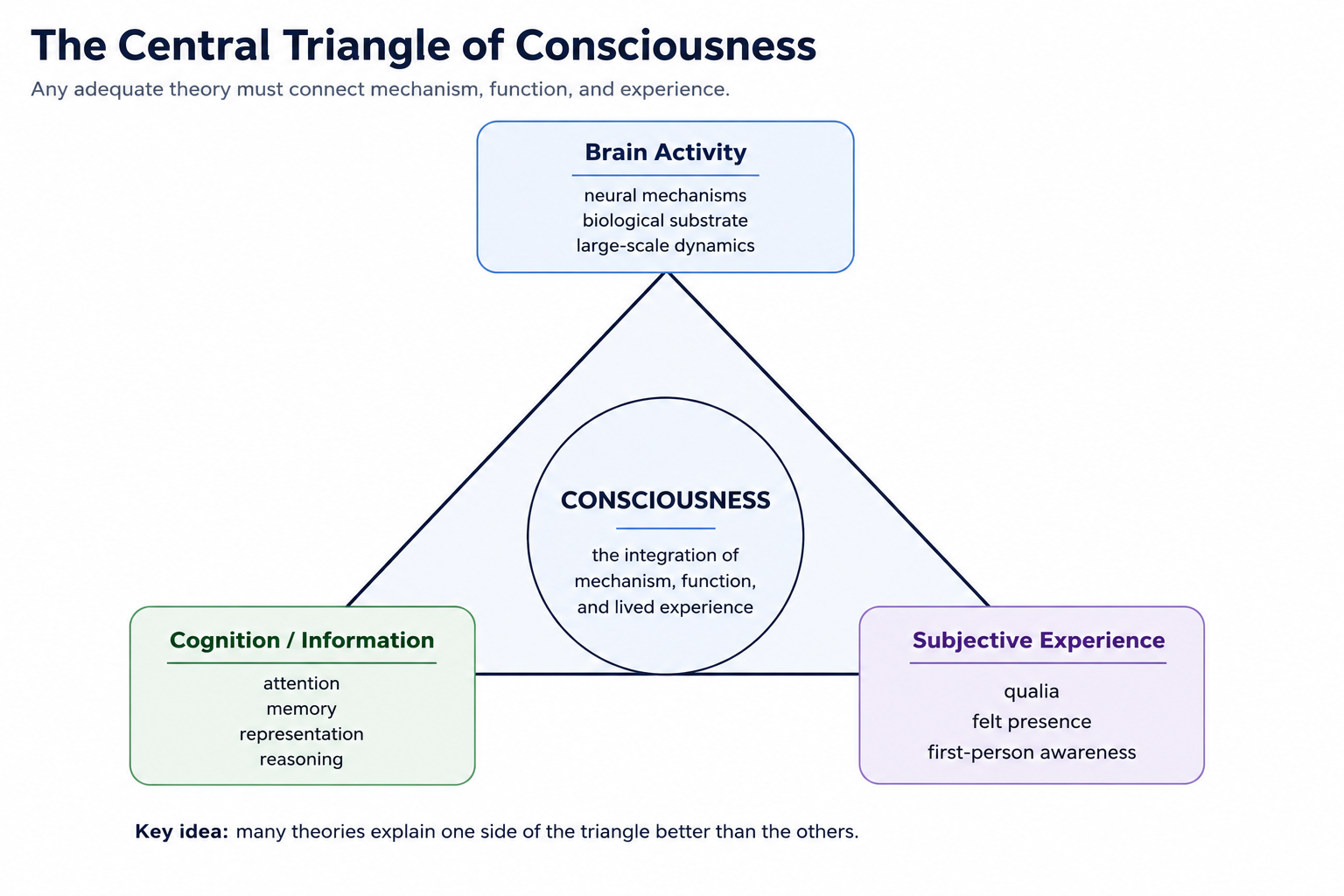
Figure 2.2: The central conceptual triangle underlying consciousness studies. Many theories explain neural activity or cognitive function successfully while remaining divided on how subjective experience emerges from these processes.
Figure @ref(fig:fig-central-triangle) summarizes this conceptual structure. Many theories explain the relation between brain activity and cognitive function. Others describe subjective experience in detail. The most difficult question is how subjective experience fits into the same explanatory framework as neural and cognitive processes.
This does not mean that neuroscience or cognitive science is irrelevant. On the contrary, empirical research has greatly improved our understanding of the conditions under which consciousness appears, disappears, and changes. The hard problem concerns whether these empirical explanations are sufficient to explain experience itself.
2.5 Historical Background
Questions about the relation between mind and matter long predate contemporary neuroscience. René Descartes argued that conscious thought could not be reduced to extended physical matter, thereby giving one influential formulation of mind-body dualism [@descartes1641]. Later philosophers challenged, revised, or rejected dualism, but the basic question remained: how should subjective experience be understood in relation to the physical world?
In the twentieth century, consciousness became less central within psychology during the rise of behaviourism. Behaviourists emphasized observable behaviour and often avoided appeals to subjective experience. The later cognitive revolution reintroduced internal mental processes, including representation, memory, attention, and information processing, into scientific psychology [@miller2003]. However, the reintroduction of cognition did not fully resolve the problem of subjective experience.
Modern debates about the hard problem were shaped especially by Thomas Nagel, Frank Jackson, Joseph Levine, and David Chalmers. Nagel argued that conscious experience has an irreducibly subjective character: there is something it is like to be a conscious organism, and this first-person character cannot be fully captured from an objective third-person perspective [@nagel1974]. Jackson’s Mary’s Room thought experiment questioned whether complete physical knowledge is sufficient for knowing what an experience is like [@jackson1982]. Levine introduced the language of the explanatory gap to describe the apparent gap between physical explanation and subjective experience [@levine1983]. Chalmers then formalized these concerns through the distinction between easy problems and the hard problem [@chalmers1995; @chalmers1996].
2.6 The Easy Problems
The easy problems concern the explanation of cognitive functions and behavioural capacities associated with consciousness. These include discrimination of stimuli, integration of information, verbal report, attention, memory access, behavioural control, metacognition, and the coordination of perception and action.
These problems are scientifically difficult. Explaining attention, memory, perception, or self-monitoring requires complex neuroscience, psychology, and computational modeling. They are called “easy” only in a relative philosophical sense: they appear compatible with ordinary forms of mechanistic explanation.
For example, a theory might explain how visual information is processed in the brain, how attention selects certain stimuli, how information becomes available for report, and how behaviour is guided by internal representations. Such explanations may be highly successful. Yet Chalmers argues that they do not automatically explain why any of these processes should be accompanied by subjective experience [@chalmers1995].
2.7 The Hard Problem
The hard problem asks why physical or functional processes are accompanied by experience. A complete neuroscientific account of colour vision might describe wavelengths, retinal processing, visual cortex activation, attention, categorization, memory, and verbal report. Yet the question remains: why should any of this feel like seeing red?
Similarly, a complete account of pain processing might describe nociceptors, spinal pathways, thalamic processing, cortical activation, avoidance behaviour, and verbal reports of pain. But why should pain hurt? Why should there be an unpleasant felt quality rather than merely information processing and behavioural output?
The hard problem therefore concerns not only what the brain does, but why brain activity is accompanied by subjective awareness. It is closely connected to the idea that neural correlates of consciousness, while important, are not automatically complete explanations of consciousness. A neural correlate may tell us when a conscious experience occurs or which brain systems are involved, but correlation alone does not explain why the experience exists.
2.8 Why the Hard Problem Feels Different
Many scientific explanations describe structure, mechanism, causation, and function. Physics explains motion and forces. Chemistry explains reactions and bonding. Biology explains cells, organs, metabolism, and evolution. These explanations proceed by describing objective relations among measurable entities and processes.
Consciousness appears different because it involves subjective feeling itself. A neuroscientific explanation may describe neural firing, information processing, behavioural responses, and cognitive integration. Yet it may still seem to leave out the qualitative character of experience: what the experience is like from the inside.
This is the source of the hard problem’s philosophical force. It is not merely that consciousness is complicated. Many scientific problems are complicated. The hard problem appears distinctive because it concerns the relation between objective explanation and subjective experience.
2.9 The Explanatory Gap
The apparent difficulty of deriving subjective experience from objective physical description is known as the explanatory gap [@levine1983]. The gap arises because scientific descriptions are usually third-personal, public, measurable, structural, and quantitative. Conscious experience, by contrast, appears first-personal, qualitative, private, and lived.
A complete neural description may identify when consciousness occurs, how conscious states change, and which mechanisms participate. However, it may not fully explain why experience exists at all. This is why the explanatory gap remains central to debates about consciousness.
Some philosophers argue that the explanatory gap reveals a deep limitation in physicalist explanation. Others argue that it reflects our current ignorance rather than an in-principle barrier. Still others claim that the gap is produced by misleading intuitions about introspection and the nature of experience [@dennett1991; @frankish2016].
2.10 Phenomenal and Access Consciousness
One important distinction in this debate is between phenomenal consciousness and access consciousness [@block1995].
Phenomenal consciousness refers to subjective experience itself: the qualitative feeling of seeing, hearing, touching, thinking, or suffering. It concerns what experience is like from the first-person perspective.
Access consciousness refers to the availability of information for reasoning, report, memory, decision-making, and behavioural control. A mental state is access-conscious when its content can be used by cognitive systems.
This distinction matters because many theories explain access consciousness more directly than phenomenal consciousness. For example, a theory may explain how information becomes available for report and action without fully explaining why that information is experienced. The distinction between phenomenal and access consciousness therefore helps clarify why theories that seem successful in one respect may still be criticized from another perspective.
2.11 Qualia and Subjective Experience
A central concept associated with the hard problem is qualia. Qualia are the qualitative or experiential features of conscious states: the redness of red, the bitterness of coffee, the warmth of sunlight, the sound of music, or the painfulness of pain.
The concept of qualia is controversial. Some philosophers treat qualia as central data that any theory of consciousness must explain. Others argue that the traditional notion of qualia is confused, exaggerated, or misleading [@dennett1991]. Illusionists, for example, argue that people mistakenly interpret introspective representations as evidence for irreducible inner properties [@frankish2016].
Despite these disagreements, qualia remain important because they focus attention on what seems most difficult to explain: the felt character of experience. A purely physical description of colour vision may include wavelengths, cones, opponent processing, cortical activation, and behavioural discrimination. Yet many philosophers argue that such a description does not by itself capture what red looks like to a subject.
2.12 Thought Experiments and the Hard Problem
Several influential thought experiments have shaped debates about the hard problem. These thought experiments do not function as empirical experiments. Rather, they are designed to test intuitions about the relation between physical facts, functional organization, and subjective experience.
2.12.1 Philosophical Zombies
A philosophical zombie is a hypothetical being physically and behaviourally identical to a conscious human but entirely lacking subjective experience. Such a being would speak, react, learn, and behave just like a conscious person, but there would be nothing it is like to be that being.
The zombie argument is associated especially with Chalmers [@chalmers1996]. Its purpose is to challenge the assumption that physical or functional equivalence automatically entails consciousness. If zombies are conceivable, Chalmers argues, then consciousness may not be logically entailed by the physical facts alone.
Critics reject this argument in different ways. Some argue that zombies are not genuinely conceivable. Others argue that conceivability does not establish metaphysical possibility. Functionalists and physicalists often claim that a being physically and functionally identical to a conscious person would necessarily be conscious [@dennett1991].
2.12.2 Mary’s Room
Frank Jackson’s Mary’s Room thought experiment imagines a scientist named Mary who knows all the physical facts about colour vision but has lived her entire life in a black-and-white environment. When Mary finally sees red for the first time, does she learn something new?
If Mary learns something new, the argument suggests that complete physical knowledge may not be sufficient for knowing subjective experience [@jackson1982]. This is known as the knowledge argument.
Physicalists have responded in several ways. Some argue that Mary gains a new ability rather than new factual knowledge. Others argue that she gains a new mode of presentation of an already known fact. Still others argue that the thought experiment exaggerates what it would mean to know all physical facts.
2.12.3 Nagel’s Bat
Thomas Nagel’s famous example asks what it is like to be a bat [@nagel1974]. Bats perceive the world partly through echolocation, a sensory modality very different from ordinary human perception. Nagel argues that even complete objective knowledge of bat neurobiology and behaviour may not reveal the subjective character of bat experience.
The point is not merely that humans cannot imagine bat experience accurately. The deeper point is that subjective experience seems tied to a particular point of view. Objective science aims to describe the world independently of particular perspectives, while consciousness appears essentially perspectival.
2.12.4 Inverted Spectrum
The inverted spectrum thought experiment asks whether two people could be physically or functionally similar while having systematically different colour experiences. For example, one person’s experience of red might be internally like another person’s experience of green, even though both use colour words and behave normally.
The thought experiment is controversial, but it highlights a central issue: behavioural and functional similarity may not obviously settle questions about phenomenal character. It is often used to challenge theories that identify consciousness entirely with function or reportability.
2.13 Why the Hard Problem Matters
The hard problem matters because a theory of consciousness can appear successful while explaining only the functions associated with consciousness. A theory may explain attention, reportability, memory access, behavioural control, or information integration without explaining why these processes are accompanied by experience.
This distinction has practical importance. In disorders of consciousness, clinicians may observe wakefulness, responsiveness, or neural activity while still facing difficult questions about awareness and experience [@laureys2005; @owen2006]. In anesthesia, researchers may identify changes in brain dynamics while still asking how these changes relate to the presence or absence of experience [@koch2016; @seth2018]. In artificial intelligence, a system may process information, generate language, recognize patterns, and report internal states while leaving unresolved whether it possesses subjective experience [@dehaene2017; @butlin2023].
The hard problem therefore influences debates about machine consciousness, animal consciousness, disorders of consciousness, anesthesia, pain, suffering, and moral status.
2.14 Criticisms of the Hard Problem
Not all philosophers and scientists accept the hard problem as a genuine explanatory problem. Some argue that it identifies a real limitation in current science. Others argue that it is based on misleading intuitions.
Daniel Dennett is one of the most influential critics of traditional approaches to qualia and the hard problem. Dennett argues that consciousness should be explained through cognitive function, information processing, and behavioural capacities rather than by appealing to mysterious private properties [@dennett1991]. From this perspective, the sense that something remains unexplained may result from confused expectations about what an explanation of consciousness should provide.
Illusionism offers a more radical critique. Illusionists argue that phenomenal consciousness, as traditionally conceived, does not exist in the way many philosophers assume [@frankish2016]. According to this view, the brain constructs introspective representations that lead us to believe we possess irreducible phenomenal properties. The task is therefore not to explain mysterious qualia, but to explain why we think we have them.
Other critics argue that the hard problem relies too heavily on intuition and thought experiments. They suggest that introspection may be unreliable, that philosophical conceivability may not reveal metaphysical possibility, and that scientific progress may gradually dissolve the apparent mystery.
2.15 Responses to the Hard Problem
Responses to the hard problem differ because theorists disagree about what consciousness is and what an explanation of consciousness should accomplish.
2.15.1 Reductionism
Reductionist approaches argue that consciousness will eventually be explained in terms of neuroscience, computation, cognitive science, and physical mechanisms. From this perspective, the hard problem reflects incomplete scientific understanding rather than a permanent barrier. As neuroscience progresses, the gap between physical processes and conscious experience may become less mysterious.
2.15.2 Functionalism
Functionalist approaches argue that mental states are defined by what they do rather than by what they are made of. On this view, consciousness depends on functional organization, causal role, and information-processing structure rather than on a special non-physical substance [@putnam1967; @fodor1975].
Functionalism is attractive because it allows consciousness to be studied scientifically and potentially applied beyond biological brains. However, critics argue that functionalism may explain access, behaviour, and cognition more easily than phenomenal experience.
2.15.3 Dualism
Dualist approaches argue that consciousness cannot be fully reduced to physical processes. Substance dualism treats mind and matter as distinct kinds of reality, while property dualism argues that conscious properties are irreducible features associated with physical systems [@descartes1641; @chalmers1996].
Dualism takes the hard problem seriously, but it faces major challenges. In particular, it must explain how consciousness relates causally to the physical world and how non-physical or irreducible experiential properties fit within scientific explanation.
2.15.4 Panpsychism
Panpsychism proposes that consciousness, or proto-consciousness, may be a fundamental feature of reality rather than something that emerges suddenly from non-conscious matter [@goff2017]. This view attempts to avoid the problem of explaining how experience arises from entirely non-experiential ingredients.
Panpsychism has gained renewed attention in contemporary philosophy, partly because it offers a direct response to the hard problem. However, it faces its own major challenge: the combination problem. If basic entities have primitive forms of experience, how do these combine into unified conscious subjects?
2.15.5 Illusionism
Illusionism attempts to dissolve rather than solve the hard problem. It argues that phenomenal consciousness, understood as irreducible private qualia, is an illusion generated by cognitive processes [@frankish2016]. The scientific task is to explain why we represent ourselves as having such experiences.
Illusionism has the advantage of fitting naturally with physicalism and cognitive science. However, many critics argue that it fails to take subjective experience seriously enough. If consciousness is an illusion, they ask, who or what is having the illusion?
2.15.6 Integrated Information Theory
Integrated Information Theory, or IIT, attempts to explain consciousness in terms of integrated informational structure and intrinsic causal organization [@tononi2004; @oizumi2014]. Unlike theories that focus mainly on access or reportability, IIT attempts to connect the structure of experience directly to the structure of integrated information.
IIT is ambitious because it aims to address consciousness as experience rather than merely as function. However, it remains controversial, especially regarding its mathematical commitments, empirical testability, and implications for consciousness in simple systems.
2.15.7 Global Workspace Theory
Global Workspace Theory explains consciousness in terms of global availability or broadcasting of information across cognitive systems [@baars1988; @dehaene2011]. Information becomes conscious when it is made widely available for reasoning, memory, decision-making, and report.
Global Workspace Theory is strongly connected to cognitive science and neuroscience. It offers a powerful account of conscious access. However, critics argue that it may not fully explain phenomenal consciousness. It may show how information becomes reportable and usable without explaining why it is experienced.
2.16 Why the Debate Persists
The hard problem persists because it concerns the relationship between two different modes of description. Objective science describes structure, mechanism, causation, and function. Conscious experience appears as lived, qualitative, first-person awareness.
The debate also persists because consciousness may not be a single unified phenomenon. Different theories attempt to explain access, integration, reportability, self-modeling, embodiment, cognition, or phenomenal experience. Disagreements sometimes arise because theories are not explaining exactly the same target.
For this reason, some theories try to solve the hard problem directly. Others attempt to dissolve it, reinterpret it, or bypass it by focusing on more empirically tractable aspects of consciousness. Whether the hard problem is a genuine limitation of physical explanation, a temporary scientific gap, or a conceptual misunderstanding remains deeply contested.
2.17 Evaluation
The hard problem remains one of the central dividing lines in consciousness research. It forces every major theory to clarify what it means by consciousness and what kind of explanation it seeks to provide.
A theory that explains attention, reportability, and information access may be powerful, but it must still clarify whether it explains subjective experience. A theory that takes subjective experience as fundamental may address the hard problem directly, but it must still explain how its claims can be connected to empirical science. A theory that rejects the hard problem must explain why the intuition behind it is so persistent.
The hard problem therefore functions not only as a scientific or philosophical challenge, but also as a boundary question about the nature of explanation itself. It asks whether consciousness can be fully understood using the same explanatory tools used elsewhere in science, or whether subjective experience requires a revision in how explanation, reduction, and mind are understood.
2.18 Chapter Summary
The hard problem of consciousness asks why physical, neural, or computational processes are accompanied by subjective experience. It differs from the easy problems, which concern cognitive functions such as attention, reportability, memory access, and behavioural control. The explanatory gap describes the apparent difficulty of deriving first-person experience from third-person physical description.
Thought experiments such as Nagel’s bat, Mary’s Room, philosophical zombies, and the inverted spectrum illustrate why some philosophers believe that functional or physical explanation may leave something out. Critics respond that these arguments rely too heavily on intuition, introspection, or misleading assumptions about qualia.
Major responses to the hard problem include reductionism, functionalism, dualism, panpsychism, illusionism, Integrated Information Theory, and Global Workspace Theory. These approaches differ not only in their proposed explanations, but also in what they take consciousness to be.
The hard problem remains unresolved because it sits at the intersection of science, philosophy, phenomenology, and metaphysics. Whether it represents a genuine barrier, a temporary gap, or a conceptual confusion continues to shape the entire field of consciousness studies.