Chapter 25 Future Directions in Consciousness Research
25.1 Chapter Overview
Consciousness research is entering a period of rapid transformation. Advances in neuroscience, artificial intelligence, computational modeling, neurotechnology, psychiatry, phenomenology, clinical medicine, and philosophy of mind are reshaping how consciousness is studied and understood.
At the same time, many foundational questions remain unresolved. Researchers still disagree about the nature of subjective experience, the hard problem, the criteria for consciousness in non-human systems, the relationship between brain activity and phenomenology, and whether artificial systems could ever possess genuine awareness [@chalmers1995; @chalmers1996; @butlin2023].
Future progress will likely require increasingly interdisciplinary approaches. No single discipline is likely to solve consciousness alone. Neuroscience provides mechanisms. Philosophy clarifies concepts. Phenomenology describes lived experience. Artificial intelligence tests computational assumptions. Clinical medicine studies disrupted and impaired consciousness. Embodied cognition connects consciousness with bodily life and environmental interaction. Consciousness-first frameworks, including panpsychism and Taheri’s T-Consciousness, challenge researchers to reconsider whether consciousness is derivative or foundational [@goff2017; @goff2019; @taheri2020; @taheri2023].
This chapter explores major future directions, emerging challenges, technological developments, ethical questions, and conceptual frontiers that may shape the next generation of consciousness research.
25.2 Guiding Questions
This chapter is organized around several guiding questions:
- What are the most important future directions in consciousness science?
- Why is interdisciplinary integration increasingly necessary?
- How might consciousness be measured without relying only on verbal report?
- What role will artificial intelligence play in testing theories of consciousness?
- How can future research compare competing theories more directly?
- What ethical challenges arise from AI, neurotechnology, animal consciousness, and disorders of consciousness?
- How can phenomenology and first-person methods be integrated with neuroscience?
- Where do consciousness-first frameworks such as T-Consciousness fit in future research?
25.3 Core Idea in One Picture
Figure @ref(fig:fig-future-directions) summarizes major future directions in consciousness research.
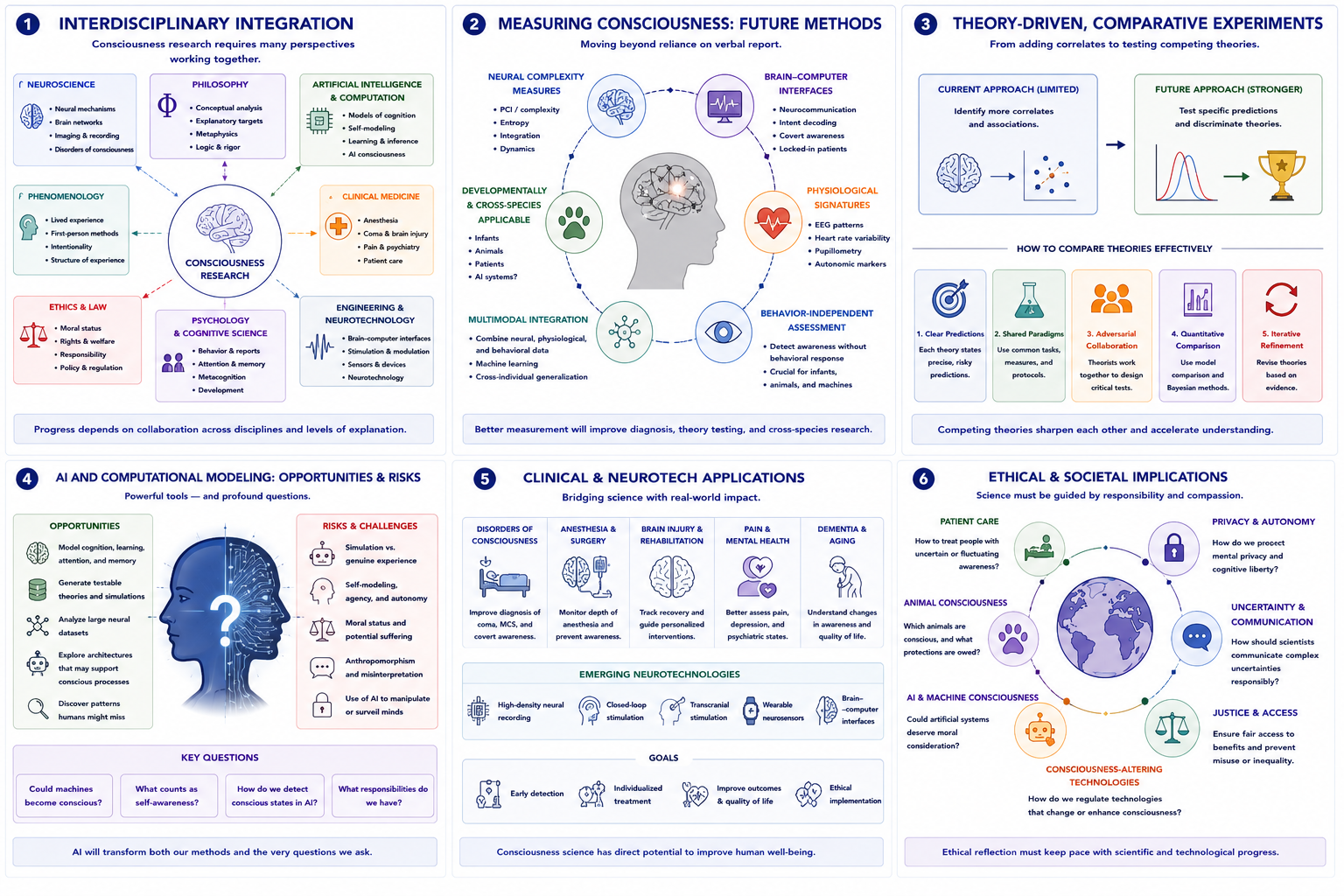
Figure 25.1: Future directions in consciousness research. Panel 1 illustrates interdisciplinary integration across neuroscience, AI, phenomenology, philosophy, and medicine. Panel 2 summarizes future methods for measuring consciousness beyond verbal report. Panel 3 compares theory-driven experimental approaches. Panel 4 illustrates future AI and computational modeling challenges. Panel 5 highlights clinical and neurotechnological applications. Panel 6 summarizes ethical and societal implications.
As Figure @ref(fig:fig-future-directions) illustrates, future consciousness research will likely depend on integration across multiple explanatory levels, methods, and disciplines. The field is moving beyond the search for single neural correlates toward broader questions involving computation, embodiment, phenomenology, clinical assessment, artificial intelligence, ethics, and metaphysics.
25.4 Why Consciousness Research Is Changing
Several developments are reshaping consciousness studies.
First, neuroscience now provides much more powerful tools for measuring brain activity. Neuroimaging, EEG, intracranial recording, stimulation methods, and computational analysis allow researchers to study consciousness across waking states, anesthesia, sleep, disorders of consciousness, and altered states [@dehaene2014; @koch2016; @laureys2005].
Second, artificial intelligence has changed the conceptual landscape. Modern AI systems can generate language, solve problems, imitate self-report, and display forms of adaptive behaviour. These abilities force researchers to distinguish intelligence from consciousness more carefully [@dehaene2017; @butlin2023].
Third, altered-state research is expanding. Studies of psychedelics, meditation, dreaming, anesthesia, and dissociation provide new ways to examine selfhood, perception, salience, and conscious content [@carhartHarris2019; @lutz2008].
Fourth, clinical research has shown that consciousness may persist even when behavioural responsiveness is absent. Cases of covert consciousness in non-responsive patients challenge simple behaviour-based definitions of awareness [@owen2006; @monti2010].
Fifth, philosophical debate remains active. The hard problem, explanatory gap, qualia, panpsychism, illusionism, and consciousness-first theories continue to challenge purely mechanistic accounts [@nagel1974; @levine1983; @frankish2016; @goff2019].
Together, these developments show that consciousness research is becoming broader, more empirical, more computational, more clinically relevant, and more philosophically demanding.
25.5 Interdisciplinary Integration
Future consciousness research will likely require deeper collaboration among neuroscientists, psychologists, AI researchers, clinicians, philosophers, computational modelers, phenomenologists, ethicists, and contemplative scholars.
Each discipline contributes something different. Neuroscience studies brain mechanisms, connectivity, anesthesia, disorders of consciousness, and large-scale integration. Psychology studies perception, attention, memory, metacognition, emotion, and report. Artificial intelligence explores computation, self-modeling, prediction, learning, and machine cognition. Phenomenology investigates lived experience, embodiment, intentionality, selfhood, and temporal structure. Clinical medicine applies consciousness research to coma, anesthesia, pain, dementia, psychiatric disorders, and end-of-life care. Philosophy clarifies explanatory targets, conceptual assumptions, metaphysical commitments, and the hard problem.
The future of the field will likely depend on connecting these perspectives rather than allowing them to develop separately. A neuroscientific theory that ignores phenomenology may miss the structure of experience. A philosophical theory that ignores neuroscience may become disconnected from evidence. A computational theory that ignores embodiment may explain intelligence without explaining lived awareness. A consciousness-first theory that ignores empirical methods may remain difficult to evaluate scientifically.
The central future task is integration across levels.
25.6 Improved Measures of Consciousness
One of the largest future priorities is developing measures of consciousness that do not rely entirely on verbal report. This is especially important for infants, non-human animals, anesthetized individuals, locked-in patients, patients with severe brain injury, and possibly artificial systems.
Current consciousness assessment often depends on behaviour or communication. However, behaviour can be misleading. A person may be conscious but unable to respond. An artificial system may produce language without being conscious. An animal may have experience without human-like report.
Future methods will likely combine several kinds of evidence.
Neural complexity measures are one promising direction. Measures related to perturbational complexity, integration, neural entropy, and large-scale connectivity attempt to assess whether a system has the kind of organized complexity associated with consciousness [@casali2013; @massimini2005].
Brain-computer interfaces may also become increasingly important. They may allow communication with patients who cannot move or speak, especially in cases of covert consciousness [@owen2006; @monti2010].
Physiological and neural signatures may help track conscious state during anesthesia, sleep, coma, and altered states. These could include EEG dynamics, recurrent processing, global integration, complexity, and thalamocortical coordination.
The goal is not to find one simple consciousness meter. Consciousness is likely multidimensional. Future assessment may require converging evidence from brain activity, behaviour, physiology, computational structure, and theory-based criteria.
25.7 Theory-Driven Experiments
Historically, many consciousness studies focused on identifying neural correlates of consciousness. This work remains important, but future progress will require more direct comparison between competing theories.
Theory-driven experiments ask not only whether a brain pattern correlates with consciousness, but which theory best predicts the pattern. For example, experiments may compare Global Workspace Theory and Integrated Information Theory, Predictive Processing and Higher-Order theories, or Recurrent Processing and global access models [@baars1988; @dehaene2011; @tononi2004; @oizumi2014; @lamme2006; @rosenthal2005].
Future research may increasingly use adversarial collaboration. In this approach, theorists with competing views agree in advance on experimental designs, predictions, and interpretation criteria. This can reduce confirmation bias and make theory comparison more rigorous.
Theory-driven research is important because many theories can explain the same findings after the fact. Stronger progress requires experiments that produce different predictions for different theories.
A mature science of consciousness will not only collect more data. It will design experiments that discriminate between explanations.
25.8 Computational Modeling and Artificial Intelligence
Artificial intelligence will play two major roles in future consciousness research. First, AI will serve as a scientific tool for modeling cognition. Second, AI will become a subject of philosophical and ethical concern in its own right.
As a scientific tool, AI can help researchers model learning, prediction, attention, memory, self-monitoring, language, decision-making, and adaptive behaviour. Computational models can make theories more precise and testable. They can clarify what kinds of architectures are needed for global access, self-modeling, metacognition, predictive inference, or recurrent processing [@friston2010; @clark2013; @clark2016].
As a subject of ethical concern, AI raises the question of whether artificial systems could ever become conscious. This question is theory-dependent. Functionalist and computational theories are generally more open to artificial consciousness. Embodied theories emphasize bodily interaction and regulation. Integrated Information Theory asks about intrinsic causal structure. Higher-Order and Attention Schema theories ask about self-monitoring and models of attention. Consciousness-first theories ask whether artificial systems can participate in or manifest consciousness in a deeper sense [@butlin2023; @taheri2020; @taheri2023].
Future AI research will need to distinguish carefully between convincing behaviour and genuine consciousness. A system may use human-like language without subjective experience. Conversely, future systems could develop consciousness-relevant architectures before society has reliable methods for recognizing them.
This uncertainty makes AI consciousness one of the most important future frontiers.
25.9 Simulation and Experience
A major future debate will concern the distinction between simulation and instantiation. A system may simulate conscious behaviour without actually being conscious. A weather simulation does not produce rain. A simulation of digestion does not digest food. The question is whether a simulation of consciousness would instantiate consciousness or merely imitate it.
Functionalists argue that if the right causal organization is implemented, consciousness may be instantiated regardless of biological substrate. Biological and embodied theorists argue that simulation may lack living regulation, affect, interoception, and bodily engagement. IIT-inspired approaches ask whether the system has intrinsic causal integration rather than merely input-output similarity [@tononi2004; @oizumi2014]. Consciousness-first approaches may ask whether the system relates to consciousness as foundational reality rather than generating it computationally [@taheri2020; @taheri2023].
This debate will become more urgent as artificial systems become more sophisticated. The future challenge will not be simply whether AI behaves intelligently, but whether any artificial architecture can support subjective experience.
25.10 Neurotechnology and Brain Interfaces
Emerging neurotechnologies may significantly transform consciousness research. These include high-density neural recording, brain-computer interfaces, closed-loop stimulation, neural decoding, non-invasive stimulation, and consciousness monitoring technologies.
These tools may improve understanding of neural integration, conscious access, covert awareness, disorders of consciousness, and altered states. They may also allow new forms of communication with patients who are unable to move or speak.
Clinical applications may include improved anesthesia monitoring, diagnosis of disorders of consciousness, treatment of depression or chronic pain, neurorehabilitation after brain injury, and communication support for locked-in patients.
At the same time, neurotechnology raises ethical concerns. Technologies capable of reading, influencing, or altering brain states raise questions about privacy, autonomy, cognitive liberty, consent, and manipulation of conscious experience.
Future consciousness research will therefore require close collaboration between science and ethics.
25.11 Clinical Applications
Consciousness research has major medical importance. Future advances may improve diagnosis, treatment, and care in anesthesia, coma, dementia, traumatic brain injury, psychiatric illness, chronic pain, and end-of-life decision-making.
One important future direction is improved detection of covert consciousness. Some patients who appear behaviourally unresponsive may retain awareness [@owen2006; @monti2010]. Better tools could improve communication, reduce misdiagnosis, and inform ethical decisions.
Another direction is anesthesia monitoring. Understanding how anesthetic agents disrupt consciousness may help prevent intraoperative awareness and improve patient safety.
A third direction is personalized consciousness medicine. Future care may use individualized neural profiles, adaptive stimulation, brain-computer interfaces, and targeted rehabilitation strategies.
A fourth direction concerns psychiatric disorders. Conditions such as depression, dissociation, psychosis, anxiety, and trauma involve altered selfhood, salience, emotion, and perception. Consciousness research may help clarify these conditions in terms of predictive processing, self-modeling, embodiment, and affective regulation [@seth2021; @friston2010].
Clinical consciousness research is therefore not only theoretical. It has direct implications for suffering, communication, treatment, and human dignity.
25.12 Psychedelics and Altered States
Research involving psychedelics, meditation, dreaming, and other altered states is expanding. These states provide valuable windows into perception, selfhood, time, emotion, salience, embodiment, and meaning.
Psychedelic research is especially important because it can alter self-boundaries, sensory intensity, emotional salience, and meaning attribution while preserving wakefulness. Predictive-processing accounts often interpret these changes in terms of altered priors, precision weighting, and increased flexibility in hierarchical models [@carhartHarris2019; @friston2010].
Meditation and contemplative practices are also important because they show that attention, self-awareness, emotional regulation, and bodily awareness can be trained and transformed [@lutz2008]. These practices may help researchers study meta-awareness, nondual experience, self-boundary changes, and altered temporality.
Future research should combine careful phenomenological reports with neural recording, computational modeling, and clinical outcome measures. Altered states should not be treated as simple proof of any single metaphysical theory. They should be studied as structured transformations of conscious experience.
25.13 Integration with Phenomenology
Future consciousness science will likely need stronger integration with phenomenology. Phenomenology helps describe what experience is like from the first-person perspective. It clarifies temporal structure, bodily awareness, selfhood, intentionality, emotion, and lived meaning.
If consciousness science ignores first-person experience, it risks ignoring the very phenomenon it aims to explain. However, phenomenology must also be methodologically disciplined. Introspection can be limited, biased, and shaped by language or expectation.
Future methods may include structured phenomenological interviews, experience sampling, dream reports, meditation-based introspective training, neurophenomenology, and careful integration of first-person reports with neural data [@varela1996; @thompson2007].
Neurophenomenology is especially important because it attempts to connect disciplined first-person reports with third-person neuroscience [@varela1996]. This approach may help bridge the gap between lived experience and measurable brain dynamics.
The future of consciousness research may therefore require not only better brain scans, but better descriptions of experience.
25.14 Cross-Species Consciousness Research
Future research will likely expand comparative studies of consciousness across species. Mammals, birds, cephalopods, insects, and other animals may possess different forms of awareness. Understanding these differences can help clarify the evolutionary origins and minimal requirements of consciousness.
Cross-species research raises difficult methodological questions. Animals cannot provide human-like verbal reports. Researchers must infer consciousness from behaviour, neural organization, learning flexibility, pain responses, attention, and adaptive action.
This research has major ethical implications. If more animals possess conscious experience than previously assumed, then moral responsibilities toward them may expand.
Future comparative consciousness research will need to avoid both anthropomorphism and under-attribution. The goal is not to assume animals experience the world exactly as humans do, but to understand diverse forms of consciousness on their own terms.
25.15 Consciousness-First Frameworks and Future Research
Future consciousness research may also need to engage more carefully with consciousness-first frameworks. These include panpsychism, cosmopsychism, idealist approaches, and Taheri’s T-Consciousness.
Panpsychism proposes that consciousness or proto-consciousness is fundamental within reality [@goff2017; @goff2019]. T-Consciousness presents consciousness as foundational and non-material, with matter, life, and organization understood in relation to consciousness rather than consciousness being produced only by physical processes [@taheri2020; @taheri2023].
These frameworks are important because they directly challenge the assumption that consciousness must be derived from non-conscious matter. They may also provide conceptual resources for rethinking the hard problem, altered states, and the relationship between life and awareness.
However, future work must be careful. Consciousness-first frameworks should not be presented as empirically established simply because they address deep philosophical questions. To become more influential within broader consciousness science, they will need clearer definitions, careful comparison with existing theories, and stronger links to empirical or phenomenological methods.
The most productive future role for T-Consciousness may be as part of a broader comparative inquiry into whether consciousness is derivative, emergent, fundamental, or foundational.
25.16 Ethical Questions
Future consciousness research raises profound ethical questions. These questions concern uncertain awareness, AI systems, animal suffering, neurotechnology, altered states, and the manipulation of conscious experience.
Disorders of consciousness raise urgent ethical questions. How should patients with uncertain awareness be treated? How should evidence of covert consciousness affect medical decisions? How should clinicians communicate uncertainty to families?
Animal consciousness raises questions about suffering, welfare, experimentation, farming, and moral protection.
Artificial consciousness raises questions about whether future AI systems could suffer, deserve moral consideration, or require rights [@bostrom2014; @floridi2016; @butlin2023].
Neurotechnology raises questions about privacy, autonomy, mental manipulation, cognitive liberty, and the ownership of neural data.
Altered-state research raises questions about consent, vulnerability, interpretation, and responsible communication.
Ethics should not be added after the science is complete. It must develop alongside consciousness research.
25.17 Responsible Communication
As consciousness research becomes more publicly visible, responsible communication will become increasingly important. Claims about AI consciousness, psychedelic states, covert awareness, animal consciousness, or consciousness-first theories can easily be misunderstood or exaggerated.
Researchers should communicate uncertainty clearly. They should avoid false hope in clinical contexts, avoid over-attributing consciousness to AI systems, avoid dismissing animal consciousness without evidence, and avoid presenting speculative theories as settled science.
Responsible communication is especially important because consciousness research touches identity, suffering, death, personhood, spirituality, medicine, and technology. These topics affect public trust and ethical decision-making.
A mature field must balance openness with caution.
25.18 Limits and Humility
Despite rapid progress, major uncertainties remain. Consciousness may not be reducible to a single variable, brain region, algorithm, or theory. It may require multi-level explanation involving neural dynamics, computation, embodiment, phenomenology, self-modeling, and metaphysics.
Future researchers should be cautious about premature claims. No current theory has solved all aspects of consciousness. The hard problem remains contested. Machine consciousness remains uncertain. Consciousness-first frameworks remain philosophically important but empirically challenging. Neural measures are improving but are not perfect consciousness detectors.
The field must balance empirical rigor with conceptual humility. Consciousness research requires openness to new frameworks, but also careful standards of evidence.
25.19 Main Comparative Conclusion
The future of consciousness research will likely not belong to a single theory, discipline, or methodology. Progress will depend on interdisciplinary collaboration, theory-driven experimentation, improved measurement techniques, integration of phenomenology and neuroscience, responsible AI research, clinical applications, and ethical reflection.
Future advances may significantly improve understanding of conscious access, neural integration, selfhood, altered states, disorders of consciousness, animal awareness, and artificial systems.
At the same time, foundational questions concerning subjective experience, qualitative feeling, and the hard problem may remain among the deepest challenges in science and philosophy.
The future of consciousness studies will therefore require integration across neuroscience, computation, phenomenology, embodiment, ethics, philosophy, and consciousness-first inquiry rather than reduction to any single framework alone.
25.20 Chapter Summary
Consciousness research is entering a period of rapid transformation. Advances in neuroscience, artificial intelligence, computational modeling, neurotechnology, altered-state research, clinical medicine, and philosophy are creating new opportunities and new challenges.
Future progress will likely require interdisciplinary integration. Neuroscience, AI, phenomenology, medicine, philosophy, ethics, and embodied cognition each contribute different tools.
Improved measures of consciousness will be essential, especially for infants, animals, impaired patients, anesthetized individuals, and artificial systems. Future methods may combine neural complexity, brain-computer interfaces, EEG, behavioural evidence, and theory-based criteria.
Theory-driven experiments will become increasingly important. Rather than only identifying neural correlates, future studies should directly compare competing theories.
AI will become both a tool and a challenge. It will help model cognition, but it will also raise difficult questions about machine consciousness, moral status, and the distinction between simulation and experience.
Neurotechnology and clinical research may improve diagnosis, communication, anesthesia monitoring, rehabilitation, and treatment of altered or impaired consciousness.
Phenomenology will remain essential because consciousness science must describe experience itself, not only external mechanisms.
Consciousness-first frameworks, including T-Consciousness, may play a future role in broadening conceptual debate, especially around the hard problem and the possibility that consciousness is foundational. However, they require careful clarification and comparison with empirical research.
The central lesson is that future consciousness research will need both scientific rigor and philosophical openness. The field is advancing, but the deepest questions remain open.