Chapter 17 Quantum Theories of Consciousness
17.1 Chapter Overview
Quantum theories of consciousness propose that classical neural computation may be insufficient to fully explain conscious experience. According to these approaches, non-classical physical processes such as quantum coherence, superposition, entanglement, indeterminacy, or state reduction may contribute in some way to consciousness, subjective awareness, or the unity of experience [@penrose1989; @penrose1994].
Most mainstream neuroscientific theories explain consciousness through neural signaling, information processing, recurrent activity, global integration, predictive inference, or cognitive access. Quantum theories ask whether these classical mechanisms are complete, or whether consciousness may also involve deeper physical processes normally studied in quantum mechanics.
Quantum theories remain highly controversial. There is no consensus in contemporary neuroscience that consciousness requires quantum explanation. Many researchers argue that classical neural processes are sufficient for explaining perception, cognition, reportability, and conscious access. Others argue that consciousness may involve features that classical computation alone cannot explain, including subjective experience, unified awareness, non-computability, or the transition from possibility to definite experience [@hameroff1996; @hameroff2014].
The best-known quantum theory of consciousness is the Orchestrated Objective Reduction model, or Orch-OR, developed by Roger Penrose and Stuart Hameroff. This theory proposes that quantum processes in neuronal microtubules may contribute to conscious moments through orchestrated quantum state reductions [@hameroff1996; @hameroff2014].
At the same time, quantum approaches face serious scientific and philosophical challenges. These include the decoherence problem, lack of direct empirical evidence, uncertainty about neural implementation, and the continuing difficulty of explaining why any physical process, quantum or classical, should produce subjective experience [@tegmark2000; @hagan2002; @chalmers1995].
This chapter examines the historical development, conceptual foundations, proposed mechanisms, strengths, criticisms, empirical challenges, and philosophical implications of quantum theories of consciousness.
17.2 Learning Objectives
After reading this chapter, the reader should be able to:
- Define the central claims of quantum theories of consciousness.
- Explain why quantum mechanisms have been proposed in consciousness research.
- Describe basic quantum concepts relevant to consciousness theories.
- Explain the Orch-OR model.
- Distinguish classical and quantum computational approaches.
- Analyze major criticisms of quantum consciousness theories.
- Evaluate the scientific status of quantum approaches.
- Distinguish quantum consciousness theories from consciousness-first frameworks such as T-Consciousness.
- Explain implications for artificial intelligence and subjective experience.
17.3 Core Idea in One Picture
Figure @ref(fig:fig-quantum) summarizes the major conceptual structure of quantum theories of consciousness.
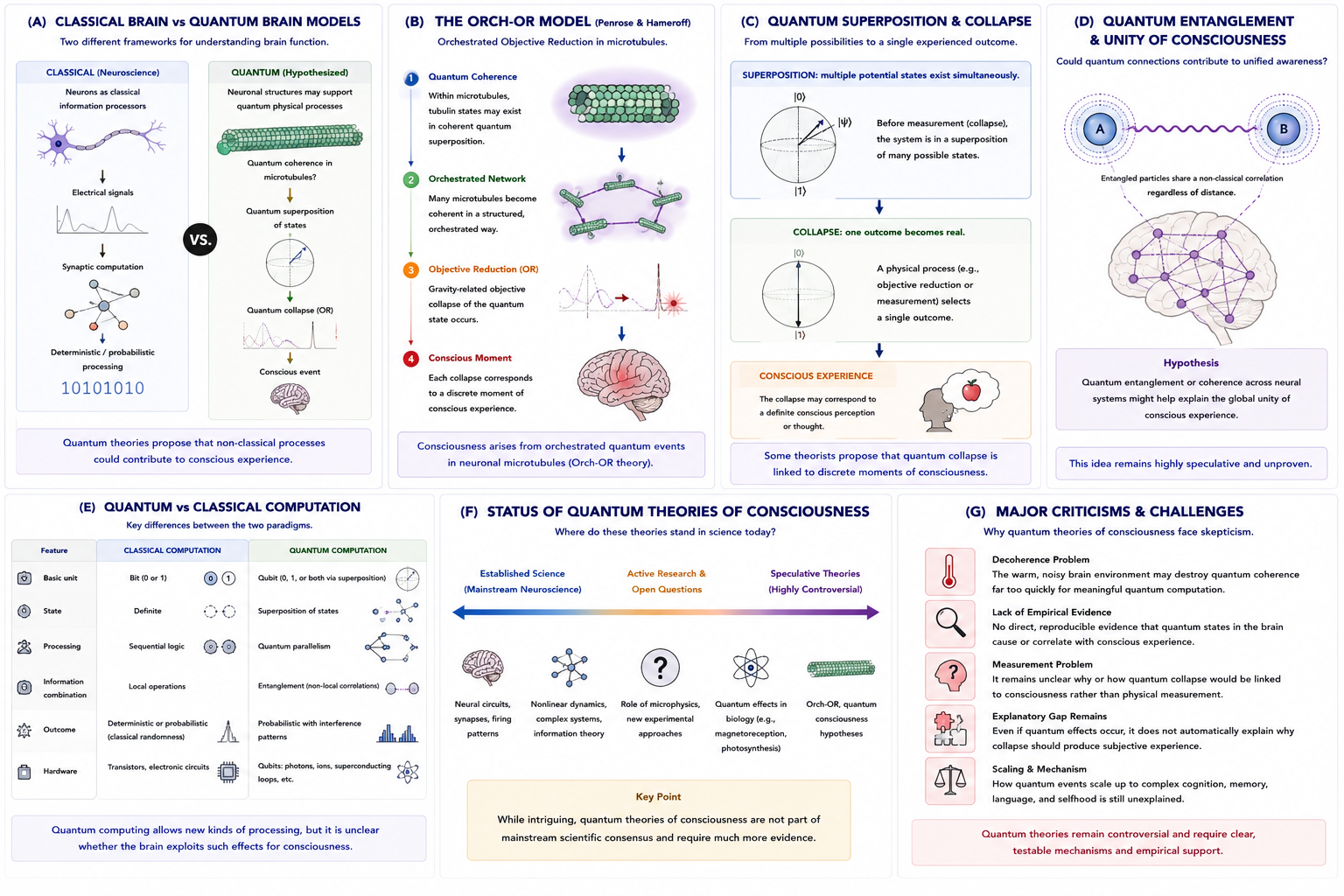
Figure 17.1: Quantum theories of consciousness. Panel A compares classical and quantum brain models. Panel B illustrates the Orch-OR model. Panel C explains quantum superposition and collapse. Panel D explores quantum entanglement and unified consciousness. Panel E compares classical and quantum computation. Panel F summarizes the scientific status of quantum theories. Panel G outlines major criticisms and challenges.
As Figure @ref(fig:fig-quantum) illustrates, quantum theories propose that non-classical physical processes may contribute to consciousness in ways not captured by standard neural computation. These theories do not necessarily reject neuroscience. Rather, they attempt to supplement classical neural explanations with deeper physical mechanisms.
The figure also highlights the central caution required when evaluating quantum theories. Even if quantum effects occur in the brain, this does not automatically show that they explain consciousness. The relationship between quantum processes and subjective experience remains speculative and contested.
17.4 Why Quantum Theories Exist
Quantum theories of consciousness emerged partly from dissatisfaction with purely classical explanations of mind. Classical neuroscience explains cognition through neurons, synapses, electrochemical signaling, brain networks, information processing, and large-scale integration. These mechanisms are powerful and empirically grounded. However, some theorists argue that they may not fully explain subjective experience itself.
The hard problem of consciousness is one motivation. Even if classical neuroscience explains behaviour, attention, memory, and reportability, it may still leave open why physical processes are accompanied by experience [@chalmers1995; @chalmers1996]. Quantum theories attempt to explore whether deeper physical mechanisms might help address this gap.
Another motivation comes from debates about computation. Roger Penrose argued that human understanding may involve non-computable processes that cannot be fully captured by classical algorithms [@penrose1989; @penrose1994]. If this is correct, then consciousness might require physical processes beyond standard computation.
A third motivation concerns the unity of consciousness. Conscious experience appears unified even though the brain is composed of many distributed processes. Some quantum theorists have speculated that non-classical coherence or entanglement could contribute to this unity, although this remains highly controversial.
Quantum theories therefore exist because they attempt to connect consciousness with fundamental physics. Their appeal lies in their ambition. Their weakness lies in the difficulty of showing that quantum mechanisms are actually necessary for consciousness.
17.5 Basic Quantum Concepts
Quantum consciousness theories draw on several concepts from quantum mechanics. These concepts are scientifically precise in physics, but they must be used carefully in consciousness research. Quantum terminology should not be used metaphorically or vaguely.
17.5.1 Superposition
Superposition refers to the ability of a quantum system to exist in a combination of possible states before measurement or interaction produces a definite outcome. In simplified terms, a quantum system may not have one definite classical state until the relevant physical process resolves it.
Some theorists speculate that conscious experience may relate to this transition from multiple possibilities to a definite outcome. However, this remains speculative. Superposition is a real quantum phenomenon, but its connection to consciousness has not been established.
17.5.2 Quantum Coherence
Quantum coherence refers to an ordered relationship among quantum states. Coherence allows quantum systems to display interference and other non-classical properties.
Some quantum theories of consciousness propose that coherent quantum states may occur temporarily in biological structures. Orch-OR, for example, proposes that microtubules inside neurons may support quantum coherence under certain conditions [@hameroff1996; @hameroff2014].
The challenge is that the brain is warm, wet, and noisy. Such environments tend to destroy delicate quantum coherence quickly. This is the basis of the decoherence criticism [@tegmark2000].
17.5.3 Entanglement
Entanglement involves non-classical correlations between quantum systems. Entangled systems cannot be fully described independently, even when separated.
Some theorists have speculated that entanglement might help explain the unity of consciousness. However, evidence for large-scale consciousness-relevant entanglement in the brain remains limited. Most mainstream theories explain conscious unity through neural integration rather than quantum entanglement.
17.5.4 Quantum State Reduction
Quantum state reduction, often called collapse, refers to the transition from a range of quantum possibilities to a definite outcome. Some interpretations of quantum mechanics treat collapse as measurement-related, while others propose objective physical collapse mechanisms.
Penrose’s objective reduction proposal is central to Orch-OR. It suggests that collapse may occur through an objective physical process related to spacetime geometry [@penrose1994].
17.6 Historical Development
Quantum approaches to consciousness developed through interactions among physics, mathematics, philosophy of mind, neuroscience, and computation. Early debates about quantum mechanics raised questions about measurement, observation, and the role of the observer. Some thinkers wondered whether consciousness might be connected to quantum measurement.
David Bohm explored holistic and non-classical interpretations of physics that influenced later discussions of mind and reality [@bohm1980]. Henry Stapp developed quantum approaches that linked consciousness with quantum measurement and mind-brain interaction [@stapp1993; @stapp2007].
Roger Penrose became one of the most influential figures in modern quantum consciousness debates. He argued that human mathematical understanding may involve non-computable insight that cannot be fully explained by classical algorithms [@penrose1989; @penrose1994]. This claim motivated his search for physical processes beyond ordinary computation.
Stuart Hameroff then proposed that microtubules inside neurons might provide a biological site for relevant quantum processes. Together, Penrose and Hameroff developed the Orch-OR model, which remains the most widely discussed quantum theory of consciousness [@hameroff1996; @hameroff2014].
Although quantum theories remain outside mainstream consensus, they continue to attract interest because they connect consciousness with foundational questions in physics and computation.
17.7 Penrose and Non-Computability
Penrose argued that consciousness may involve forms of understanding that exceed classical computation. His argument drew partly on Gödelian ideas about mathematical truth and formal systems. He suggested that human mathematicians can sometimes recognize truths that cannot be fully captured by formal algorithms [@penrose1989; @penrose1994].
From this perspective, the mind may not be equivalent to a classical digital computer. If consciousness involves non-computable processes, then standard artificial intelligence and classical computationalism may be incomplete.
This argument is controversial. Many philosophers and computer scientists reject the claim that Gödel’s theorem shows human cognition is non-computable. Others argue that even if some brain processes are non-computable, this does not automatically explain consciousness.
Nevertheless, Penrose’s non-computability argument remains historically important because it motivated one of the most influential quantum approaches to consciousness.
17.8 The Orch-OR Theory
The Orchestrated Objective Reduction theory, or Orch-OR, is the best-known quantum theory of consciousness. It was developed by Roger Penrose and Stuart Hameroff [@hameroff1996; @hameroff2014].
According to Orch-OR, quantum processes occur inside neuronal microtubules. Microtubules are structural components within cells, including neurons. Hameroff proposed that microtubules may support organized quantum states. Penrose proposed that quantum state reduction may occur through objective physical processes related to spacetime structure.
The theory can be summarized as follows:
- Quantum coherence occurs within microtubules.
- These quantum states become organized or “orchestrated” by biological processes.
- Objective reduction occurs when a threshold is reached.
- Conscious moments correspond to these orchestrated reductions.
Orch-OR is ambitious because it attempts to connect consciousness with quantum gravity, cellular biology, and neural function. It also attempts to provide a mechanism for discrete conscious moments.
However, Orch-OR remains highly controversial. Critics question whether microtubules can sustain quantum coherence long enough, whether objective reduction occurs as proposed, and whether such events would explain subjective experience even if they occurred.
17.9 The Decoherence Debate
The decoherence problem is one of the strongest criticisms of quantum theories of consciousness. Quantum coherence is fragile. In warm and noisy environments, quantum states usually decohere very quickly, losing the properties that make them distinctively quantum.
Max Tegmark argued that quantum coherence in the brain would decohere too rapidly to play a meaningful role in neural computation [@tegmark2000]. This criticism became highly influential because it challenged the biological plausibility of quantum brain models.
Supporters of Orch-OR responded that Tegmark’s estimates may not apply correctly to microtubule conditions and that biological structures might protect quantum coherence more effectively than assumed [@hagan2002]. They also point to evidence that some biological systems exploit quantum effects, such as photosynthesis and avian magnetoreception.
However, showing that quantum effects occur in biology is not the same as showing that quantum effects explain consciousness. The key issue is whether quantum coherence occurs in brain structures in a way that is functionally relevant to conscious experience.
The decoherence debate remains unresolved, but it illustrates the scientific challenge quantum theories face.
17.10 Quantum Superposition and Conscious Experience
Some quantum consciousness theories speculate that conscious moments may be related to the transition from superposition to definite outcome. In simplified terms:
superposition → reduction/collapse → definite experienceThis idea is attractive because conscious experience appears definite. At any given moment, one experiences a particular world, not a set of unresolved possibilities. Quantum collapse seems, at least superficially, to involve a transition from possibility to actuality.
However, this connection remains speculative. The fact that quantum systems undergo state reduction does not explain why reduction should feel like anything. Nor does it explain why particular reductions would produce particular experiences, such as seeing red, feeling pain, or hearing music.
This is a version of the hard problem. Quantum collapse may be physically mysterious, but mystery in physics does not automatically solve mystery in consciousness.
17.11 Quantum Entanglement and the Unity of Consciousness
The unity of consciousness is another motivation for quantum theories. Conscious experience appears integrated. Visual perception, sound, bodily feeling, memory, and thought are usually experienced as parts of one field of awareness.
Some theorists speculate that quantum entanglement or coherence could contribute to this unity. Entanglement involves non-classical correlations between parts of a system, and this has led some to wonder whether quantum processes might help bind distributed neural activity.
However, mainstream neuroscience usually explains unity through large-scale neural integration, recurrent processing, global availability, synchronized activity, and embodied self-modeling rather than quantum entanglement [@koch2016; @seth2021].
The quantum unity proposal therefore remains speculative. It is not enough to say that both entanglement and consciousness involve unity. A theory must show how specific quantum mechanisms produce the specific unity of subjective experience.
17.12 Quantum and Classical Computation
Quantum theories of consciousness often contrast classical computation with quantum computation. Classical computation uses bits, rule-governed operations, and classical information processing. Quantum computation uses qubits, superposition, interference, and entanglement.
Some theorists argue that quantum computation may provide capacities unavailable to classical computation. If the brain used quantum computation, then consciousness might depend on mechanisms not captured by classical digital models.
However, two questions must be separated. First, does the brain perform quantum computation in any consciousness-relevant way? Second, even if it does, would quantum computation explain subjective experience?
Current evidence does not show that quantum computation is necessary for consciousness. Classical neural models remain highly successful in explaining perception, attention, memory, decision-making, and behaviour. Quantum theories must therefore show both biological plausibility and explanatory necessity.
17.13 Quantum Theories and Artificial Intelligence
Quantum theories have important implications for artificial intelligence. If consciousness depends on quantum coherence, microtubule dynamics, objective reduction, or other non-classical biological processes, then current classical AI systems may lack essential ingredients for consciousness.
This challenges strong computationalist views. A classical AI system might simulate intelligent behaviour, solve problems, generate language, and model itself without possessing the physical processes required for subjective experience.
However, quantum theories do not automatically rule out artificial consciousness. A future artificial system might incorporate quantum processes or non-classical physical architectures. The question is whether those processes would be organized in a way relevant to conscious experience.
At present, there is no consensus that quantum mechanisms are necessary for consciousness, and no consensus that current AI systems are conscious [@butlin2023]. Quantum approaches therefore contribute to AI consciousness debates mainly by challenging the assumption that classical computation is obviously sufficient.
17.14 Quantum Theories and T-Consciousness
Quantum theories should be distinguished from consciousness-first frameworks such as Taheri’s T-Consciousness. Quantum theories attempt to explain consciousness through physical processes described by quantum mechanics. They remain physical theories, even when speculative.
T-Consciousness, by contrast, is better understood as a consciousness-first framework. It treats consciousness as non-material and foundational, rather than as a product of neural or quantum mechanisms [@taheri2020; @taheri2023].
This distinction is important. Because quantum theories use ideas such as fields, coherence, or non-classical physics, they can sometimes be confused with broader consciousness-first frameworks. However, quantum consciousness theories and T-Consciousness are not the same. Quantum theories ask whether physical quantum processes contribute to consciousness. T-Consciousness asks whether consciousness itself is a foundational reality through which matter, life, and organization are understood.
For this reason, T-Consciousness may be mentioned briefly in this chapter as a related alternative framework, but its main discussion belongs in the broader chapter on consciousness-first theories.
17.15 Scientific Status of Quantum Theories
Quantum theories of consciousness remain speculative. They are not part of mainstream consensus neuroscience. Most current research on consciousness focuses on neural correlates, recurrent processing, global workspace dynamics, predictive processing, integrated information, attention, and brain network organization.
Some quantum effects are well established in biology. Examples often discussed include photosynthesis, enzyme activity, and avian magnetoreception. These show that biological systems can sometimes exploit quantum phenomena.
However, evidence directly linking quantum states to conscious experience remains weak. It has not been demonstrated that quantum coherence in microtubules, quantum collapse, or entanglement plays a necessary role in consciousness.
This does not mean quantum theories are impossible. It means that their current scientific status is uncertain. They remain speculative proposals requiring stronger empirical support and clearer testable predictions.
17.16 Strengths of Quantum Theories
Quantum theories have several strengths. First, they engage with fundamental physics. They ask whether consciousness may require explanations deeper than classical neural computation.
Second, they directly challenge simplistic computational reductionism. They remind researchers that intelligence, computation, and consciousness may not be identical.
Third, they attempt to address the hard problem and the unity of consciousness rather than focusing only on behaviour or reportability.
Fourth, they stimulate interdisciplinary dialogue among neuroscience, physics, philosophy, mathematics, and cognitive science.
Fifth, they encourage careful thinking about the physical basis of mind. Even if quantum theories turn out to be incorrect, they force consciousness research to clarify what kinds of physical explanation are required.
17.17 Weaknesses and Criticisms
Quantum theories also face major criticisms. The most important is the decoherence problem. Critics argue that the brain’s warm, wet, and noisy environment may destroy quantum coherence too quickly for it to play a meaningful role in consciousness [@tegmark2000].
A second criticism is lack of direct empirical evidence. No experiment has yet shown that quantum brain states cause conscious experience.
A third criticism is explanatory insufficiency. Even if quantum processes occur in the brain, it remains unclear why they should produce subjective feeling. Quantum physics may be strange, but strangeness does not explain phenomenology.
A fourth criticism is the scaling problem. Quantum events at microscopic levels must somehow scale up to cognition, memory, selfhood, language, and unified awareness. This connection remains unclear.
A fifth criticism is the risk of quantum mysticism. Quantum concepts are sometimes used loosely to make consciousness seem mysterious or profound without providing rigorous mechanisms. Scientific quantum theories must avoid vague metaphor and remain physically precise.
17.18 Relation to the Hard Problem
Quantum theories are often motivated by the hard problem of consciousness. Classical neuroscience may explain behaviour, cognition, attention, and reportability, but critics argue that it does not fully explain why subjective experience exists.
Quantum theories attempt to introduce deeper physical mechanisms that might be more closely connected to consciousness itself. Orch-OR, for example, proposes that conscious moments correspond to objective reductions in quantum states [@hameroff2014].
However, the hard problem remains. Why should objective reduction feel like anything? Why should quantum coherence produce experience? Why should quantum indeterminacy generate subjectivity?
Quantum theories may deepen the physical story, but they do not automatically bridge the explanatory gap. They must still explain the relationship between physical process and phenomenal experience.
17.19 Relation to Other Theories
Quantum theories differ from most other theories discussed in this book.
17.19.1 Relation to Computationalism
Computationalism explains mind in terms of information processing and functional organization. Quantum theories challenge the idea that classical computation is sufficient for consciousness. Penrose’s view is especially critical of classical computationalism [@penrose1989; @turing1950].
17.19.2 Relation to Biological Naturalism
Quantum theories may overlap with biological naturalism if they argue that consciousness depends on specific biological structures such as microtubules. However, unlike standard biological naturalism, they appeal to non-classical physical processes.
17.19.3 Relation to Global Workspace Theory
Global Workspace Theory explains consciousness through global broadcasting and cognitive access. Quantum theories do not focus primarily on access or reportability. They ask whether deeper physical processes underlie conscious moments.
17.19.4 Relation to Integrated Information Theory
Integrated Information Theory explains consciousness through intrinsic integrated causal structure. Quantum theories may share an interest in fundamental physical structure, but IIT does not require quantum mechanisms [@tononi2004; @oizumi2014].
17.19.5 Relation to Panpsychism
Some interpretations of quantum consciousness are sometimes associated with panpsychist or consciousness-fundamental views. However, they should be kept distinct. Panpsychism treats experience as fundamental. Quantum theories usually attempt to identify physical mechanisms that contribute to consciousness.
17.19.6 Relation to T-Consciousness
T-Consciousness is not a quantum theory in the standard scientific sense. It is better treated as a consciousness-first framework. It should be compared with panpsychism, cosmopsychism, and other consciousness-first views more than with Orch-OR or quantum computation.
17.20 Open Questions
Several questions remain unresolved. Do meaningful quantum states occur in brain structures relevant to consciousness? Can microtubules sustain quantum coherence long enough to matter? Is objective reduction a real physical process? Would quantum collapse explain subjective feeling? Are quantum mechanisms necessary for consciousness or merely incidental biological details? Could artificial systems become conscious without quantum processes? Can quantum theories generate clear experimental predictions?
These questions show why quantum theories remain both intriguing and controversial. They are bold, but they require stronger empirical and theoretical support.
17.21 Evaluation
Quantum theories of consciousness are among the most speculative approaches in consciousness research. Their greatest strength is that they connect consciousness with fundamental physics and challenge the assumption that classical computation is obviously sufficient for mind.
Their greatest weakness is lack of empirical support. No direct evidence currently shows that quantum processes in the brain produce consciousness. The decoherence problem, scaling problem, and explanatory gap remain serious obstacles.
Quantum theories are therefore best understood as exploratory and controversial frameworks. They may eventually contribute to consciousness science if they generate testable predictions and empirical support. At present, however, mainstream neuroscience does not require quantum explanations of consciousness.
The philosophical value of quantum theories lies in how they challenge simple assumptions about computation, physical explanation, and the nature of conscious experience. Their scientific value depends on whether future evidence can show that quantum mechanisms are necessary or relevant to consciousness.
17.22 Chapter Summary
Quantum theories of consciousness propose that non-classical physical processes may contribute to conscious experience beyond standard neural computation. These approaches explore possible roles for superposition, coherence, entanglement, collapse, and quantum computation.
The most influential proposal is Orch-OR, developed by Roger Penrose and Stuart Hameroff. Orch-OR suggests that orchestrated quantum state reductions within neuronal microtubules may contribute to conscious moments.
Quantum theories are motivated by concerns about the hard problem, unity of consciousness, non-computability, and the limits of classical computation. They challenge the idea that intelligence or information processing alone is sufficient for subjective experience.
However, quantum theories remain controversial. Major challenges include decoherence, lack of direct empirical evidence, unclear neural implementation, the scaling problem, and the continuing difficulty of explaining why quantum processes should feel like anything.
Quantum theories should also be distinguished from T-Consciousness. Quantum theories appeal to physical quantum mechanisms. T-Consciousness treats consciousness as a non-material foundational reality and should be discussed mainly with consciousness-first frameworks.
The central unresolved question is whether quantum processes are necessary for consciousness, or whether consciousness can be fully explained through classical neural, computational, and embodied mechanisms.