Autocatalytic Networks
Source:vignettes/6. autocatalytic-networks.Rmd
6. autocatalytic-networks.RmdAutocatalytic Networks with lifesimulatoR
This tutorial introduces autocatalytic networks. In origin-of-life research, autocatalysis is important because it offers a possible route from ordinary chemistry to self-sustaining chemical organization.
A catalyst is something that helps a reaction occur more easily without being consumed by the reaction. An autocatalytic system is one in which the products of reactions help produce more of themselves, either directly or indirectly. In a network, molecule A might help produce molecule B, molecule B might help produce molecule C, and molecule C might help produce molecule A. Together, the system can become self-reinforcing.
This idea matters because early life may not have begun with a single perfect self-replicator. It may have involved networks of mutually reinforcing chemical reactions. Life is not only about individual molecules; life also depends on systems of interaction. Modern cells contain large networks of reactions, enzymes, metabolites, and feedback loops. Autocatalytic network models provide a simplified way to explore how self-maintaining organization could emerge before modern biology.
What is an autocatalytic network?
An autocatalytic network is a system in which molecules help produce other molecules in the same system. Instead of one molecule simply copying itself, a group of molecules collectively supports its own production.
This shifts attention from individual molecules to systems of interactions. In such systems, persistence may emerge from the network as a whole.
This is different from a simple replication-first model, where the main focus is on a molecule that can copy itself.
Simulating a toy autocatalytic network
lifesimulatoR includes a simplified autocatalytic
network model. The main function is
autocatalytic_network().
network <- autocatalytic_network(
  n_types = 8,
  steps = 50,
  catalysis_probability = 0.2,
  seed = 123
)

names(network)
## [1] "time_series" "catalysis_matrix"The function creates a toy system with a number of molecular types and probabilistic catalytic relationships between them.
The returned object includes two main components:
-
time_series: a tibble showing molecular abundances over time. -
catalysis_matrix: a matrix showing which molecular types catalyze others.
head(network$time_series)## # A tibble: 6 × 3
## step molecule abundance
## <int> <chr> <dbl>
## 1 0 M1 0.833
## 2 0 M2 0.504
## 3 0 M3 0.829
## 4 0 M4 0.831
## 5 0 M5 0.815
## 6 0 M6 0.496
network$catalysis_matrix## [,1] [,2] [,3] [,4] [,5] [,6] [,7] [,8]
## [1,] FALSE FALSE FALSE FALSE FALSE TRUE FALSE TRUE
## [2,] FALSE FALSE TRUE FALSE FALSE FALSE FALSE FALSE
## [3,] FALSE FALSE FALSE FALSE TRUE FALSE TRUE FALSE
## [4,] FALSE FALSE FALSE FALSE FALSE FALSE FALSE FALSE
## [5,] FALSE FALSE FALSE FALSE FALSE TRUE FALSE FALSE
## [6,] TRUE FALSE FALSE TRUE FALSE FALSE TRUE TRUE
## [7,] FALSE TRUE FALSE FALSE FALSE FALSE FALSE FALSE
## [8,] FALSE FALSE FALSE FALSE FALSE FALSE FALSE FALSEUnderstanding the parameters
The main arguments are:
-
n_types: the number of molecular types in the system. -
steps: the number of simulation steps. -
catalysis_probability: the probability that one molecule type catalyzes another. -
seed: an optional random seed for reproducibility.
The catalysis_probability parameter is especially
important. If this value is very low, few catalytic connections form. If
it is higher, the network becomes more connected.
In origin-of-life theory, the emergence of a sufficiently connected catalytic network may be a key transition.
Why network connectivity matters
A set of isolated molecules may react occasionally, but it may not sustain itself. A connected network can create feedback. Once feedback exists, some molecular systems may persist longer, grow faster, or resist disappearance.
The simplified question is:
At what point does a random chemical network become organized enough to support self-sustaining dynamics?
This is not only a chemistry question. It is also a systems question. The structure of the network matters.
Time series output
The time_series output can be used to track how the
system changes over time.
head(network$time_series)## # A tibble: 6 × 3
## step molecule abundance
## <int> <chr> <dbl>
## 1 0 M1 0.833
## 2 0 M2 0.504
## 3 0 M3 0.829
## 4 0 M4 0.831
## 5 0 M5 0.815
## 6 0 M6 0.496
summary(network$time_series)## step molecule abundance
## Min. : 0 Length:408 Min. : 0.4959
## 1st Qu.:12 Class :character 1st Qu.: 3.8842
## Median :25 Mode :character Median : 16.7127
## Mean :25 Mean : 48.5247
## 3rd Qu.:38 3rd Qu.: 65.6887
## Max. :50 Max. :366.1732Depending on the simulation settings, the time series may show whether some molecule types become more abundant than others.
Plotting one molecule type
We can use plot_simulation() to visualize the abundance
of one molecule type through time.
m1 <- subset(network$time_series, molecule == "M1")

plot_simulation(m1, x = "step", y = "abundance")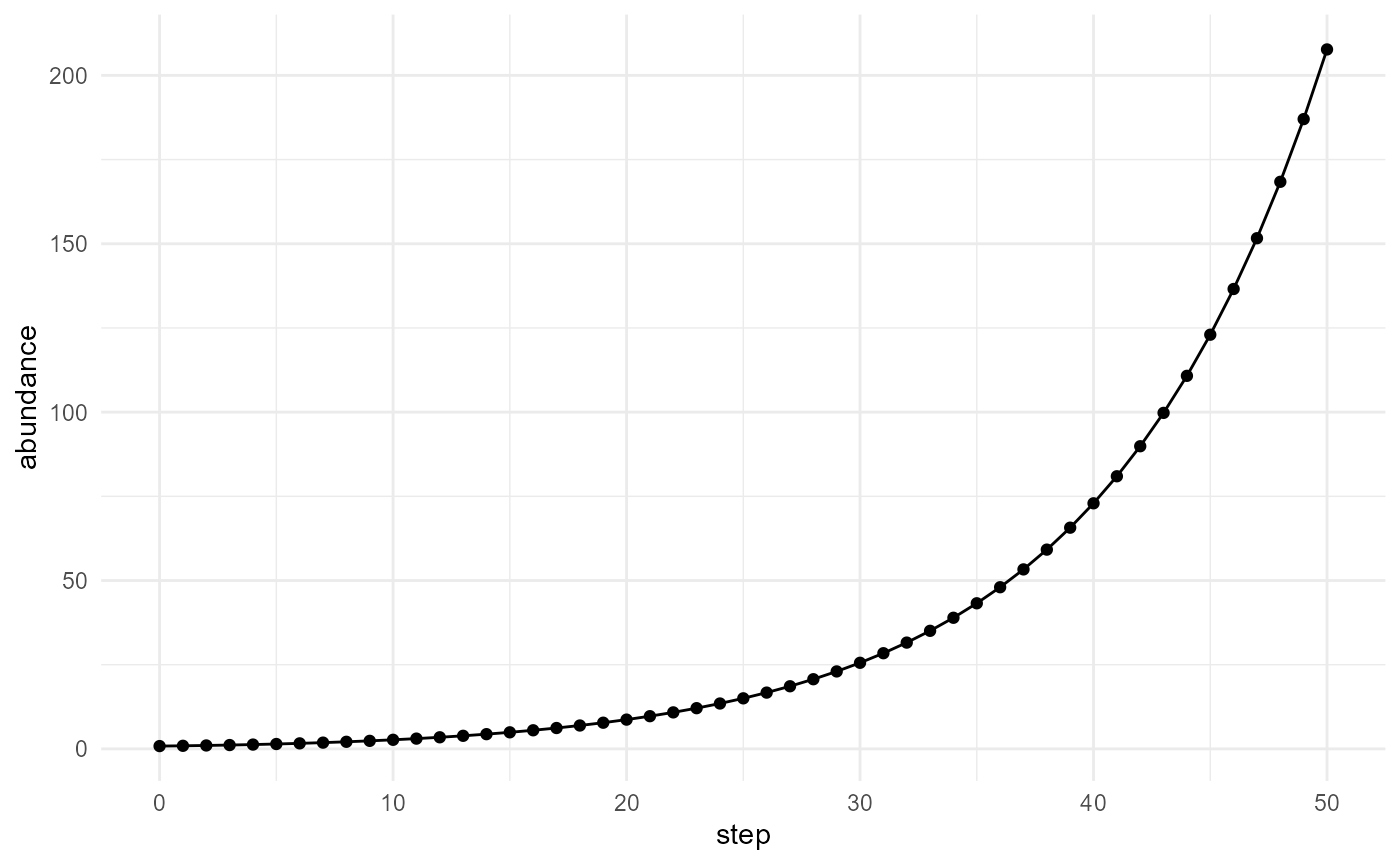
This plot shows how the abundance of molecule M1 changes
through the simulation.
Summarizing final abundances
It is often useful to look at the final simulation step.
final_step <- max(network$time_series$step)

final_abundances <- subset(network$time_series, step == final_step)

final_abundances
## # A tibble: 8 × 3
## step molecule abundance
## <int> <chr> <dbl>
## 1 50 M1 208.
## 2 50 M2 266.
## 3 50 M3 199.
## 4 50 M4 208.
## 5 50 M5 148.
## 6 50 M6 271.
## 7 50 M7 354.
## 8 50 M8 366.This output shows which molecule types are most abundant at the end of the simulation.
Experiment 1: Low versus high catalysis probability
We can compare two networks: one with sparse catalytic connections and one with more frequent catalytic connections.
sparse_network <- autocatalytic_network(
  n_types = 8,
  steps = 50,
  catalysis_probability = 0.05,
  seed = 123
)

dense_network <- autocatalytic_network(
  n_types = 8,
  steps = 50,
  catalysis_probability = 0.4,
  seed = 123
)

head(sparse_network$time_series)
## # A tibble: 6 × 3
## step molecule abundance
## <int> <chr> <dbl>
## 1 0 M1 0.833
## 2 0 M2 0.504
## 3 0 M3 0.829
## 4 0 M4 0.831
## 5 0 M5 0.815
## 6 0 M6 0.496
head(dense_network$time_series)## # A tibble: 6 × 3
## step molecule abundance
## <int> <chr> <dbl>
## 1 0 M1 0.833
## 2 0 M2 0.504
## 3 0 M3 0.829
## 4 0 M4 0.831
## 5 0 M5 0.815
## 6 0 M6 0.496In a sparse network, many molecular types may have few or no catalytic relationships. In a denser network, feedback loops are more likely. This can make the system more dynamic and potentially more self-reinforcing.
Experiment 2: Compare final abundance patterns
sparse_final <- subset(
  sparse_network$time_series,
  step == max(sparse_network$time_series$step)
)

dense_final <- subset(
  dense_network$time_series,
  step == max(dense_network$time_series$step)
)

sparse_final
## # A tibble: 8 × 3
## step molecule abundance
## <int> <chr> <dbl>
## 1 50 M1 6.12
## 2 50 M2 1.77
## 3 50 M3 6.13
## 4 50 M4 1.89
## 5 50 M5 14.0
## 6 50 M6 1.77
## 7 50 M7 14.0
## 8 50 M8 1.83
dense_final## # A tibble: 8 × 3
## step molecule abundance
## <int> <chr> <dbl>
## 1 50 M1 76522.
## 2 50 M2 66124.
## 3 50 M3 48509.
## 4 50 M4 156282.
## 5 50 M5 234561.
## 6 50 M6 225042.
## 7 50 M7 194458.
## 8 50 M8 221803.This comparison helps illustrate how changing network connectivity may affect final molecular abundance.
Experiment 3: Increasing the number of molecular types
A larger system may allow more possible catalytic relationships.
larger_network <- autocatalytic_network(
  n_types = 15,
  steps = 50,
  catalysis_probability = 0.2,
  seed = 123
)

head(larger_network$time_series)
## # A tibble: 6 × 3
## step molecule abundance
## <int> <chr> <dbl>
## 1 0 M1 0.456
## 2 0 M2 0.530
## 3 0 M3 0.604
## 4 0 M4 0.728
## 5 0 M5 0.924
## 6 0 M6 0.657As n_types increases, the number of possible
relationships grows. This can make the network more complex, even if the
probability of each individual catalytic relationship stays the
same.
Teaching interpretation
This model can be used to introduce the following ideas:
- Mutual reinforcement
- Chemical networks
- Feedback loops
- Collective self-maintenance
- Emergence of system-level behaviour
- Network connectivity
- System-level selection
The key teaching point is that an origin-of-life model does not always need to begin with a single molecule that copies itself perfectly. It can also begin with interacting systems that collectively sustain themselves.
Autocatalysis and the origin of life
Autocatalytic networks are relevant to several origin-of-life hypotheses. Some theories suggest that life began not with a single self-replicating molecule, but with a network of mutually supporting reactions. This is often associated with metabolism-first or network-first perspectives.
In this view, the earliest life-like systems may have been chemical networks that could maintain themselves, process energy, and generate more components of the same network. Genetic replication may have become dominant later.
This contrasts with RNA World models, where the focus is often on molecules capable of both storing information and catalyzing reactions.
These views are not necessarily mutually exclusive. A mature origin-of-life theory may need to explain how networks, compartments, energy flows, and information-carrying molecules became coupled.
What this model includes and excludes
This simplified model includes:
- Molecular types
- Probabilistic catalytic relationships
- Time evolution
- Network-level behaviour
- Abundance changes
It does not include:
- Real reaction kinetics
- Thermodynamic constraints
- Spatial structure
- Energy gradients
- Detailed molecular chemistry
- Realistic reaction pathways
For teaching purposes, this limitation is useful. It allows students to focus on the network concept before adding chemical detail.
Interpretation
The key idea is that autocatalytic networks shift the focus from individual molecules to systems of interaction. A molecule may not be impressive by itself, but a network of molecules can produce feedback, persistence, and organization.
This is one reason autocatalysis is such an important idea in origin-of-life research. It provides a possible bridge between random chemistry and the organized, self-maintaining systems seen in living organisms.
Suggested exercises
- Run the model with different values of
catalysis_probability. - Increase
n_typesand observe whether larger systems behave differently. - Compare short simulations and long simulations.
- Plot several molecule types and compare their abundance trajectories.
- Discuss how autocatalytic networks differ from simple molecular replication.
- Propose one additional feature that would make the model more chemically realistic.
- Discuss how autocatalytic networks might interact with protocells.
- Compare network-first and replication-first views of the origin of life.