Chapter 3 RNA World Hypothesis
3.1 Chapter Overview
This chapter examines the RNA World hypothesis, one of the most influential models in origin-of-life research. The chapter explains why RNA is considered a possible bridge between chemistry and biology, reviews its historical development, describes its proposed mechanism, evaluates supporting evidence, and discusses the major challenges that remain.
3.2 Key Terms
- RNA World
- Ribozyme
- Heredity
- Catalysis
- Replication
- Molecular evolution
- Information storage
- Proto-selection
3.3 Core Idea
The RNA World hypothesis proposes that RNA preceded DNA and proteins as the central molecule of early biological systems. The hypothesis is powerful because RNA can perform two functions that are essential for life: it can store genetic information and, in some cases, catalyze chemical reactions (Gilbert 1986).
In modern life, DNA primarily stores genetic information, proteins perform most catalytic functions, and RNA acts as an intermediary between them. The RNA World hypothesis suggests that, before this division of labour evolved, RNA may have carried out both informational and catalytic roles.
3.4 Historical Context
The term “RNA World” was formalized by Walter Gilbert in 1986 (Gilbert 1986), but the idea developed from earlier discoveries in molecular biology. The discovery of catalytic RNA molecules, known as ribozymes, showed that RNA was not merely a passive messenger molecule but could also participate directly in chemical catalysis.
This discovery was significant because it provided a possible solution to a major origin-of-life problem: which came first, genetic information or functional enzymes? If RNA could perform both roles, then early life may not have required separate DNA genomes and protein enzymes at the beginning.
3.5 Mechanistic Basis
The RNA World hypothesis proposes that early RNA-like molecules formed, copied themselves imperfectly, and underwent selection based on their stability, catalytic ability, and replication efficiency. In this framework, RNA acted as a bridge between prebiotic chemistry and biological evolution.
RNA is proposed to have supported early life-like systems through four related functions:
- Storing sequence-based information
- Catalyzing chemical reactions
- Supporting copying or template-directed replication
- Allowing variation and selection among molecular populations
Figure 3.1 summarizes the mechanistic logic of the RNA World hypothesis.
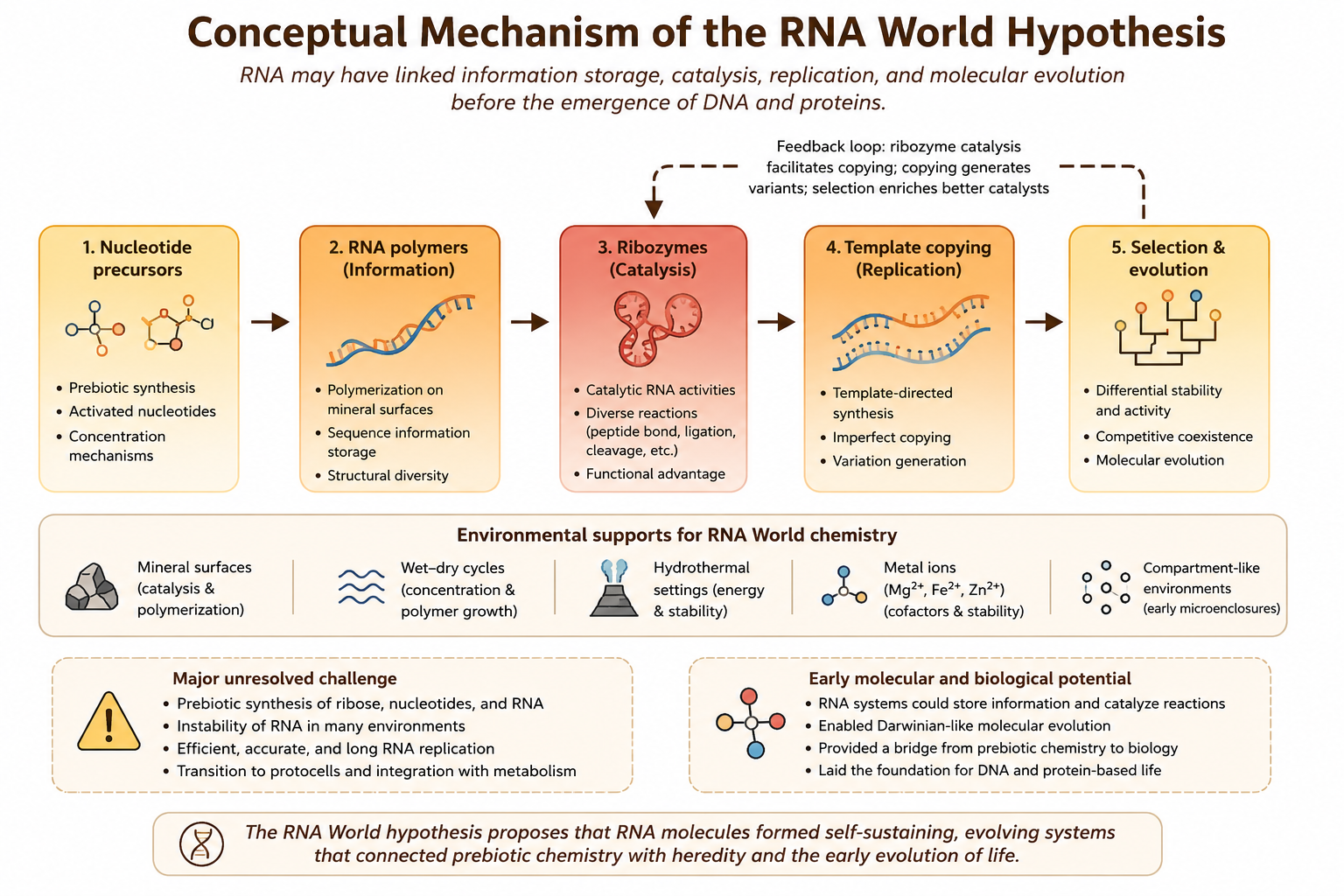
Figure 3.1: Conceptual mechanism of the RNA World hypothesis.
The figure illustrates why RNA remains central to origin-of-life research: it provides a plausible molecular link between chemical complexity and Darwinian evolution.
3.6 What the Theory Explains Well
The RNA World hypothesis is strongest at explaining the emergence of heredity and pre-cellular molecular evolution. Unlike the primordial soup model, which mainly explains the formation of organic ingredients, the RNA World hypothesis directly addresses how information could be stored, copied, and modified over time.
This makes the theory especially important because heredity is one of the defining features of life. Without some mechanism for information transfer, chemical systems may become complex, but they cannot evolve in a Darwinian sense.
3.7 What Makes It Plausible
Several features make the RNA World hypothesis scientifically plausible.
First, RNA can store information in its nucleotide sequence. Second, some RNA molecules can act as ribozymes and catalyze reactions. Third, RNA plays central roles in modern cells, including in translation, gene regulation, and protein synthesis. The ribosome itself contains a catalytic RNA core, suggesting that RNA may preserve traces of an ancient biochemical world (Joyce 2002).
These observations suggest that RNA is not simply a later accessory molecule, but may have played a deeper role in the early evolution of biological systems.
3.8 Key Experimental and Observational Support
The strongest support for the RNA World hypothesis comes from the discovery and study of catalytic ribozymes. Ribozymes demonstrate that RNA can catalyze reactions without proteins, supporting the idea that early biological systems may have relied on RNA-based catalysis.
In vitro evolution experiments also show that RNA molecules can be selected for specific catalytic or binding functions under laboratory conditions (Joyce 2002). These experiments demonstrate that RNA populations can undergo variation and selection, which are essential ingredients for molecular evolution.
Additional support comes from the central role of RNA in modern biology. Ribosomal RNA performs the key catalytic step in protein synthesis, and many essential cellular processes still depend on RNA-based mechanisms.
3.9 Major Gaps and Critiques
Despite its strengths, the RNA World hypothesis faces major challenges.
The most important gap is prebiotic accessibility. RNA is chemically complex, relatively fragile, and difficult to synthesize under realistic early Earth conditions. Forming ribose sugars, nucleobases, phosphate groups, and linking them into stable nucleotides remains a major chemical problem.
Additional challenges include:
- Difficulty producing RNA nucleotides under plausible prebiotic conditions
- Instability of RNA in many environmental settings
- The challenge of forming long RNA polymers
- The difficulty of achieving accurate RNA replication without enzymes
- The need for concentration mechanisms to prevent dilution
- The lack of clear explanation for how RNA systems became enclosed in protocells
For these reasons, many researchers consider the RNA World hypothesis powerful but incomplete.
3.10 Integration with Other Theories
The RNA World hypothesis is often treated as part of a broader hybrid model of abiogenesis. It may explain the emergence of heredity, but it likely required support from other prebiotic processes.
For example, primordial soup chemistry may have supplied some organic precursors. Wet–dry cycles or mineral surfaces may have helped concentrate and polymerize nucleotides. Lipid compartments may have protected RNA molecules and allowed early protocells to form. Metabolic or geochemical systems may also have supplied energy and chemical scaffolding.
In this broader view, the RNA World may not represent the very beginning of abiogenesis, but rather an important intermediate stage between prebiotic chemistry and early cellular life.
3.11 Systems Perspective
Within the comparative framework of this book, the RNA World hypothesis primarily addresses the third major hurdle of abiogenesis: information storage and replication.
Its greatest contribution is that it offers a plausible route from chemistry to heredity. However, it does not fully explain the earlier formation of RNA building blocks, nor does it independently explain metabolism or compartment formation.
Therefore, the RNA World hypothesis is best understood as a central but partial explanation within a larger systems-level model of life’s emergence.
3.12 Modern Relevance
The RNA World hypothesis continues to influence modern origin-of-life research, synthetic biology, molecular evolution, and astrobiology. It provides a model for how simple molecular systems might begin to evolve before the appearance of DNA genomes and protein enzymes.
The hypothesis also helps explain why RNA remains so deeply embedded in modern biology. Its central role in translation, regulation, and catalysis may reflect an ancient evolutionary legacy.
3.13 Current Scientific Standing
The RNA World hypothesis remains one of the most influential origin-of-life theories. It is widely regarded as a strong explanation for the emergence of heredity and early molecular evolution.
However, most current interpretations do not treat RNA World as a complete standalone theory. Instead, RNA-based systems are often viewed as one phase within a broader sequence involving prebiotic chemistry, environmental concentration, mineral catalysis, energy flow, and protocell formation.
3.14 Comparative Assessment
| Dimension | Assessment |
|---|---|
| Primary Contribution | Information storage, catalysis, and early heredity |
| Explanatory Strength | Strong for heredity and molecular evolution |
| Mechanistic Plausibility | Moderate to high |
| Experimental Support | Strong for ribozymes and RNA evolution |
| Environmental Realism | Challenging due to RNA synthesis and instability |
| Main Limitation | Difficulty forming and replicating RNA under prebiotic conditions |
| Integrative Potential | High |
| Current Scientific Standing | Central but incomplete component of abiogenesis models |
3.15 Comparative Performance
| Question | RNA World Performance |
|---|---|
| Produces organic building blocks? | Weak to limited |
| Explains polymer formation? | Moderate, but chemically challenging |
| Explains heredity? | Strong |
| Explains catalysis? | Strong |
| Explains metabolism? | Limited |
| Explains compartment formation? | Weak |
| Supported experimentally? | Strong for ribozymes and in vitro evolution |
| Useful in hybrid models? | Strong |