Chapter 1 Introduction
The origin of life remains one of the most profound unresolved questions in modern science. Although evolutionary biology explains how life diversifies through natural selection, the processes that transformed non-living chemistry into the first living systems remain uncertain. Understanding this transition requires contributions from multiple scientific disciplines, including chemistry, molecular biology, geology, planetary science, thermodynamics, and systems theory.
Over the past century, numerous origin-of-life theories have been proposed to explain different stages of this transition. Some models focus on the abiotic synthesis of organic molecules under early Earth conditions, whereas others emphasize the emergence of self-organizing chemical systems, informational polymers such as RNA, primitive metabolic networks, or membrane-bound protocells. Additional hypotheses investigate the catalytic role of mineral surfaces, hydrothermal environments, wet–dry cycling, or the extraterrestrial delivery of organic compounds.
Importantly, these theories do not necessarily compete as mutually exclusive explanations. Instead, many may describe different stages within a broader progression from geochemistry to early biological evolution. This systems perspective forms the central conceptual framework of this book.
1.1 The Complexity of Abiogenesis
Any comprehensive explanation for the origin of life must account for several major scientific transitions. Early Earth chemistry needed to generate organic building blocks, organize them into increasingly complex chemical systems, develop mechanisms for information storage and replication, and ultimately produce populations capable of Darwinian evolution.
Figure 1.1 summarizes four major hurdles that any successful origin-of-life theory must ultimately address.
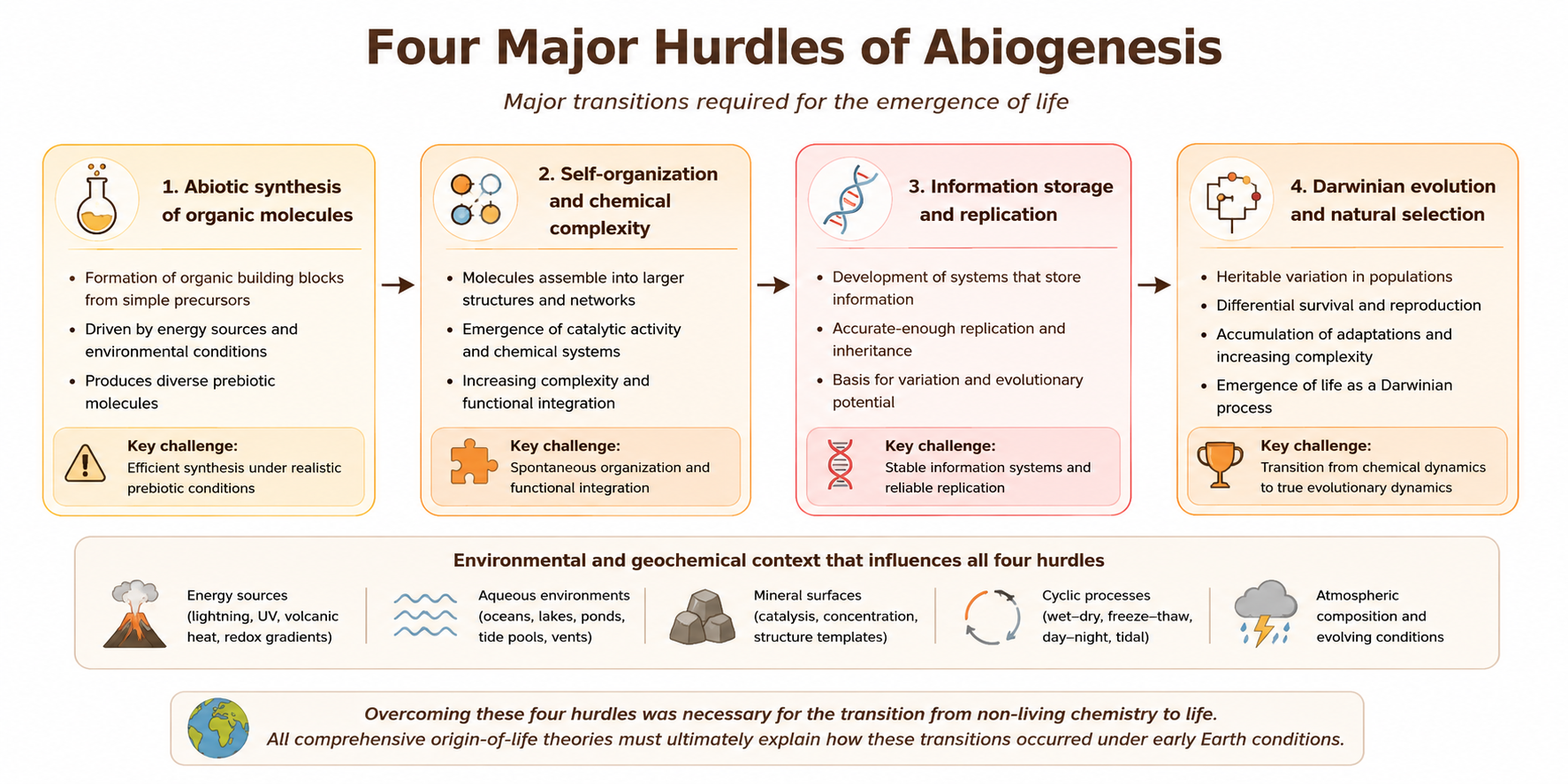
Figure 1.1: Four major hurdles that any comprehensive origin-of-life theory must address.
The first hurdle involves the abiotic synthesis of biologically relevant organic molecules such as amino acids, nucleotides, lipids, and simple sugars. The second concerns the emergence of chemical organization and increasing molecular complexity, including polymer formation and catalytic interactions. The third hurdle requires mechanisms for information storage, replication, and heredity, which are necessary for preserving and transmitting molecular structure across generations. Finally, life requires systems capable of variation, selection, and adaptive evolution.
These challenges are deeply interconnected and remain difficult to explain simultaneously within a single unified framework. As a result, modern origin-of-life research increasingly explores the possibility that multiple mechanisms operated together under early Earth conditions.
1.2 Sequential and Hybrid Models of Life’s Emergence
Rather than viewing abiogenesis as a single event, many modern researchers interpret it as a gradual sequence of transitions occurring over extended geological timescales. In this view, different origin-of-life theories may explain different stages within a larger pathway from geochemistry to primitive cellular evolution.
Figure 1.2 illustrates a simplified conceptual progression linking major stages in the transition from non-living chemistry to early biological systems.
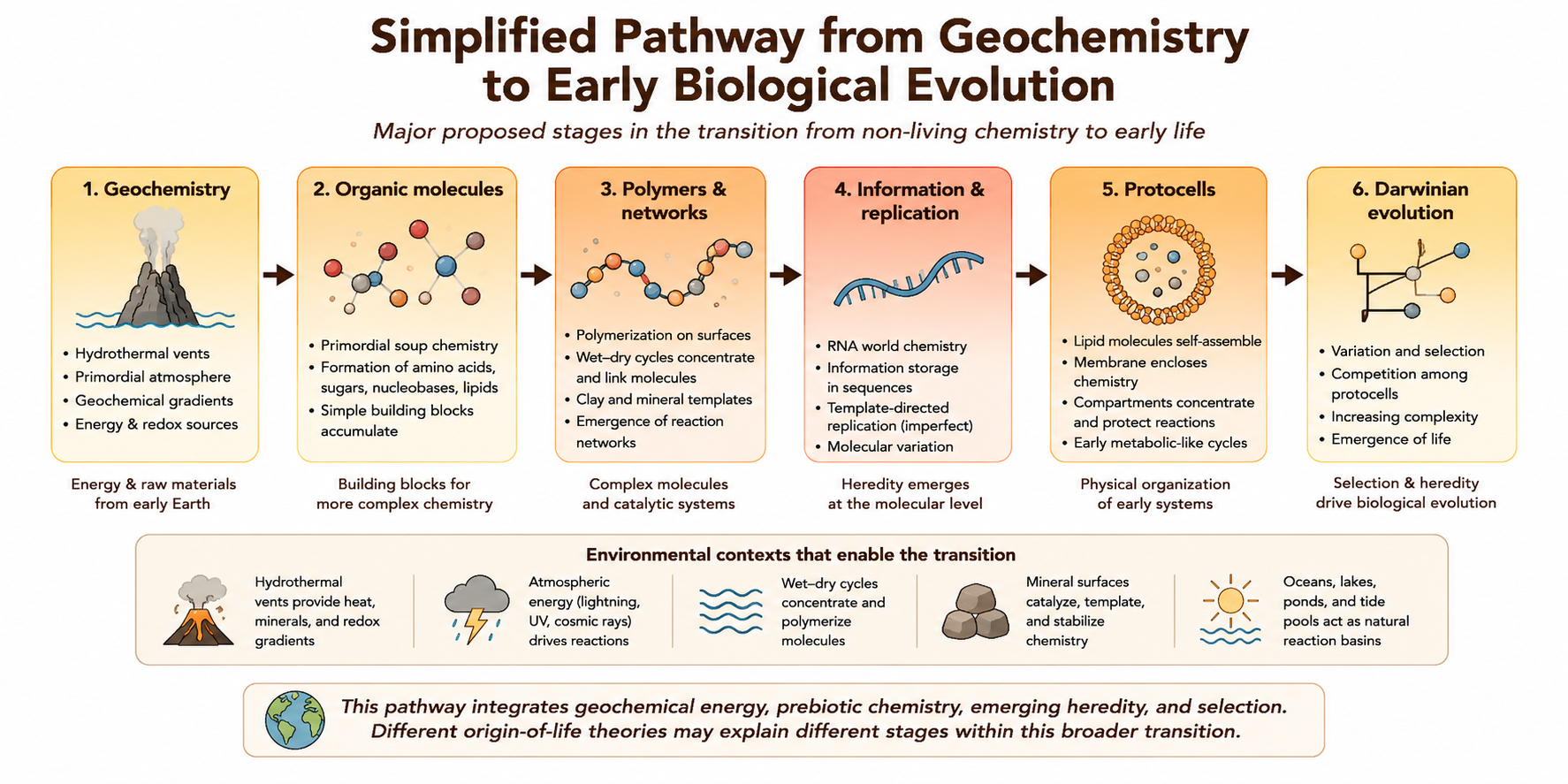
Figure 1.2: Simplified pathway showing major proposed stages in the transition from geochemistry to biological evolution and examples of theories associated with each stage.
In this framework, geochemical environments such as hydrothermal systems or the early atmosphere may have contributed to the synthesis of organic molecules. Wet–dry cycles, mineral surfaces, and related mechanisms may have promoted polymer formation and increasing chemical organization. RNA-based or protein-assisted systems may then have introduced primitive heredity and replication, while lipid membranes and protocell formation may have stabilized increasingly complex chemical networks.
This staged interpretation helps explain why no individual theory fully resolves the origin-of-life problem. Different models may contribute to different transitions within the overall emergence of life.
1.3 Methodological Approach
This book evaluates each major origin-of-life theory using a consistent comparative framework based on:
- Explanatory scope
- Mechanistic plausibility
- Experimental and empirical support
- Environmental realism
- Remaining unresolved gaps
- Integrative potential with other models
The goal is not to identify a single “winning” theory, but to evaluate which mechanisms appear scientifically plausible, experimentally testable, and potentially compatible within broader hybrid models of abiogenesis.
The chapters that follow examine each major theory individually before comparing their explanatory strengths, limitations, and possible integration into larger systems-level models for the emergence of life.