Chapter 7 Clay and Mineral Template Hypotheses
7.1 Chapter Overview
This chapter examines clay and mineral template hypotheses, which propose that mineral surfaces on early Earth may have played a central role in organizing, concentrating, and catalyzing prebiotic chemistry.
Unlike theories focused primarily on heredity, metabolism, or compartment formation, mineral template models emphasize the importance of solid surfaces as physical and chemical scaffolds for molecular organization. Certain minerals may have promoted adsorption, alignment, polymerization, and stabilization of organic molecules under realistic prebiotic conditions.
The chapter reviews the historical development of mineral-template theories, the mechanisms by which mineral surfaces influence chemical reactions, experimental evidence for surface-catalyzed polymerization, major limitations, and the role of minerals within broader hybrid models of abiogenesis.
7.2 Key Terms
- Clay minerals
- Mineral templates
- Surface catalysis
- Adsorption
- Montmorillonite
- Prebiotic polymerization
- Chemical scaffolding
- Surface chemistry
- Mineral-assisted organization
7.3 Core Idea
Clay and mineral template hypotheses propose that mineral surfaces may have acted as natural catalytic and organizational platforms during the origin of life.
In aqueous environments, organic molecules are often highly diluted and randomly distributed. Mineral surfaces can partially overcome this problem by adsorbing molecules onto structured solid interfaces where they become concentrated and spatially organized.
This organization may promote: - Chemical reactions - Polymer formation - Molecular alignment - Stabilization of intermediates - Primitive catalytic networks
Some minerals may therefore have functioned as primitive templates that guided increasingly complex chemistry before the emergence of fully biological systems.
7.4 Historical Context
Interest in mineral-assisted prebiotic chemistry developed partly in response to challenges faced by purely solution-based origin-of-life models.
Researchers recognized that mineral surfaces naturally: - Concentrate molecules - Provide catalytic sites - Stabilize reactive intermediates - Create structured microenvironments
A major development came from the work of A. G. Cairns-Smith, who proposed that clay crystals themselves may have participated in primitive information transfer and selection processes.
Later experimental work demonstrated that minerals such as montmorillonite clay can catalyze RNA-like polymerization reactions under laboratory conditions (Ferris 2006).
These findings increased scientific interest in the possible role of minerals as early organizational scaffolds.
7.5 Mechanistic Basis
Mineral template hypotheses are based on interactions between dissolved organic molecules and structured mineral surfaces.
Key mechanisms include:
- Adsorption of molecules onto mineral surfaces
- Surface concentration of reactants
- Alignment of molecules into reactive orientations
- Catalysis of bond formation
- Stabilization of polymers and intermediates
Certain clay minerals possess layered structures and charged surfaces that can attract and organize organic molecules.
Figure 7.1 summarizes the conceptual mechanism proposed by clay and mineral template hypotheses.
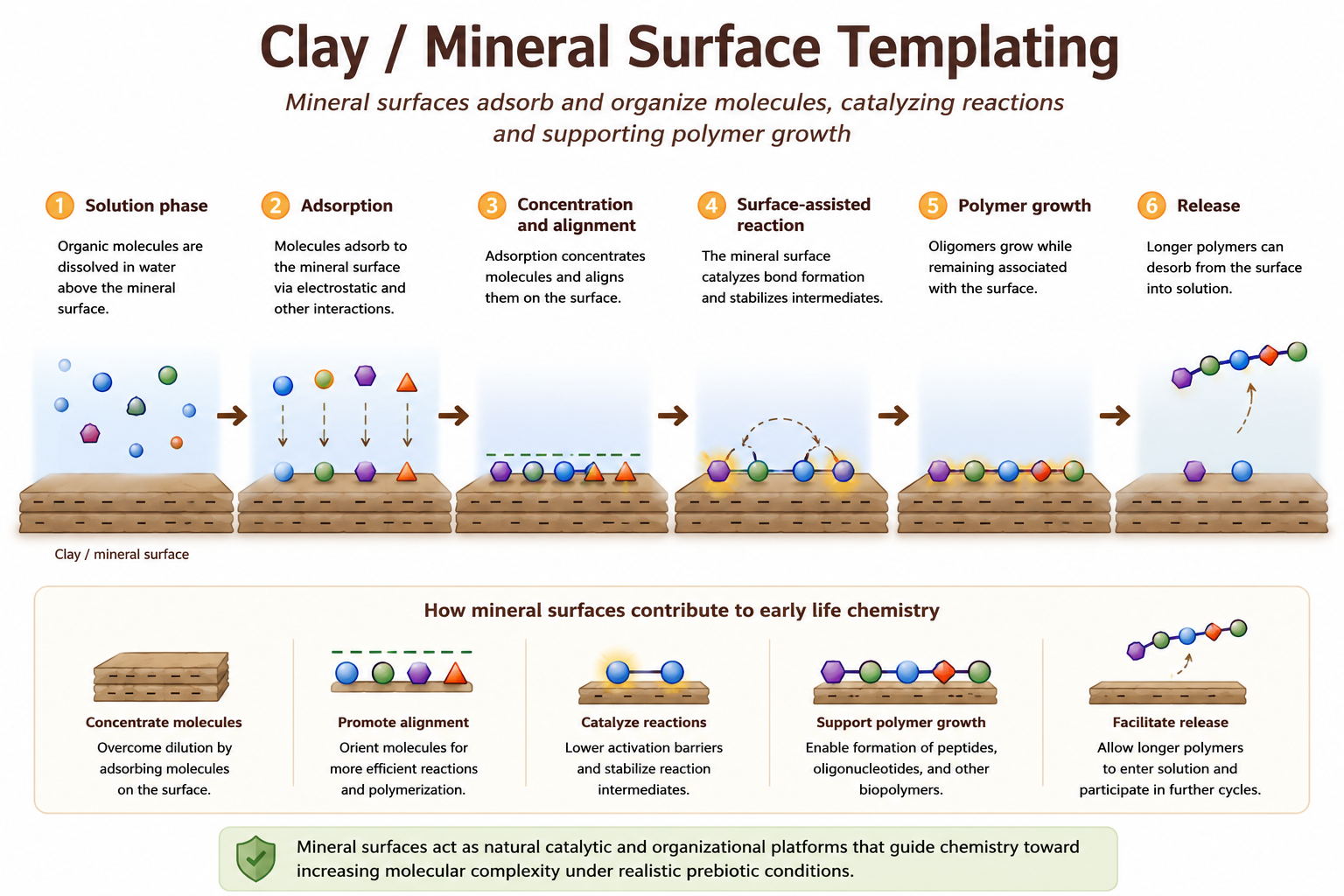
Figure 7.1: Conceptual mechanism of clay and mineral template hypotheses.
The figure illustrates how mineral surfaces may have concentrated molecules, promoted polymerization, and supported increasingly organized prebiotic chemistry.
Unlike purely aqueous chemistry models, mineral-template theories emphasize the importance of structured physical surfaces in guiding chemical evolution.
7.6 Mineral Surfaces and Prebiotic Chemistry
Minerals may have influenced prebiotic chemistry in several important ways.
7.6.1 Concentration of Molecules
Adsorption onto mineral surfaces can locally increase molecular concentration, helping overcome dilution problems present in open aqueous environments.
7.6.2 Molecular Alignment
Surface structures may orient molecules into favorable geometries for chemical reactions and polymer formation.
7.7 Important Mineral Candidates
Several minerals are commonly discussed in origin-of-life research:
- Montmorillonite clay
- Iron–sulfur minerals
- Pyrite surfaces
- Silicate minerals
- Metal sulfides
Montmorillonite is especially important because experiments demonstrate that it can catalyze the formation of RNA-like oligomers from activated nucleotides.
Iron–sulfur minerals are also closely connected with metabolism-first and hydrothermal vent theories.
7.8 Relationship with Other Theories
Mineral-template theories integrate naturally with several other abiogenesis models.
Mineral surfaces may support: - Primordial soup chemistry - RNA polymerization - Wet–dry cycle chemistry - Lipid assembly - Proto-metabolic reactions
In many hybrid frameworks: - Primordial synthesis generates organic molecules - Mineral surfaces organize and catalyze reactions - Wet–dry cycles promote polymerization - Protocells provide compartmentalization - RNA systems introduce heredity
Thus, minerals may have acted as physical scaffolds linking multiple stages of prebiotic evolution.
7.9 What the Theory Explains Well
Clay and mineral template hypotheses are particularly strong at explaining:
- Spatial organization of molecules
- Surface catalysis
- Concentration mechanisms
- Polymer alignment
- Reaction scaffolding
- Enhanced polymerization
These theories provide plausible physical mechanisms for organizing prebiotic chemistry under realistic geological conditions.
7.10 What Makes It Plausible
Several observations support the plausibility of mineral-template models:
- Mineral surfaces naturally occur on Earth
- Many minerals adsorb organic molecules
- Surface catalysis is common in chemistry
- Clay minerals promote polymerization experimentally
- Minerals provide stable microenvironments
The theory is attractive because it relies on ordinary geological processes that likely existed on the early Earth.
7.11 Key Experimental and Observational Support
Laboratory experiments demonstrate that clay minerals such as montmorillonite can catalyze the formation of RNA-like oligomers from activated nucleotides (Ferris 2006).
Additional studies show that minerals can: - Concentrate organic molecules - Promote vesicle assembly - Catalyze condensation reactions - Stabilize polymers
Geological evidence also indicates that clay-rich and mineral-rich environments were widespread on the early Earth.
7.12 Major Gaps and Critiques
Despite their strengths, mineral-template theories face several important limitations.
Major unresolved questions include: - Transition from surface-bound chemistry to free-living systems - Emergence of heredity - Development of autonomous metabolism - Transfer of information away from mineral templates - Environmental realism of some experimental conditions
Critics also argue that mineral surfaces alone do not explain: - Self-replication - Cellular organization - Darwinian evolution
Consequently, most researchers view mineral-template theories as partial rather than complete explanations of abiogenesis.
7.13 Systems Perspective
Within the comparative framework of this book, clay and mineral template hypotheses primarily address chemical organization and catalysis.
Their greatest strength lies in explaining how structured physical environments may have guided increasingly complex chemistry before the emergence of fully biological systems.
However, these theories do not independently explain: - Stable heredity - Cellular compartmentalization - Fully developed metabolism
For this reason, mineral-template models are generally treated as complementary components within broader systems-level origin-of-life frameworks.
7.14 Modern Relevance
Mineral-template research remains highly influential in: - Prebiotic chemistry - Surface chemistry - Geochemistry - Systems chemistry - Astrobiology
Modern studies increasingly examine how mineral surfaces interact with: - RNA systems - Lipid membranes - Wet–dry cycles - Hydrothermal chemistry
Because minerals are abundant throughout the Solar System, these theories are also relevant to the search for extraterrestrial life.
7.15 Current Scientific Standing
Clay and mineral template hypotheses remain influential and actively studied components of modern origin-of-life research. Although they are rarely viewed as complete standalone explanations, they are widely considered plausible mechanisms for organizing and catalyzing increasingly complex prebiotic chemistry.
Many current hybrid models incorporate mineral surfaces as important environmental scaffolds linking chemistry, polymerization, and early molecular organization.
7.16 Comparative Assessment
| Dimension | Assessment |
|---|---|
| Primary Contribution | Molecular organization and surface catalysis |
| Explanatory Strength | Strong for spatial organization |
| Mechanistic Plausibility | Moderate–high |
| Experimental Support | Moderate–strong |
| Environmental Realism | Moderate |
| Main Limitation | Weak explanation for autonomy and heredity |
| Integrative Potential | Very high |
| Current Scientific Standing | Important component of hybrid abiogenesis models |
7.17 Comparative Performance
| Question | Clay/Mineral Template Performance |
|---|---|
| Produces organic building blocks? | Weak |
| Explains concentration mechanisms? | Strong |
| Explains polymerization? | Moderate–strong |
| Explains heredity? | Weak |
| Explains metabolism? | Weak–moderate |
| Supported experimentally? | Moderate–strong |
| Useful in hybrid models? | Very strong |