Chapter 2 Primordial Soup and Chemical Evolution
2.1 Chapter Overview
This chapter examines the primordial soup hypothesis as one of the earliest and most influential models of abiotic chemical evolution. The discussion begins with the historical origins of the theory, followed by its mechanistic foundations, environmental setting, experimental evidence, explanatory strengths, major criticisms, and current scientific standing within modern origin-of-life research.
2.2 Key Terms
- Abiogenesis
- Prebiotic chemistry
- Chemical evolution
- Reducing atmosphere
- Organic synthesis
- Amino acids
- Nucleobases
- Primordial soup
2.3 Core Idea
The primordial soup model proposes that the building blocks of life formed through abiotic chemical reactions occurring in early Earth environments. According to this hypothesis, simple inorganic molecules present in the primitive atmosphere, oceans, or shallow water bodies gradually reacted under the influence of external energy sources to produce increasingly complex organic compounds.
Over time, these organic molecules may have accumulated within the early oceans, ponds, or other localized environments, forming a chemically rich “soup” from which more advanced prebiotic systems could eventually emerge.
2.4 Historical Context
The modern scientific formulation of this idea was independently proposed during the 1920s by Alexander Oparin and J.B.S. Haldane. Both scientists argued that the early Earth atmosphere differed substantially from the modern oxygen-rich atmosphere and may have provided favorable conditions for abiotic organic synthesis.
The hypothesis gained major experimental support in 1953 through the Miller–Urey experiment, in which Stanley Miller demonstrated that amino acids and other organic compounds could form under simulated early Earth conditions involving methane, ammonia, hydrogen, water vapor, and electrical discharge (Miller 1953).
This experiment became one of the foundational milestones in origin-of-life research because it showed that biologically relevant molecules did not necessarily require living organisms for their formation.
2.5 Mechanistic Basis
To understand why the primordial soup model became influential, it is necessary to examine the chemical mechanisms underlying the theory.
The primordial soup framework proposes that simple atmospheric and geochemical compounds—including water vapor, methane, ammonia, carbon dioxide, hydrogen, and nitrogen-containing molecules—underwent chemical reactions driven by energy sources such as:
- Lightning discharges
- Ultraviolet radiation
- Volcanic heat
- Hydrothermal activity
- Impact-related energy
These reactions may have generated amino acids, nucleobases, lipids, sugars, and other biologically relevant organic compounds. Subsequent concentration processes, evaporation cycles, mineral interactions, or localized environmental conditions may then have increased chemical complexity further.
Figure 2.1 summarizes the simplified chemical progression proposed by the primordial soup model.
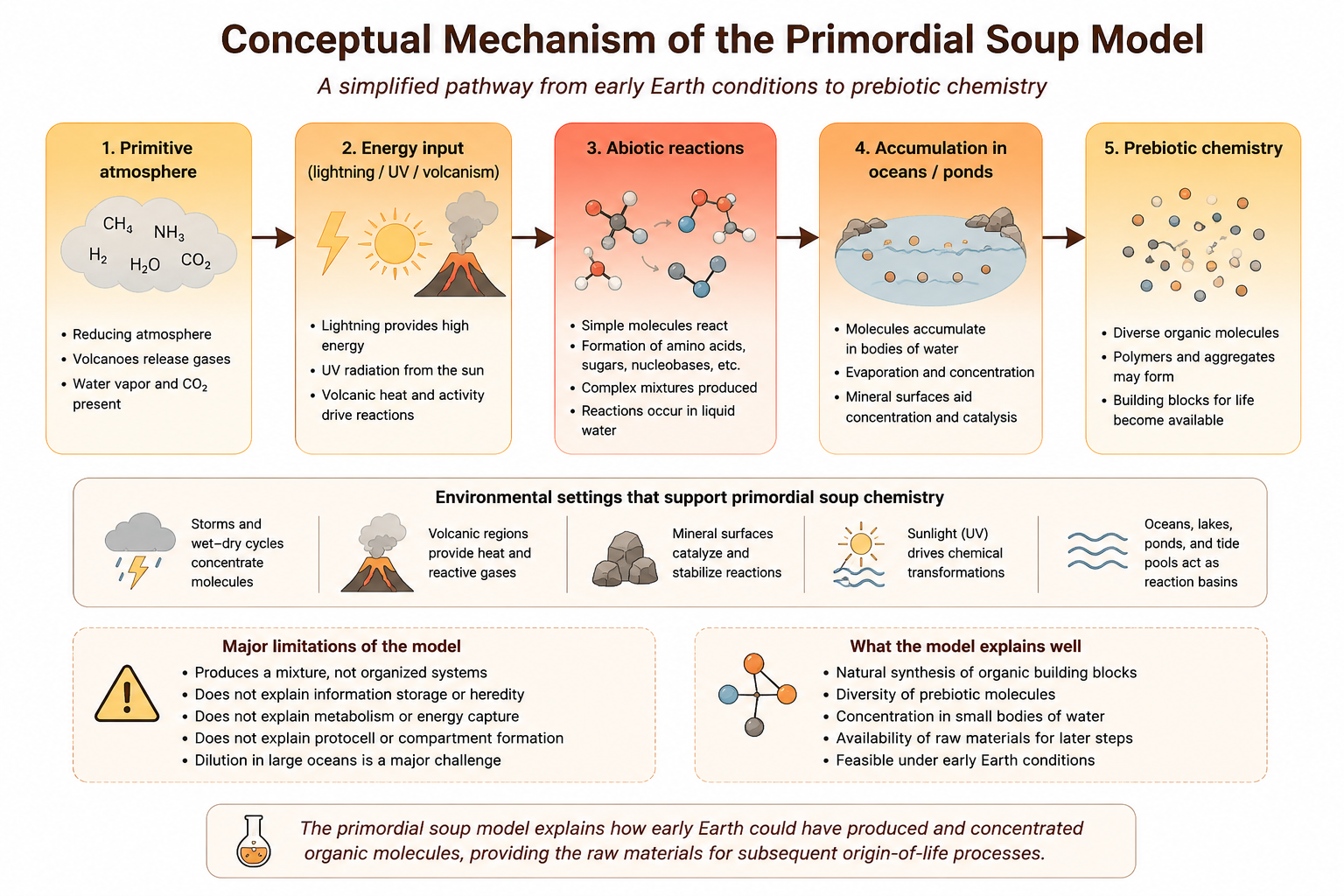
Figure 2.1: Conceptual mechanism of the primordial soup model.
In many versions of the theory, the accumulation of these molecules created chemically enriched environments capable of supporting additional prebiotic reactions and increasing molecular complexity.
2.6 Environmental Setting
Early versions of the primordial soup hypothesis often assumed a strongly reducing atmosphere rich in methane, ammonia, hydrogen, and water vapor. Such conditions are chemically favorable for organic synthesis. However, the exact composition of the early Earth atmosphere remains debated, and many modern models suggest it may have been more neutral, containing higher proportions of carbon dioxide, nitrogen, and water vapor.
This uncertainty does not eliminate the possibility of abiotic organic synthesis, but it changes where such synthesis may have been most plausible. Instead of occurring uniformly across the entire atmosphere or ocean, organic production may have been concentrated in localized environments such as volcanic regions, hydrothermal systems, impact sites, shallow ponds, or evaporating pools.
This environmental refinement is important because many prebiotic reactions require not only raw ingredients and energy, but also mechanisms for concentrating molecules and preventing rapid dilution.
2.7 What the Theory Explains Well
The primordial soup model is particularly strong at explaining the abiotic synthesis of prebiotic chemical building blocks. Laboratory experiments and astronomical observations demonstrate that many biologically relevant organic molecules can form naturally under non-biological conditions.
The theory also provides a chemically intuitive starting point for abiogenesis by showing that complex organic chemistry can emerge from relatively simple inorganic precursors under plausible environmental conditions.
The significance of the primordial soup hypothesis extends beyond the origin of life itself. It helped establish the idea that the boundary between chemistry and biology may be gradual rather than abrupt.
2.8 What Makes It Plausible
Several lines of evidence support the plausibility of primordial soup chemistry:
- Laboratory synthesis experiments can generate organic compounds under simulated prebiotic conditions
- Carbonaceous meteorites contain amino acids and diverse organic molecules
- Organic chemistry occurs naturally in interstellar clouds, comets, and planetary environments
- Volcanic, hydrothermal, and impact environments provide realistic energy gradients capable of driving chemical reactions
- Wet–dry or evaporative settings may help concentrate organic compounds
Together, these observations support the idea that abiotic organic synthesis is chemically feasible on planetary bodies.
2.9 Key Experimental and Observational Support
The Miller–Urey experiment remains the most iconic demonstration of abiotic organic synthesis (Miller 1953). Later experiments using revised atmospheric compositions and alternative energy sources have also generated amino acids, nucleobases, and lipid precursors under a variety of simulated early Earth conditions.
In addition, analyses of carbonaceous chondrite meteorites such as the Murchison meteorite have revealed numerous organic compounds, including amino acids and nitrogen-containing molecules. These findings suggest that prebiotic organic chemistry may occur naturally both on Earth and in extraterrestrial environments.
This evidence does not prove that life began in a global oceanic soup, but it strongly supports the broader claim that organic precursor molecules can form through natural chemical processes.
2.10 Major Gaps and Critiques
Despite its strengths, the primordial soup model faces several major limitations.
Most importantly, the theory explains the production of chemical ingredients but does not adequately explain how these molecules became organized into self-sustaining, information-bearing systems capable of replication and evolution.
Additional challenges include:
- Dilution of organic molecules in large ocean environments
- Instability of some biomolecules in aqueous conditions
- Difficulty forming long polymers spontaneously
- Lack of a clear mechanism for heredity or metabolic organization
- Uncertainty regarding the exact composition of the early Earth atmosphere
- Limited explanation for compartment formation and protocell development
For these reasons, primordial soup models are generally considered necessary but insufficient explanations for the complete emergence of life.
2.11 Integration with Other Theories
The primordial soup model is most powerful when viewed as one component of a broader origin-of-life framework. It may explain the source of organic building blocks that later participated in other prebiotic processes.
For example, organic compounds produced through atmospheric chemistry, hydrothermal reactions, or extraterrestrial delivery could have been concentrated by wet–dry cycles, organized on mineral surfaces, incorporated into lipid compartments, or used in early RNA-like systems.
In this sense, primordial soup chemistry may provide the ingredients, while other theories attempt to explain organization, replication, metabolism, and compartmentalization.
2.12 Systems Perspective
The primordial soup model primarily addresses the first major hurdle of abiogenesis: the synthesis of organic building blocks. However, the theory alone does not fully explain how these molecules became organized into replicating and evolving systems.
Consequently, modern origin-of-life research often combines primordial synthesis models with theories involving mineral catalysis, self-organization, RNA heredity, metabolism-first pathways, or protocell formation.
This makes the primordial soup hypothesis foundational, but not complete.
2.13 Modern Relevance
The primordial soup framework also remains important in modern astrobiology. Because abiotic organic synthesis appears chemically feasible under a range of planetary conditions, similar processes may occur on Mars, icy moons, comets, meteorites, or exoplanets with suitable chemical ingredients and energy sources.
The theory therefore contributes not only to understanding life’s origin on Earth, but also to broader questions about where life might emerge elsewhere in the universe.
2.14 Current Scientific Standing
The primordial soup framework remains one of the foundational models in origin-of-life research and continues to play a central role in prebiotic chemistry. Most modern researchers accept that abiotic organic synthesis likely occurred on the early Earth to some extent.
However, contemporary origin-of-life studies increasingly view primordial soup chemistry as one component within a larger sequence of prebiotic transitions rather than a complete standalone explanation for abiogenesis. Modern hybrid models often integrate primordial synthesis with mineral catalysis, hydrothermal environments, RNA-based heredity, metabolism-first chemistry, or protocell formation.
2.15 Comparative Assessment
| Dimension | Assessment |
|---|---|
| Primary Contribution | Abiotic synthesis of organic building blocks |
| Explanatory Strength | Strong for precursor chemistry |
| Mechanistic Plausibility | High |
| Experimental Support | Strong for organic synthesis |
| Environmental Realism | Plausible, but dependent on local conditions |
| Main Limitation | Does not explain organization, heredity, or evolution |
| Integrative Potential | High |
| Current Scientific Standing | Foundational but incomplete component of abiogenesis models |