Purpose
This article introduces the conceptual foundation of
artificialLifeR. Artificial life studies life-like
organization using artificial systems, computational models,
simulations, robotics, and theoretical frameworks (Langton 1989; Bedau 2003).
The package does not attempt to define life once and for all. Instead, it provides simplified simulations that help learners explore how agents, resources, reproduction, mutation, selection, and population dynamics can generate life-like patterns.
The guiding question is:
What can simplified artificial systems teach us about life-like organization?
What is artificial life?
Artificial life is a field that studies life-like processes in artificial systems. These systems may be computer simulations, mathematical models, digital organisms, robots, chemical models, or theoretical frameworks.
Rather than studying only existing biological organisms, artificial life asks broader questions:
- What makes a system life-like?
- How can organization arise from simpler parts?
- How do agents interact with environments?
- How do reproduction, mutation, and selection shape populations?
- How can local rules generate system-level patterns?
- What is the difference between being life-like and being alive?
Artificial life is therefore both scientific and philosophical. It helps learners think about life as a process, not only as a category.
Artificial life as a bottom-up field
Artificial life often studies life from the bottom up. Instead of beginning with a complete organism, it begins with simpler units and rules. Researchers then examine whether population-level or system-level organization can arise.
This bottom-up approach is useful because many living systems depend on interactions among parts. A living cell is not explained only by listing its molecules. A population is not explained only by listing organisms. Organization matters.
Artificial-life models therefore ask how life-like properties may arise from:
- local interaction;
- energy or resource constraints;
- reproduction;
- variation;
- inheritance;
- selection;
- adaptation;
- system-level feedback.
The main idea is:
Life-like organization may arise from interacting processes, not from isolated parts alone.
Life-like does not mean alive
A central distinction is between a system that is life-like and a system that is alive.
A simulation may be life-like if it shows simplified properties such as reproduction, variation, competition, adaptation, or population change. But this does not mean the simulation is biologically alive.
This distinction is important for responsible interpretation.
artificialLifeR creates educational models of life-like
processes. It does not create life.
A careful statement is:
The package illustrates simplified life-like dynamics.
An overstatement would be:
The package creates living systems.
The first statement is appropriate. The second is not.
Why use simulations?
Simulations are useful because they make assumptions visible. In a simulation, learners can change parameters and observe how the system responds.
For example, users can ask:
- What happens if resources become scarce?
- What happens if mutation rate increases?
- What happens if only some agents survive?
- What happens if carrying capacity changes?
- What happens when reproduction requires energy?
This makes artificial life useful for teaching. A simulation does not need to be fully realistic to be educational. A good toy model can isolate one idea and make it easier to understand.
Core concepts in artificial life
artificialLifeR focuses on several core artificial-life
concepts.
| Concept | Meaning |
|---|---|
| Agents | Simplified individuals or units in a model |
| Environment | The space or conditions in which agents act |
| Resources | Energy-like quantities that support survival or reproduction |
| Reproduction | Creation of new agents |
| Inheritance | Transmission of traits from parent to offspring |
| Mutation | Random variation in traits |
| Selection | Differential persistence or reproduction |
| Population dynamics | Change in population size or composition over time |
| Emergence | System-level patterns arising from local rules |
These concepts are connected. Artificial-life dynamics usually become interesting when several of them interact.
Relation to the package
artificialLifeR provides simplified functions for
exploring these concepts.
| Function | Conceptual role |
|---|---|
create_agents() |
Creates artificial individuals with traits and energy |
simulate_resource_competition() |
Models agents interacting with resource constraints |
simulate_reproduction() |
Models simplified reproduction and inheritance |
simulate_mutation() |
Introduces trait variation |
simulate_selection() |
Models differential persistence based on fitness-like scores |
simulate_population_dynamics() |
Shows population-level change over time |
measure_life_like_complexity() |
Provides simple summaries of diversity and change |
plot_alife_sim() |
Visualizes artificial-life outputs |
These functions are intentionally simple. Their purpose is not to replace detailed biological models. Their purpose is to make artificial-life concepts visible and teachable.
Minimal example
The simplest starting point is a population of artificial agents.
agents <- create_agents(
  n_agents = 50,
  seed = 1
)

head(agents)
#>   agent         x          y    energy      speed efficiency
#> 1     1 0.2655087 0.47761962 1.0597159 0.03759267  0.5450187
#> 2     2 0.3721239 0.86120948 0.9081960 0.05084232  0.4981440
#> 3     3 0.5728534 0.43809711 1.0511680 0.03178157  0.4681932
#> 4     4 0.9082078 0.24479728 0.8305955 0.05316058  0.4070638
#> 5     5 0.2016819 0.07067905 1.2149536 0.03690831  0.3512540
#> 6     6 0.8983897 0.09946616 1.2970600 0.08534575  0.3924808
#>   reproduction_threshold age alive
#> 1               1.540940   0  TRUE
#> 2               1.668887   0  TRUE
#> 3               1.658659   0  TRUE
#> 4               1.466909   0  TRUE
#> 5               1.271476   0  TRUE
#> 6               1.749766   0  TRUE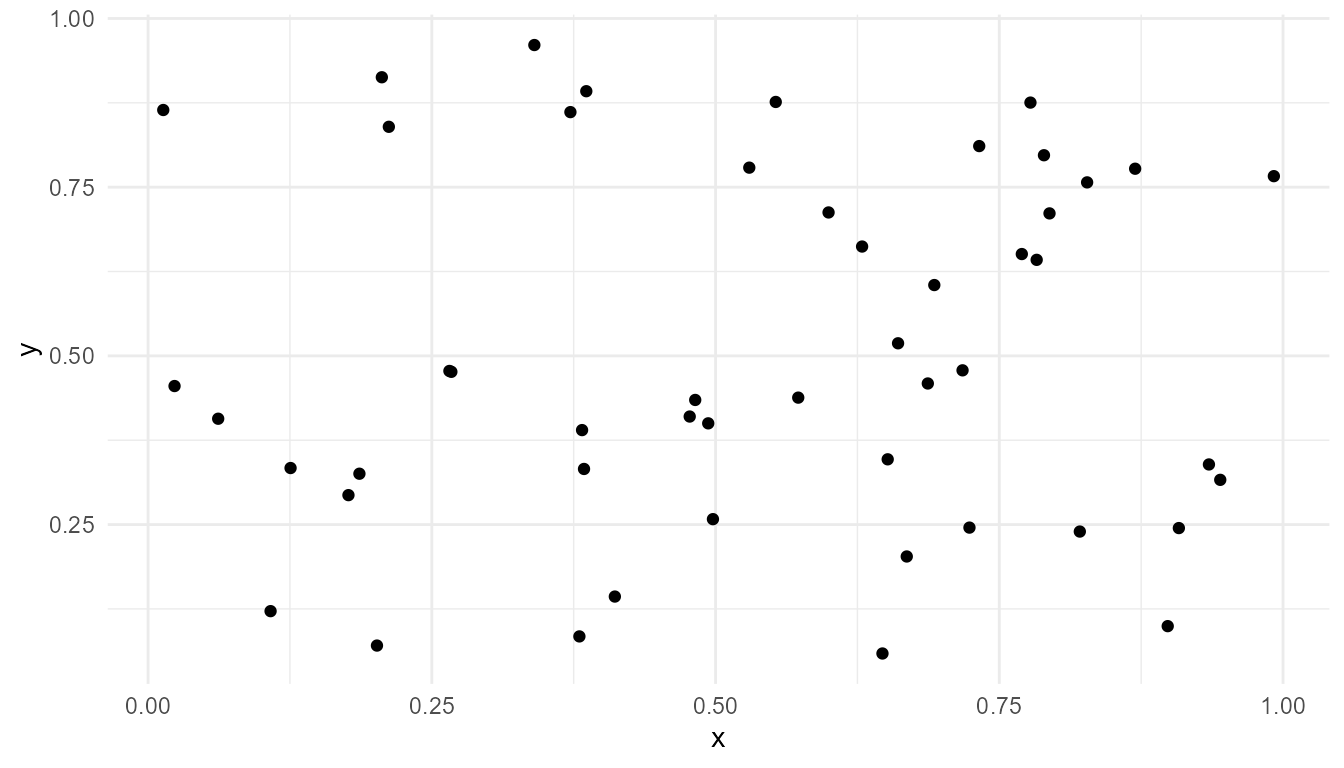
Interpretation
The agents have positions, energy, and traits. These traits do not make the agents alive. They create a simplified population in which life-like processes can be explored.
A careful interpretation is:
This output shows a simulated population of artificial agents.
An overstatement would be:
This output shows real organisms.
The model is useful because it gives learners a starting point for exploring how agent traits and environmental rules can produce population-level outcomes.
Artificial life and emergence
Artificial life is closely related to emergence. In many artificial-life models, system-level behavior arises from local interactions among agents and environments (Holland 1998; Mitchell 2009).
For example:
- population growth can arise from individual reproduction;
- adaptation-like patterns can arise when variation and selection operate together;
- resource competition can produce survival differences without a central controller;
- trait distributions can shift over time through repeated local events.
The system-level pattern is not usually programmed directly. Instead, it develops through the repeated application of model rules.
This is why artificial life is useful for studying emergence:
It shows how simple rules can generate organized patterns over time.
Artificial life and origin-of-life thinking
Artificial life is also relevant to origin-of-life questions. Origin-of-life research asks how non-living chemical systems may have become organized, self-maintaining, and evolvable.
artificialLifeR does not simulate real prebiotic
chemistry. It does not model real molecules, membranes, RNA, metabolism,
or laboratory chemistry.
However, it can help learners think about abstract ingredients of life-like organization, such as:
- persistence;
- reproduction;
- variation;
- selection;
- resource use;
- environmental constraint;
- population-level change.
This makes the package a conceptual tool, not a complete origin-of-life model.
Artificial life and consciousness
Artificial life can sometimes overlap with discussions of cognition and consciousness because it involves agents, environments, behaviour, and adaptation.
However, life-like behaviour is not the same as consciousness. A simulated population may reproduce, mutate, or adapt without having awareness or subjective experience.
artificialLifeR does not model consciousness. It does
not detect, measure, or create awareness.
A careful statement is:
Artificial-life models can inform discussions of agency, adaptation, and organization.
An overstatement would be:
Artificial-life models show that artificial agents are conscious.
This distinction is important for responsible interpretation.
What the package captures
The package captures several important artificial-life ideas:
- agents can vary in traits;
- environments can impose constraints;
- resources can affect survival;
- reproduction can transmit traits;
- mutation can introduce novelty;
- selection can change population composition;
- population-level patterns can emerge over time;
- simple rules can produce complex-looking outcomes.
These ideas make the package useful for teaching and conceptual exploration.
What the package does not capture
The package is intentionally simplified. It does not model:
- real genetics;
- real metabolism;
- biochemical networks;
- development;
- ecological realism;
- consciousness;
- subjective experience;
- full biological evolution;
- real origin-of-life chemistry.
The models are toy models. Their value lies in clarity, not realism.
Responsible interpretation
It is better to say:
The model illustrates life-like dynamics.
than:
The model creates life.
It is better to say:
The simulation shows simplified reproduction, mutation, or selection-like processes.
than:
The simulation fully models biological evolution.
It is better to say:
The package helps learners explore artificial-life concepts.
than:
The package proves how life began.
Responsible interpretation keeps the package academically credible.
Educational use
This chapter can support several classroom or self-study questions:
- What is artificial life?
- What does it mean for a system to be life-like?
- Why are agents and environments important?
- Why do resources and constraints matter?
- How do reproduction and mutation affect populations?
- How is selection different from adaptation?
- What is emergence?
- What are the limits of toy models?
These questions help learners use the package as a conceptual toolkit.
Key takeaway
Artificial life uses artificial systems to explore life-like
organization. artificialLifeR provides simplified
educational simulations that make core ideas visible: agents,
environments, resources, reproduction, mutation, selection, and
population dynamics.
The package does not create life or fully model biology. Its strength is conceptual clarity. It helps users explore how life-like patterns can arise from simple rules while preserving the distinction between toy models and real living systems.