Chapter 7 Comparing Origin-of-Life Frameworks
7.1 Why This Chapter Matters
The previous chapters introduced several major pieces of the origin-of-life puzzle:
- Prebiotic chemistry
- Molecular evolution
- Diversity and complexity
- Protocells
- Autocatalytic networks
Each topic explains something important, but none of them alone fully explains the origin of life.
This chapter brings these ideas together.
The goal is not to choose one theory as the final answer. Instead, the goal is to compare what each framework explains well, what it struggles to explain, and how multiple frameworks may fit together.
7.2 The Central Problem
Origin-of-life research asks how non-living chemistry became living biology.
This transition likely required several processes to become linked:
- Molecular building blocks had to form
- Molecules had to interact
- Some systems had to persist
- Information had to be stored and transmitted
- Variation had to appear
- Selection had to act
- Compartments had to organize chemical systems
- Energy flow had to sustain reactions
Different theories emphasize different starting points.
7.3 Major Origin-of-Life Frameworks
Origin-of-life theories often differ in what they treat as the first major breakthrough.
| Framework | Main Starting Point | Central Idea |
|---|---|---|
| RNA World | Information-bearing molecules | RNA-like molecules stored information and catalyzed reactions |
| Metabolism First | Energy and reaction networks | Self-sustaining chemical cycles emerged before genes |
| Protocell First | Compartments | Cell-like boundaries organized chemistry |
| Autocatalytic Sets | Networks | Molecules collectively supported their own production |
| Hybrid Models | Integration | Life emerged from coupling among molecules, networks, compartments, and energy flow |
These frameworks are sometimes presented as competitors, but they may also be complementary.
7.4 RNA World
The RNA World hypothesis proposes that early life may have been based on RNA-like molecules.
RNA is important because it can:
- Store information
- Participate in catalysis
- Be copied with variation
- Support evolutionary dynamics
In this view, the origin of life begins with information-bearing molecules.
7.5 What RNA World Explains Well
RNA World models help explain:
- Heredity
- Mutation
- Selection
- Molecular evolution
- The central role of RNA in modern biology
RNA still plays essential roles in living cells, including protein synthesis and regulation. This makes RNA a plausible relic of an earlier stage of life.
7.6 What RNA World Struggles to Explain
RNA World models face several challenges:
- How did the first RNA-like molecules form?
- How were nucleotides produced under prebiotic conditions?
- How did long enough RNA molecules accumulate?
- How did early replication become accurate enough?
- How were RNA molecules protected from degradation?
The key difficulty is that RNA is chemically complex.
7.7 RNA World in lifesimulatoR
rna_like <- simulate_abiogenesis(
  n_molecules = 100,
  generations = 100,
  mutation_rate = 0.02,
  selection_strength = 1,
  seed = 123
)

head(rna_like)
## # A tibble: 6 × 6
## generation n_molecules mean_length mean_fitness diversity max_fitness
## <int> <int> <dbl> <dbl> <int> <dbl>
## 1 0 100 12.6 1.00 100 1.25
## 2 1 100 12.7 1.04 67 1.25
## 3 2 100 12.3 1.05 61 1.25
## 4 3 100 12.3 1.11 61 1.25
## 5 4 100 12.5 1.11 48 1.25
## 6 5 100 12.8 1.13 53 1.25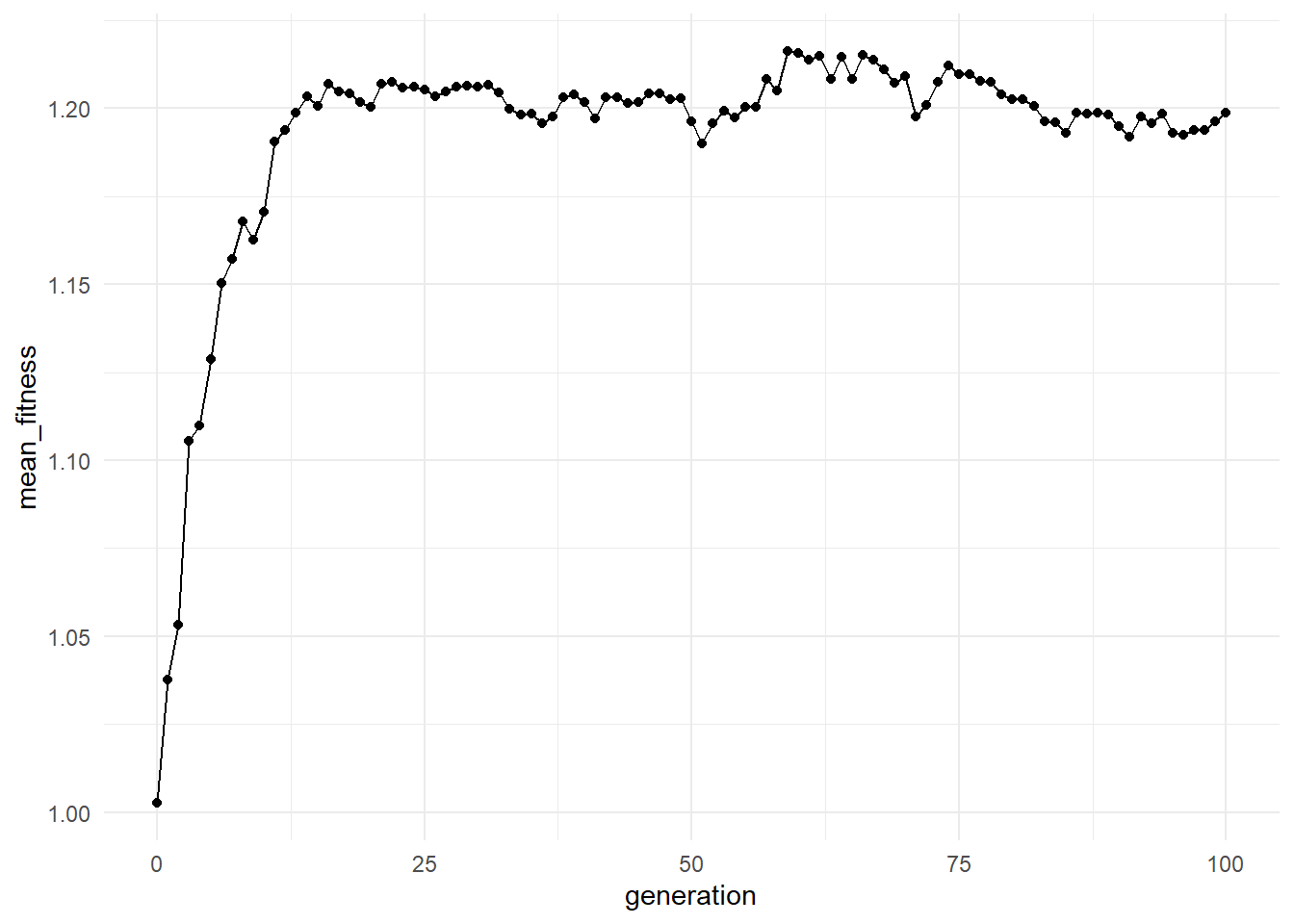
7.8 Interpretation
This simulation represents a simplified replication-first model.
If mean fitness increases, the model demonstrates how variation, mutation, replication, and selection can drive evolutionary change.
7.9 Metabolism First
Metabolism-first theories propose that life began with self-sustaining reaction networks rather than genetic molecules.
In this view, the earliest life-like systems may have been organized flows of matter and energy.
Instead of asking how the first genetic molecule formed, metabolism-first models ask:
How could chemistry organize itself into self-maintaining reaction cycles?
7.10 What Metabolism First Explains Well
Metabolism-first models help explain:
- Energy flow
- Chemical self-organization
- Reaction cycles
- Geochemical continuity
- Environmental gradients
These theories are frequently associated with hydrothermal vent environments.
7.11 What Metabolism First Struggles to Explain
Metabolism-first models face several questions:
- How did reaction networks become heritable?
- How did they evolve without genetic information?
- How were successful networks preserved?
- How did metabolism become linked to informational polymers?
The key difficulty is explaining how chemical organization became evolvable.
7.12 Autocatalytic Set Theory
Autocatalytic set theory proposes that molecules formed networks in which members helped produce one another.
No single molecule needed to reproduce itself perfectly.
Instead, the network as a whole became self-supporting.
7.13 What Autocatalytic Sets Explain Well
Autocatalytic network models help explain:
- Collective organization
- Self-maintenance
- Feedback loops
- Emergence
- Network-level behavior
They demonstrate how system-level organization can arise from interactions among many components.
7.14 What Autocatalytic Sets Struggle to Explain
Autocatalytic set models face important questions:
- How is information stored?
- How are successful networks inherited?
- How does selection act on networks?
- How do networks avoid collapse?
- How do they become coupled to compartments?
The key difficulty is connecting network self-maintenance to heredity and evolution.
7.15 Autocatalytic Networks in lifesimulatoR
auto <- autocatalytic_network(
  n_types = 8,
  steps = 50,
  catalysis_probability = 0.2,
  seed = 123
)

head(auto$time_series)
## # A tibble: 6 × 3
## step molecule abundance
## <int> <chr> <dbl>
## 1 0 M1 0.833
## 2 0 M2 0.504
## 3 0 M3 0.829
## 4 0 M4 0.831
## 5 0 M5 0.815
## 6 0 M6 0.496## [,1] [,2] [,3] [,4] [,5] [,6] [,7] [,8]
## [1,] FALSE FALSE FALSE FALSE FALSE TRUE FALSE TRUE
## [2,] FALSE FALSE TRUE FALSE FALSE FALSE FALSE FALSE
## [3,] FALSE FALSE FALSE FALSE TRUE FALSE TRUE FALSE
## [4,] FALSE FALSE FALSE FALSE FALSE FALSE FALSE FALSE
## [5,] FALSE FALSE FALSE FALSE FALSE TRUE FALSE FALSE
## [6,] TRUE FALSE FALSE TRUE FALSE FALSE TRUE TRUE
## [7,] FALSE TRUE FALSE FALSE FALSE FALSE FALSE FALSE
## [8,] FALSE FALSE FALSE FALSE FALSE FALSE FALSE FALSE7.16 Interpretation
This simulation illustrates how catalytic relationships can produce system-level dynamics.
The model does not simulate real reaction chemistry, but it helps explore how networks can become more important than individual molecules.
7.17 Protocell First
Protocell-first theories emphasize the importance of compartments.
A protocell is a simplified cell-like structure that separates an internal chemical environment from the outside world.
Compartments may have helped early systems by:
- Concentrating molecules
- Protecting fragile chemistry
- Allowing repeated interactions
- Supporting primitive inheritance
- Creating units of selection
7.18 What Protocell Models Explain Well
Protocell models help explain:
- Individuality
- Boundaries
- Growth
- Division
- Group-level selection
- The transition from chemistry to cell-like systems
Compartments are especially important because modern life is cellular.
7.19 What Protocell Models Struggle to Explain
Protocell-first models also face challenges:
- What molecules formed the first membranes?
- How did protocells grow and divide reliably?
- How were useful internal molecules retained?
- How did protocells acquire metabolism or genetic systems?
- How did protocell traits become heritable?
The key difficulty is explaining how compartments became linked to internal chemistry and information.
7.20 Protocells in lifesimulatoR
proto <- protocell_simulation(
  n_cells = 20,
  steps = 100,
  growth_rate = 0.2,
  division_threshold = 10,
  leakage_rate = 0.03,
  seed = 123
)

head(proto)
## # A tibble: 6 × 4
## step n_cells mean_abundance max_abundance
## <int> <int> <dbl> <dbl>
## 1 0 20 2.10 2.91
## 2 1 20 2.24 3.14
## 3 2 20 2.39 3.24
## 4 3 20 2.54 3.58
## 5 4 20 2.67 3.78
## 6 5 20 2.80 3.95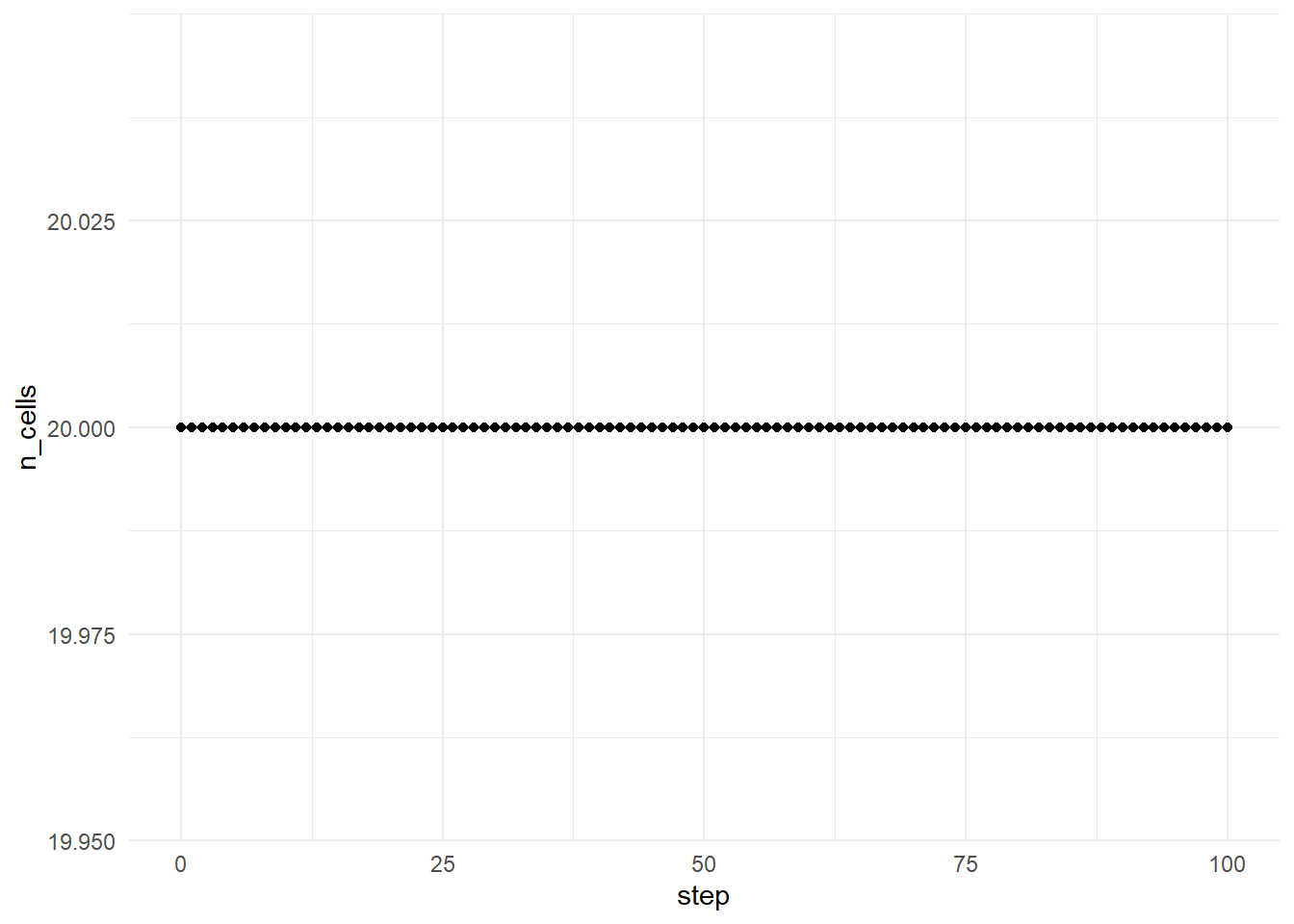
7.21 Interpretation
This simulation shows how simple growth, leakage, and division rules can create protocell population dynamics.
7.22 The Chicken-and-Egg Problem
A central challenge in origin-of-life research is the chicken-and-egg problem.
Which came first?
- Information?
- Metabolism?
- Compartments?
- Networks?
Different theories answer differently.
7.24 Comparing Strengths and Limitations
| Framework | Explains Well | Struggles To Explain |
|---|---|---|
| RNA World | Information, heredity, mutation, selection | Origin of first replicators |
| Metabolism First | Energy flow, reaction cycles | Heredity and evolvability |
| Protocell First | Boundaries, individuality | Origin of information systems |
| Autocatalytic Sets | Self-organization, feedback | Accurate inheritance |
| Hybrid Models | Integrates strengths | Harder to test experimentally |
7.25 Are These Theories Competitors?
It is tempting to treat origin-of-life theories as mutually exclusive.
However, they may describe different parts of the same process.
For example:
- Prebiotic chemistry may have produced molecular diversity
- Autocatalytic networks may have organized some molecules into self-maintaining systems
- Protocells may have contained and protected these systems
- RNA-like molecules may have introduced stronger heredity
- Selection may have acted at both molecular and compartment levels
In this view, the origin of life was not a single event.
It was a sequence of transitions.
7.26 Toward a Hybrid Model
A hybrid model may be the most realistic framework.
Such a model would include:
- Chemistry producing molecular diversity
- Networks generating self-maintenance
- Compartments creating individuality
- Informational molecules enabling heredity
- Energy flow sustaining reactions
- Selection shaping populations
The central idea is:
Life may have emerged when chemistry, information, networks, compartments, and energy flow became coupled.
7.27 Conceptual Map
Prebiotic chemistry
        ↓
Molecular diversity
        ↓
Autocatalytic interactions
        ↓
Compartmentalization
        ↓
Molecular evolution
        ↓
Coupled chemical systems
        ↓
Earliest life
7.28 Package Comparison
The package allows users to explore simplified versions of several frameworks.
7.28.1 Molecular Evolution
mol <- simulate_abiogenesis(
  n_molecules = 100,
  generations = 100,
  mutation_rate = 0.02,
  selection_strength = 1,
  seed = 123
)

tail(mol)
## # A tibble: 6 × 6
## generation n_molecules mean_length mean_fitness diversity max_fitness
## <int> <int> <dbl> <dbl> <int> <dbl>
## 1 95 100 10.6 1.19 56 1.24
## 2 96 100 10.9 1.19 55 1.24
## 3 97 100 10.8 1.19 55 1.20
## 4 98 100 10.8 1.19 51 1.20
## 5 99 100 10.8 1.20 56 1.20
## 6 100 100 10.8 1.20 56 1.207.28.2 Protocells
## # A tibble: 6 × 4
##    step n_cells mean_abundance max_abundance
##   <int>   <int>          <dbl>         <dbl>
## 1    95      20           6.84          7.44
## 2    96      20           6.85          7.41
## 3    97      20           6.87          7.43
## 4    98      20           6.89          7.48
## 5    99      20           6.91          7.56
## 6   100      20           6.90          7.49
7.28.3 Autocatalytic Networks
net <- autocatalytic_network(
  n_types = 8,
  steps = 50,
  catalysis_probability = 0.2,
  seed = 123
)

tail(net$time_series)
## # A tibble: 6 × 3
## step molecule abundance
## <int> <chr> <dbl>
## 1 50 M3 199.
## 2 50 M4 208.
## 3 50 M5 148.
## 4 50 M6 271.
## 5 50 M7 354.
## 6 50 M8 366.7.29 What a Complete Model Would Need
A more complete origin-of-life simulation would include:
- Realistic prebiotic chemistry
- Energy sources and sinks
- Molecular degradation
- Catalytic reaction networks
- Compartments
- Transport across boundaries
- Heredity
- Mutation
- Selection
- Environmental change
- Spatial structure
Such a model would be vastly more complex than the current educational simulations.
7.30 Open Questions in Origin-of-Life Research
Despite decades of research, the origin of life remains one of science’s greatest unsolved problems. Significant progress has been made, but many fundamental questions remain open.
7.30.1 What Is Life?
A surprisingly difficult question is:
What exactly do we mean by life?
Scientists generally agree that living systems exhibit characteristics such as:
- organization,
- metabolism,
- reproduction,
- evolution,
- information storage,
- adaptation.
However, there is no universally accepted definition.
For example:
- Are viruses alive?
- Could self-maintaining chemical systems be considered alive?
- Is evolution required before a system can be called living?
Understanding the origin of life requires understanding what life itself actually is.
7.30.2 How Did Information First Emerge?
Modern life depends on information stored in DNA and RNA.
Important questions include:
- Did RNA emerge first?
- Were there earlier information systems?
- How did molecular information become heritable?
- How did accurate replication arise?
Information is central to biology, but its earliest origins remain uncertain.
7.30.3 How Did Metabolism Begin?
Living systems continuously process energy and matter.
Open questions include:
- How did the first reaction networks arise?
- Could metabolism emerge spontaneously?
- What role did hydrothermal vents play?
- How did energy flow become organized?
The emergence of metabolism remains one of the major challenges for origin-of-life theories.
7.30.4 How Did Compartments Arise?
Cells depend on membranes and compartments.
Researchers continue to investigate:
- What molecules formed the first membranes?
- How stable were early protocells?
- How did compartments interact with molecular evolution?
- How did primitive cells become increasingly complex?
Compartmentalization may have been essential for transforming chemistry into biology.
7.30.5 Was the Origin of Life Inevitable?
One of the most profound questions is whether life is common or rare.
Possible viewpoints include:
- Life emerges whenever suitable conditions exist.
- Life is extremely unlikely and rare.
- Multiple pathways can lead to life.
- Life may emerge repeatedly under different chemical conditions.
At present, we do not know which possibility is correct.
7.30.6 Is Life Common in the Universe?
The search for life beyond Earth is closely connected to origin-of-life research.
Questions include:
- Did life emerge independently elsewhere?
- What environments are most promising?
- Should we expect life to resemble Earth life?
- Could completely different forms of life exist?
Astrobiology continues to expand our understanding of these possibilities.
7.31 Future Directions
Origin-of-life research is advancing rapidly through new experiments, computational models, and interdisciplinary collaboration.
Several areas are likely to play major roles in future discoveries.
7.31.1 Experimental Advances
Researchers are actively exploring:
- Prebiotic synthesis pathways
- Synthetic protocells
- Artificial evolution experiments
- RNA catalysis
- Self-assembling chemical systems
- Laboratory models of early Earth environments
These studies help constrain what may have been possible on the early Earth.
7.31.2 Computational Advances
Computer simulations are becoming increasingly important.
Future models may include:
- Realistic reaction chemistry
- Molecular folding
- Environmental variability
- Energy flow
- Multi-level selection
- Spatial structure
- Network evolution
- Coupled protocell-network systems
Computational models allow researchers to explore scenarios that are difficult to study experimentally.
7.31.3 Future Directions for lifesimulatoR
The current package focuses on educational models. Future versions could incorporate more advanced concepts, including:
- RNA World simulations
- Metabolism-first models
- Hydrothermal vent environments
- Wet-dry cycling chemistry
- Lipid vesicle formation
- Multi-level selection
- Spatial simulations
- Energy-gradient environments
- Reaction-diffusion systems
- Information-theoretic complexity metrics
- Evolution of protocells
- Coupled network-compartment simulations
- Interactive Shiny applications
- Animated educational visualizations
These additions would allow users to explore a broader range of origin-of-life hypotheses.
7.32 Final Reflections
The origin of life remains one of the deepest scientific mysteries.
No single theory currently explains how non-living matter became living systems. Instead, researchers continue to investigate how molecular information, reaction networks, compartmentalization, and energy flow may have combined to produce the first life-like systems.
The purpose of this book has not been to provide a final answer. Rather, it has been to introduce the major ideas, theories, models, and questions that shape modern origin-of-life research.
Through the simplified simulations provided by lifesimulatoR, readers can explore these concepts directly and develop intuition about how complex biological systems may emerge from simpler beginnings.
The story of life’s origins is still being written. Future discoveries may confirm existing theories, reveal entirely new mechanisms, or show that several frameworks must be combined to explain how life first emerged.
Perhaps the most exciting aspect of origin-of-life research is that some of the most important discoveries may still lie ahead.
7.33 Key Takeaways
- Origin-of-life theories emphasize different starting points.
- RNA World focuses on information and heredity.
- Metabolism First focuses on energy flow and reaction cycles.
- Protocell First focuses on compartments and individuality.
- Autocatalytic Set Theory focuses on network self-maintenance.
- Hybrid models combine these ideas.
- Theories may be complementary rather than mutually exclusive.
- A complete theory likely requires chemistry, information, networks, compartments, and energy flow.
lifesimulatoRprovides simplified models for exploring these frameworks.
7.34 Suggested Readings
- Gilbert, W. (1986). The RNA World
- Kauffman, S. (1993). The Origins of Order
- Deamer, D. (2019). Assembling Life
- Szostak, J. W., Bartel, D. P., & Luisi, P. L. (2001). Synthesizing Life
- Smith, E., & Morowitz, H. J. (2016). The Origin and Nature of Life on Earth
- Walker, S. I. (2017). Origins of Life and Complexity
7.35 Reflection Questions
- Which framework seems most convincing?
- Are these theories competitors or complementary explanations?
- What does each framework explain particularly well?
- What does each framework fail to explain?
- Could life have emerged through several interacting processes rather than one dominant mechanism?
- Which process seems most fundamental: information, metabolism, compartments, or networks?
- What would be needed to build a more complete simulation?
- How could
lifesimulatoRbe expanded to better compare these hypotheses? - Does a hybrid model make the origin of life easier or harder to explain?
- What would count as strong evidence for one framework over another?