Theory background
Global Workspace Theory proposes that conscious access involves information becoming globally available to many specialized systems.
In simple terms:
- Many processes operate locally.
- They compete for attention.
- One signal may become dominant.
- The winning signal is broadcast to the wider system.
Run the simulation
gw <- simulate_global_workspace(n_processes = 10, steps = 120, noise = 0.1, ignition_threshold = 0.75, seed = 10)
head(gw)
#>   step process activation winner is_winner broadcast ignited
#> 1    1      P1  0.7189298     P4     FALSE 0.0000000    TRUE
#> 2    1      P2  0.5504773     P4     FALSE 0.0000000    TRUE
#> 3    1      P3  0.4504827     P4     FALSE 0.0000000    TRUE
#> 4    1      P4  0.8099538     P4      TRUE 0.8099538    TRUE
#> 5    1      P5  0.3825086     P4     FALSE 0.0000000    TRUE
#> 6    1      P6  0.4128062     P4     FALSE 0.0000000    TRUE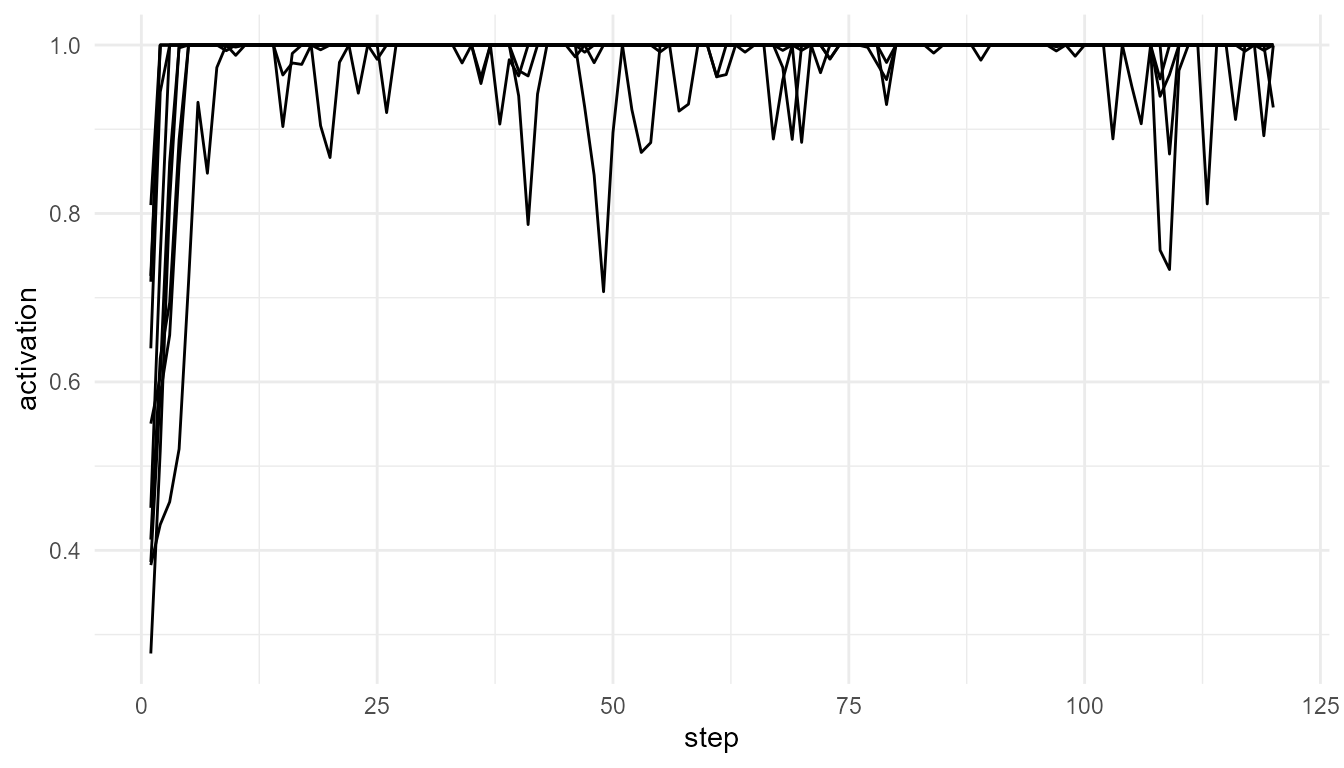
Inspect winning processes
table(gw$winner)
#>
#>   P1   P4
#> 1190   10